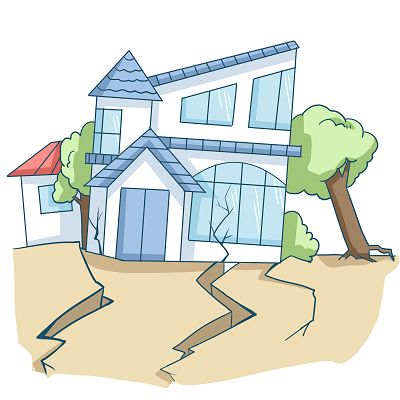
The seismic disaster reduction section, knowledge i, seismic knowledge earthquake, is a natural phenomenon with an average of over 40,000 earthquakes per day. As early as the pre-b. D., the earthquake in shanxi, now known as bo state, was recorded in our country's era of peace. We are still in the fifth active phase of the earthquake in the 20th century, until the beginning of this century. The earth's interior, which gives human beings a living environment, can be divided into three layers: the core, the mantle and the crust. The earth's crust is red in many parts, such as the pacific, eurasia, the americas, africa, the antarctic and so on, as well as many sub-plains. Earthquakes occur as a result of the drift of the earth's plates, the collisions, the sudden release of large amounts of energy accumulated within the earth or the vibration of the earth's surface called earthquakes caused by human factors. By cause, earthquakes can be classified as natural earthquakes (e. G. Structural earthquakes, volcanic earthquakes, falling earthquakes, etc.) and human-induced earthquakes (e. G. Reservoir earthquakes, nuclear explosions, etc.). Structural earthquakes are the most harmful to humans because they are earthquakes caused by rock fractures caused by changes in the geological structure within the earth. The place where an earthquake occurs inside the earth is called the source of the earthquake, the projection point on the surface of the earth is called the epicentre, and any point on the ground is the distance from the earthquake, the radius of the earthquake. 7. Earthquakes are divided into shallow, medium and deep-source earthquakes. Earthquakes at depths of 70 km from the surface are called shallow-source earthquakes; earthquakes at depths of 70-300 km are called medium-source earthquakes; earthquakes at depths of over 300 km are called deep-source earthquakes. The most devastating of these are shallow earthquakes. In the event of an earthquake, the source of the earthquake was transmitted in the form of seismic waves. Earthquake waves consist of vertical and cross-wave waves. Flows are fast, up and down, and decays fast, which is usually felt close to the epicentre. The speed of transvestite flows is slow, the right and the right are shaking, the amplitude is large, the effect is long, and the main cause of damage to the building is the wave. People can tell by feeling how close the earthquake is. First it's clear up and down, then it's clear to shake the right and left, and then it's near-earthquake, when it's near, it should be avoided immediately; then it's clear to shake the right and left, it's not visible up and down, it's long-earthquake. The magnitude of the seismic energy is called the seismic level, the greater the energy releases, the greater the seismic level. (b) the 8. 9 magnitude earthquake that occurred in chile, south america, on 22 may 1960, on 31 january 1906, off the ecuador-colombia border of south america and on 2 march 1933, on the sea on the western and western sides of japan. An earthquake has only one magnitude. For example, on 9 july 1979, the 6th magnitude earthquake, the wave and the 6th degree, was a shock level and for ihem. The timing, location and magnitude of earthquakes are called earthquakes. The size of the seismic scale can be divided into: (1) microshock: i. E., microshocks of up to 2. 8 magnitudes, with no visible sense; (2) sensory earthquakes: earthquakes of up to 2. 8 - 4. 5 degrees, with feelings; (3) destructive earthquakes: in general, earthquakes above 4. 5 levels cause loss of human life and property, which is called destructive earthquakes; (4) medium-sized and powerful earthquakes: 4. 5-6. 9 magnitude earthquakes; (5) strong earthquakes: earthquakes above 7 levels, devastating and impacting high-level earthquakes. Seismic intensity: is the extent of damage to the ground during an earthquake. An earthquake, different degrees of intensity from the epicentre, different degrees of intensity at the same distance. The intensity is related to the magnitude of the shock, the proximity of the earthquake, the depth of the earthquake, geological conditions and the quality of surface buildings. The intensity of the earthquake was 1-12 degrees. 1 - 2 degrees: people do not feel; 3 degrees: people feel; 4 - 5 degrees: people feel, doors and windows sound and objects fall; 6 degrees: ground pedestrians are unstable, houses crack, causing devastating earthquakes; 7 - 8 degrees: people stand unstable, most houses are destroyed and chimneys are broken; 9 - 10 degrees: house buildings are severely damaged, railway tracks deformed and the surface is fractured; 11 - 12 degrees: houses are generally destroyed, the ground is seriously deformed, and mountains are landslide, causing enormous disaster. An average 6-degree earthquake with a height of 8 degrees, an unstable stand-up, most houses destroyed, chimneys broken, frame buildings and new brick houses severely damaged. 15. Seismic zone: is the zone where earthquakes occur in a series. There are two of the world's largest seismic zones: the pacific rim earthquake zone and the euro-asian earthquake zone (the mediterranean-himaria earthquake zone). Seismic disasters: seismic disasters are significant to humans and can be classified as: (1) direct disasters: earthquakes that directly result in the destruction of buildings, damage to engineering equipment, loss of human life, damage to property. (2) secondary disasters: disasters caused by fires, floods, toxic pollution, gas pipeline explosions, tsunamis, pestilence, etc. Resulting from direct disasters, also known as secondary disasters. The worst of secondary disasters is fire. The biggest earthquake fire in the history of our country was the big 8 earthquake of 1739, which burned five days and five nights. (3) a broad disaster (also known as three disasters): a disaster aggravated by a secondary disaster, such as a disaster caused by a social panic caused by a failure of the chain of command due to inadequate earthquake-resistant systems. The size of an earthquake disaster is associated with factors such as magnitude, depth, location, duration, population density, construction base and quality. Our country is one of the countries with a devastating earthquake disaster because: (1) our continent is surrounded by two major seismic zones, the pacific rim earthquake and the euro-asian earthquake, and the internal earthquake fracture zone is very active; (2) it is an internal earthquake of the continental plate, which is shallow, high in frequency, powerful and widespread; (3) it has a large population and buildings are less resilient to earthquakes; and (4) it has a low awareness of earthquake mitigation and a high disaster rate. In the history of our country, there have been several mega-earthquakes, such as the following: (1) 1303, a major earthquake of the 8th degree in shanxi hongyi killed 200,000 people; (2) january 23rd, 1556, a major earthquake of the 8th grade in shaanxihua county killed 830,000 people: of these, 600,000 were killed by plagues and famines, the largest in the world; (3) 8. 5 magnitude earthquakes in ningshahara in 1920, resulting in 230,000 deaths; (4) magnitude earthquakes in march 1966, with more than 880 deaths and more than 30,000 injuries, resulting in economic losses; (5) magnitude earthquakes of 7. 8 magnitude in tangshan on 28 july 1976, which in just a dozen seconds caused the ruins of cities with more than 1 million people, with 242,000 people killed and 164,000 seriously injured, the largest earthquake in the history of modern earthquakes since the establishment of the country. In order not to forget the tragic lessons of the earthquake, my government has designated this tangshan earthquake day, 28 july, as an earthquake anniversary for the entire nation. (6) on 21 september 1999, a major earthquake of 7. 6 magnitude struck taiwan, releasing energy equivalent to 400 or more 20,000 tons of atomic bombs, killing nearly 3,000 people and injuring more than 1,300, damaging more than 110 million homes, leaving more than 320,000 homeless, more than 20,000 aftershocks and economic losses of $11. 8 billion. Be the rare great earthquake of the 20th century. My province is classified as a national earthquake-focused surveillance and defence area because (1) it belongs to the geological structure of the middle power earthquake; (2) it is densely populated; and (3) it is economically developed. In the event of a devastating earthquake, economic losses and social impacts cannot be underestimated. For example (1) on 9 july 1979, a 6-grade earthquake hit sunyang city, which killed 46 people, injured 2965 people, destroyed more than 400,000 houses and caused direct economic losses of $245 million. In order not to forget the lessons of history, the people's government of jiangsu province designated this earthquake day, 9 july, as an earthquake anniversary for the people of the province. (2) on 10 february 1990, an earthquake of 5. 14 magnitudes, known as tartar, destroyed more than 100,000 houses and caused direct economic damage of 130 million yuan, the worst direct economic loss in the country. There have been 31 earthquakes in the history of huehue. The two most serious earthquakes since the founding of the country were: (a) on april 22, 1974, affected by a magnitude of 5. 5 earthquake; and (b) on july 9, 1979, the impact of a magnitude 6 earthquake affected the city with a strong sense of shock and caused damage to 21 communes, 262 production units, 25 people, 446 homes and 100 million dollars in economic losses. Therefore, our city is part of the national earthquake-focused area of defence. Earthquake mitigation: earthquake disasters endanger human life and property. However, it can be reduced through scientific monitoring advisories and defensive initiatives。i have pursued the goal of “prevent, defend and rescue” by establishing an integrated defence system, i. E., by preparing (1) earthquake monitoring warnings; (2) earthquake disaster prevention; (3) earthquake response; and (4) post-earthquake response and reconstruction. Earthquakes cause people