Tonight's news blew up the light module. So what's the light module
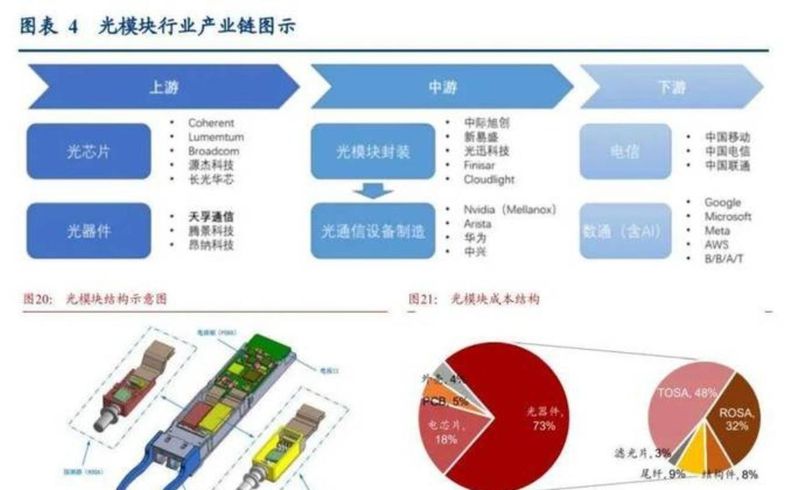
In short, optical transceiver module is the core device for the conversion of telecommunications and light signals. In the data centre, continuous transmission of big data between servers, gpus and switches is required, while the light module carries the task of “data handling”: the transmission end converts the telecommunications generated by the chip into a light signal, via a fibre-optic high-speed transmission; and the receiving end converts the light signals back into a telecommunications unit for the processing of the chip。
If data centres are compared to a city, gpu, cpu and other computing chips are the brain that handles information, and the light module and fibre-optic network is the highway that connects these “brains”。
In the past, light modules were mainly applied to telecommunications networks and traditional data centres. However, data exchange within the data centre is increasing exponentially as the demand for generating ai, large model training and ai reasoning increases rapidly. Particularly in the ai cluster, thousands of gpus require frequent exchange of model parameters and calculations, placing unprecedented demands on network bandwidth. From 400g, 800g, to 1. 6t or even 3. 2t, and at a higher rate in the future, light modules are becoming an important infrastructure supporting the expansion of ai's computing power。
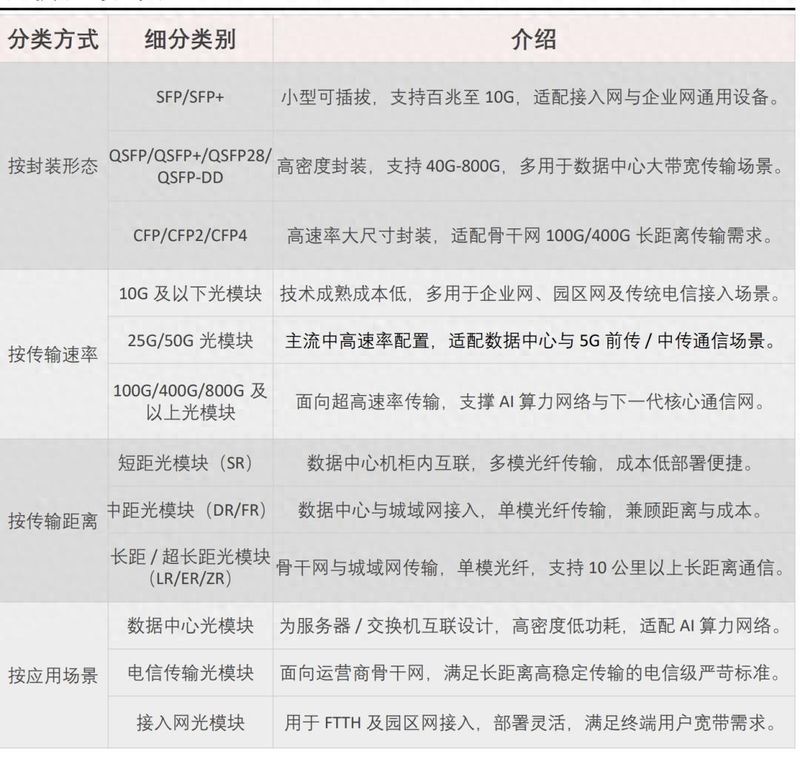
Light modules cannot be replaced because light communication has the advantage of higher bandwidth, lower wear and tear and lower utility than conventional copper line connections. At present, in the high-speed light module, core devices include lasers, light detectors, dsp chips and so forth, in which the inp (phosphate) lasers and silicon phototics technology have become a priority development direction for the industry。
At the same time, with the increasing performance of the ai chip and the challenges to the traditional light module architecture, the industry is moving towards the cpo (co-packaged optics, compressed optics) to move the optical engine closer to gpu or switch chips to reduce telecommunications transmission distance, reduce power consumption and increase bandwidth。
As a result, the light module is gradually being transformed from a traditional communication device into a critical link in the al-age computing infrastructure. Future ai competition is not only a competition for chip computing but also for data connectivity efficiency, and the light module is the “high-speed route” connecting all of this。
China light module, what level
If, in the past, chinese firms have faced the challenge of “hard core and low spirits” in the semiconductor industry, the light module is just one of the few areas of china’s semiconductor chain that are already globally competitive。
In the global high-speed light module market, chinese manufacturers already occupy a very important position, especially in the area of high-speed light modules for 400 g and 800 g data centres, among others, and chinese enterprises are becoming important players in global supply chains。
According to the lightcounting list of light module supplier top10, published by lightcounting, an independent market research institute in the light communications industry, middle-class innovation ranks number 1 globally, consolidating leadership; and new build-up of the united states corent to global level 2. Top10 light module manufacturers also include the 4th-ranked photo-ray technology, the 6th-ranked najin-tech (formerly haisin broadband), the 7th-ranked china works company, the 8th-ranked solar light power, and the 10th-ranked cambridge technology。
In other words, out of the top 10 suppliers of modules, seven chinese light module manufacturers were closed down. In particular, during the 800g-ray module era promoted by ai, chinese enterprises ' competitiveness was further enhanced. According to data from market research institutions, chinese manufacturers already hold a high share of the high-speed light modules procured by major cloud manufacturers and ai infrastructure builders worldwide, and are one of the important suppliers of the ecology of the british weidai server. According to analysts, nvidia 800g optical module 60% from innolight and eoptolInk, the rest goes to lumentum, cohen and broadcom。
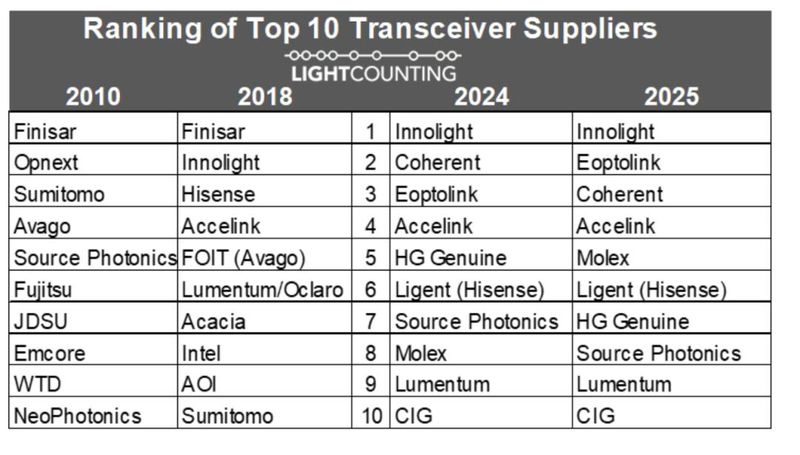
According to lightcounting, the list only measures the sales of the light module, excluding all other products, which explains the relative backwardness of coherent and lumentum. Lightcounting is also the leading suppliers that no longer include the wwdm module in the list, such as cisco, ciena, huaiye, marvell and nokia。
However, there are also obvious short panels in the light module industry in china。
While the light module appears to be a “small box”, its core value is actually concentrated on upstream light chips. At present, chinese enterprises have a clear advantage in light module mechanics and containment tests, but there is still a gap between high-end light chips and international lead levels。
For example, the core components in the high-speed light module include lasers (laser), optical moders (modulator), optical detectors (pd) and dsp chips. Of these, high-end eml laser chips, advanced silicon-ray chips and some high-speed optical appliances are still largely in the hands of overseas manufacturers。
This is why, in recent years, as the ai data centre enters a high-speed development phase, the industrial focus has been on inp (phosphates) materials, photochip capacity. The outbreak of light module demand is in essence moving upstream to facilitate the upgrading of the entire light communications industry chain。
On the whole, china's light module industry is characterized by a very distinct feature: “smalls are strong, chips are weak; manufacturing is strong and ground materials and cores still need to be broken”
If the whole chain of the light communications industry is compared to the automobile industry, chinese enterprises are now the world’s leading car factory, with strong size and cost advantages in the field of light module manufacturing; but there is still a need to keep up with engines, core parts, etc。
The advent of the ai era is opening up new opportunities for china's light module industry. With the rapid growth in demand for 800 g, 1. 6 t and even 3. 2 t-ray modules, the key to future competition will be not just the assembly capacity of the modules, but the availability of high-speed photochips, advanced seals and next-generation light interconnection technologies。
In other words, the china light module has been on the first global ladder, but the next competition will move from "do the light module" to "take the light chip"。
How about the light module market
With regard to market space, the latest forecast released by lightcounting in march 2026 indicates that the global light module market will remain at 60 per cent growth in 2026, with a global market size projected at nearly $60 billion by 2031。
According to yole group, the global light transceiver market is entering a new growth cycle. From $23. 4 billion in 2025 to $112. 3 billion in 2031, the data and communications application market will show a remarkable 30 per cent complex annual growth rate. This increase is mainly due to artificial intelligence training and reasoning infrastructure, which are expected to account for over 90 per cent of total market income by the end of the projection period。
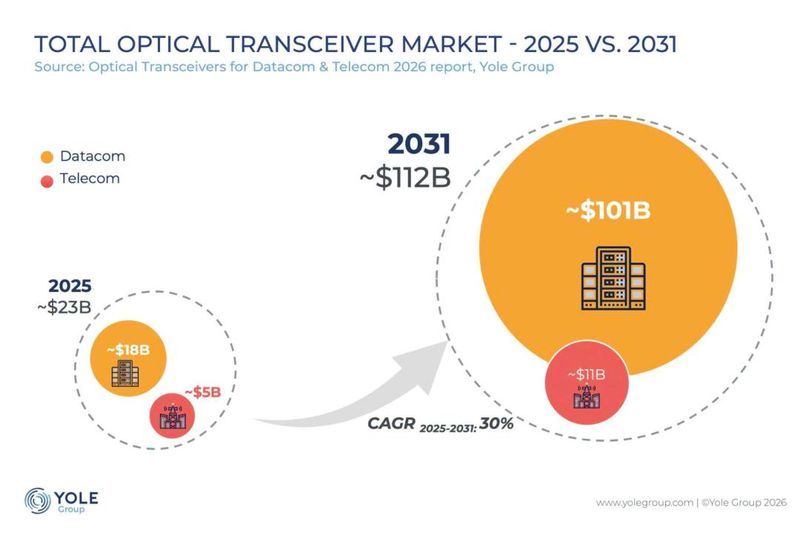
Yole indicated that, while 800g remained the main driver of market sales and revenue in today's data-communication light module, the strategic focus of the industry had apparently shifted to the next transformation point. 1. 6 t-ray modules are moving from the sample phase to the volume phase, and innolight is expected to account for approximately 50-60 per cent of the 1. 6t market by 2026Ink is also advancing the volume of 1. 6t, with the second generation of osfp-xd/rhs using the 3nm dsp process reducing power consumption by about 20 per cent; cohen is also actively advancing the volume. The real focus of the discussion is no longer just an increase in port speed, but how to achieve 1. 6t through the light module of the 200g/channel, a stricter budget for power consumption, more stringent heat-dissemination requirements and a broader transition to new modules and systems architecture。
In this sense, 800g is the business backbone of today's markets, but 1. 6t has begun to influence design priorities, supply chain decisions and technology road maps, all of which will define the next phase of competition patterns。
Yole noted that the transformation was particularly important because it was forcing deeper innovations in the design, power supply, cooling and manufacturing of light modules. The shortage of 200 g/routing eml chips, led by coherent and lumentum, has now become a key constraint in the production of 1. 6 t-ray modules in 2026, contributing to the optimization of markets to higher speed corridors, more sophisticated photons structures and more sophisticated systems. That is why the 1. 6t light module should be considered the next competitive threshold for the entire data communication light module ecosystem。
Vertical integration, in yole's view, is the way to win: leading suppliers combine laser purchases, dsp cooperation and sealing under the same roof, leading to 18-24 months of rapid product listing. Innolight and eoptolThis model is exemplified by ink, which launched 800 g and early 1. 6 t products at the fastest possible pace。