Go to school
New entrants to school
Safety guidelines
New entrants to university campuses mean a new phase of independent living and learning, but strange environments also harbour a variety of security risks. This is followed by the five core dimensions of personal, property, fire, network and psychology, which are designed to streamline security points and responses and help the new generation build secure lines。
Let's see
I. Human security
"no isolation, no discipline, no accident." line
Physical security is the foundation of all life and learning, and there is a need to focus on avoiding “single risk” “transport risk” and “activity risk”, which can be protected in three ways:
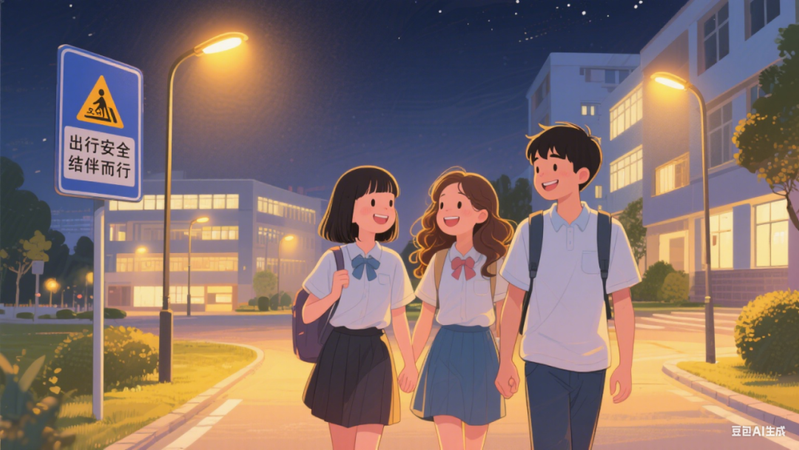
Travel safety: accompanying, rejecting “dangerous travel”
At night (especially after 2200 hours) not to travel alone to areas with inadequate lighting, such as playground corners, remote floors of school buildings and alleys around the campus, or to travel with at least 1-2 students。
Traffic rules are observed in schools, and there are no electric vehicles on board and no runways across the playground。
Out of school, they refuse to travel in a “black car” without a license and without operational qualifications, prefer a bus, taxi or a regular internet car to be shared with their relatives and friends。
2. Security of dormitories: vigilance: "impersons", lock "safe doors"
In the case of strangers who “go to the door and sell stationery/cosmetics” “proclaimed maintenance staff”, they first verify their identity through the cat's eye or contact the catheter to confirm that they do not open the door easily。
If the roommate is not present, no “leave the door” requests for strangers。
Every day before sleeping, when leaving the dormitories, it is important to check whether the doors and windows are locked (especially the balcony doors, the windows that are down) and to avoid giving the burglar an opportunity to be “involved”。
Resolutely refusing to stay outside of school, including relatives and friends of fellow students, to prevent danger to the safety of persons and property。
Activity security: "preparation" to avoid "hazardous movement"
Before participating in sports courses, sports events, etc., the body is fully warmed (e. G. Stretching joints, moving muscles) to avoid spraining and pulling injuries due to rigidity of the body, and wearing protective gear (e. G. Basketball wrists, running knees) as required by the project。
Participation in activities such as community practice, out-of-school research, etc., is informed in advance about the process and security concerns, and does not leave the team to act alone. Risks such as climbing, water and so on can be explained to the organizers if they are unable to do so。
Ii. Property security
Remember the principles of "prevent theft, protection against fraud, protection against blackmail."
The cost of living, tuition fees for university students is mostly personal or household savings, and the safety of property is protected through “active protection” and “alert trap”, focusing on three types of risks:
1. Protection against theft: “priority items remain undisturbed, no living accommodations in cash”
When studying in libraries and classrooms, when you leave your seat, you must carry with you valuable items such as mobile phones, computers, tablets and so forth and not hand them over to strangers。
In the dormitories, lock-in desk drawers or boxes can be acquired, and important documents such as identity cards, bank cards and so forth can be kept。
No large amounts of cash are stored in dormitories, and it is proposed that living expenses be deposited in bank cards, with priority given to mobile payments for daily consumption。
If large sums of money are received, such as tuition fees, subsidies, etc., they are deposited in the bank in time to avoid theft by “cash disclosure”。
Prevention of fraud: “rejection of temptation not to disclose, verification of information for retransfer”
Caution on the “school loan” “training loan” trap: loans that use “no collateral, low interest, fast-on-the-book” as a headline, are mostly loan sharks and may be accompanied by violence。
If you need financial resources, you can apply to a school for a study grant, a job as a student at work, or you can ask for help from relatives and friends。
Beware of strange information: when receiving information on “false tutors, school principals charging fees for teaching materials, training fees” “sms alerts for pre-payment” “proclaims that an order is abnormally refunded”, identity card numbers, bank cards, certification codes are not easily disclosed, and information can be verified through official channels (e. G. School officer network, mentor micro-letters) and untransferable prior to verification。

3. Protection against theft: “intensively guarded and valuables placed close to each other”
There are intensive crowds of people in canteen lines, playgrounds, bus train peaks, etc., with backpacks tilted to the chest or within sight, and mobile phones, wallets, etc. Were not placed outside the jacket in easily touched positions。
If a person is found to have frequent contact with his or her bag or pocket or if the behaviour of the surrounding person is abnormal, he or she can move in a timely manner and, if necessary, seek help from his or her classmates or staff to avoid the theft of property that is difficult to trace。
Iii. Fire safety
Compliance with the "no violation, common sense, know location" requirement
Houses of residence and school buildings are the main venues for the daily activities of university students. Fire safety is directly related to the safety of their own lives and those of others, and is subject to strict observance of regulations and the maintenance of fire awareness:
Non-compliance: “no access to dormitories for large power appliances and no desirability of private exploitation”
There is limited electrical load in the dormitories, and the use of large power appliances such as electric thermal blankets, cooking, fast heat, electric fire pans is strictly prohibited, which can trigger circuit overloads, resulting in short roads and fires。
No poor-quality plug-ins are used to avoid fires caused by ageing and poor exposure。
Wires are not used in a private manner, wires are not passed through the bedhead, the top of the closet, and plugs are not placed on the bed, sofa, etc。
If the dormitories are found to have broken electrical cords, they will be repaired in a timely manner and will not be repaired on their own。

Common sense: “no flammable and explosive materials, familiar with the location of fire-fighting facilities”
Fire lighters, gasoline, fireworks, etc., are not brought into the dormitories, and they are subject to open fire or high temperatures that trigger explosions and burning。
When using items such as mosquitoes, candles, etc., it is necessary to stay away from flammable substances such as curtains, sheets, etc., and must be extinguished when a person leaves。
Upon admission to the dormitories, familiarize themselves with the fire escape location of the dormitory floor (usually in the stairwell, with a “safe exit” mark) and the fire extinguisher location of the school building, cafeteria (mostly around the corner of the corridor, entrance)
In case of a fire, it can be dealt with in accordance with the principle that “the fire shall be extinguished with fire extinguishers, and the fire shall escape along the fire escape route”, where the mouth and mouth shall be covered with wet towels and bend over and down。
Iv. Cybersecurity
“no arbitrariness, no disclosure, no participation”
Undergraduate students rely more on the internet for their daily studies (e. G., checking information, doing homework), social networking (e. G., adding friends, talking to the community) and protecting personal information and the online environment by regulating internet access, focusing on three points:
Undiscretionary: “unknown links do not click, unknown software do not download”
Links received from strangers (e. G., "specific character" "red bag" "see video" links), e-mail attachments, are not easily clicked to avoid the link containing viruses, wooden horses, leading to the theft of account codes。
When downloading software, priority is given to downloading it from official application stores (e. G., mobile phone application market, software network) and no “breakdown” software of unknown origin is installed。
Installation of poison-killing software for computers and mobile phones, regular updating of systems and software versions and repair of security gaps。
The use of public wifi (e. G. Unofficial wifi, café wifi on campus) does not record accounts involving funds such as online banks, payment treasures, etc., to avoid the interception of information。

Non-disclosure: “personal information is not disclosed and account codes are complex”
Private information such as the address of his dormitory, cell phone number, curriculum, travel plans, etc., is not publicly disclosed on social platforms (e. G., the circle of friends, microblogging, tremors) to avoid being used by outlaws to create personal or property risks。
When setting the account password, avoid using simple passwords such as “birthday, school number, 123456,” using a combination of “letter + numbers + special symbols” and using different passwords for different platforms (e. G., micro-intelligence, qqq, bank cards) to reduce the risk of “a secret stolen, multi-coded”。
No participation: “no contact with illegal activities, no dissemination of bad information”
It is clear that the “network billing” “network gambling” “transfers money to others” is an offence that may lead not only to fraud (e. G. Not returning commission after a bill is drawn, gambling loses money) but also to criminal and legal liability。
It can be reported to the platform if it encounters bad information, such as rumours, violence, pornography, etc., and does not click or disseminate; it does not engage in online verbal warfare, malicious criticism, rational use of the network and maintenance of a good network environment。
V. Private security
"adaptation, timely recourse, rational communication"
From high school to university, the environment, relationships, learning patterns have changed, and some new students may be mentally ill and need to maintain mental health through “self-regulation” and “external support”:
Active adaptation: “receiving change, actively integrating into the new environment”
In case of anxiety and depression due to “wanted homes, incompetence in collective life, learning under stress”, an attempt can be made to adapt to university life by “developing life plans (such as routines, regular sports)” “developing hobbyes (such as membership in associations, learning musical instruments)” “involved to meet fellow students (such as eating with roommates, classes)”。
If you find yourself temporarily lagging behind others in social and learning life, you do not have to be too subjugated。
Timely recourse: “emotional discomfort, professional help is trustworthy”
If anxiety, depression, insomnia, etc. Lasts for more than two weeks, affecting normal learning, life, and not alone, you can speak to a counselor on your own initiative, or you can seek help at a school psychological counselling centre (the school psychological counselling is mostly free of charge and strictly protects privacy); you can also communicate with parents and get family support。
Information on psychological assistance: in addition to school psychological counselling centres, a 24-hour national psychological help line (e. G. 400-161-9995, 010-82951332) can be called to obtain specialized psychological counselling when needed。
Reasonable communication: “immediate human tension, calm resolution of disputes and consensus-building”
When dealing with roommates and classmates, it is possible to avoid quarrels and cold war when differences of opinion arise due to life habits (e. G. Time spent at rest, hygiene habits), to choose the time when both sides are calm and to communicate their thoughts openly (e. G., “i'm used to sleeping at 10 o'clock in the evening, can you do so later”) and to listen to each other's needs and to find a compromise。
If post-communication tensions remain unresolved, recourse can be made to counsellors, dormitory directors, third-party mediation to resolve differences, and to refrain from extreme methods such as “isolation” and “collateral retaliation” to avoid escalation and affect the psychological state of the conflict。

Dear new students, welcome to college! This will be a new starting point for you to explore knowledge, pursue your dreams and realize the transformation of your growth. A wonderful journey, full of infinite possibilities, is about to begin. While you look forward to embracing university life, security has always been the “lifeline” for this journey, and each of the five areas of safety referred to above — human beings, property, fire, network and psychology — is relevant to your daily learning life and needs to be kept in mind。
It is to be hoped that the new students will be able to internalize this security knowledge into their daily habits, both by courageously exploring unknowns, actively participating in school life, and by keeping the security strings tight and protecting themselves。
May you both reap knowledge and friendship and have a safe, healthy and full time on the campuses and begin a wonderful chapter of your lives