Nearly 90% of consumers are satisfied with auto maintenance services (theme)
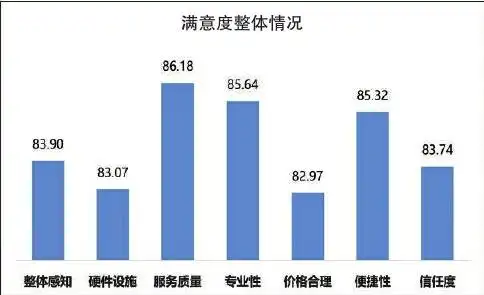
With the rapid development of the economy and society, cars have become the standard for the vast majority of the country's households, and the resulting maintenance and repair services have become indispensable consumption items in the daily lives of consumers. From october to november 2022, the jiangxi consumer rights and protection commission commissioned a province-wide one-month vehicle maintenance service satisfaction survey with a third-party company. On 14 june, a survey released by the jiangxi departmental commission for protection of the rights of the child revealed that the overall consumer perception rating for the jiangxi car maintenance and repair industry was 83. 90, and that 10. 09 per cent of consumers had had consumer disputes when receiving car maintenance and repair services。
Half the consumers are used to car protection at 4s
The survey was commissioned by the jiangxi departmental insurance commission to be conducted by a third-party company on a random basis in 11 of the province's established municipalities. The investigators interviewed a cumulative number of 1,219 consumers who had been engaged in car repair maintenance in 4s stores, brand chains or street repair shops in the past year, as well as secret confidential customers in 80 different types of doors throughout the province。
The survey, presented by sun weihong, deputy secretary-general of the jiangxi department of social protection, focused on three areas: consumer consumption habits; consumer satisfaction assessment; and consumer disputes and resolution. Among them, consumer consumption habits include five rating indicators, such as protection shop selection, preservation concerns, protection cycles, preservation spending; consumer satisfaction, such as seven indicators, such as overall perception, hardware facilities, quality of service, professionalism, price reasonableness, convenience, trustworthiness, and six complaints; and consumer disputes and resolution, such as, inter alia, preservation back-up, reasons for protection disputes, protection dispute resolution, statute of limitations, dispute resolution evaluation, dispute resolution processes and barriers, dispute protection channel selection and knowledge。
The survey found that nearly 50 per cent of consumers had car protection cycles of 6-12 months and 40 per cent of consumers of 3-6 months; more than 40 per cent spent an average of $1,000-3000 per year on auto protection and 30 per cent of consumers spent within $1,000; 46. 92 per cent of consumers used to choose 4s for car protection, choosing brand chains and street repair shops to account for 28. 22 per cent and 22. 07 per cent respectively, while the other options were only 2. 79 per cent. Among them, consumers who often go to 4s focused on the level of maintenance technology, the quality of spare parts; consumers who choose brand chains are more concerned with preserving efficiency and technology; and consumers who choose street repair shops are more concerned with price preferences and address locations。
More than 10% of consumers have had consumer disputes with businesses
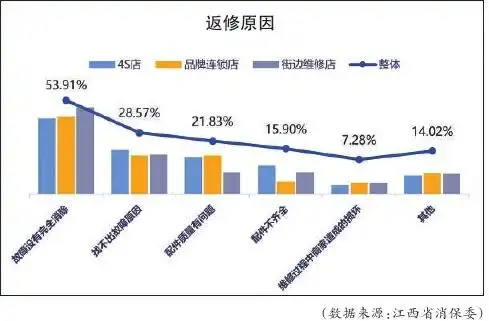
The survey showed that the overall consumer perception rating for the car maintenance and repair industry was 83. 90 and that the overall assessment was relatively good. However, 10. 09 per cent of consumers indicated that there had been disputes with businesses over car maintenance, mainly because the failure had not been completely eliminated. In addition, the most salient problems of consumer dissatisfaction are inadequate hardware facilities and unreasonable commercial prices for the maintenance of the site; lack of expertise and difficulty of proof are major obstacles to consumer advocacy。
Zhang chong, deputy director, consumer education and consumer guidance division, jiangxi province, told journalists that the level of satisfaction of brand chains was relatively high at 84. 84; 4s was the second highest at 83. 99; and the level of satisfaction of street maintenance was relatively low at 82. 72. Consumer dissatisfaction and expectations in the automobile maintenance and repair industry have been concentrated in such areas as integrity transparency, value for money, professionalism and accessibility. In particular, in terms of integrity and transparency, consumers wish to see the protection process through glass walls or surveillance equipment, to make it more transparent by disclosing information about the protection process, and to make the price more transparent; in terms of value, consumers want the spare parts to be repaired or replaced in a realistic manner, and the price is clearer; in terms of professionalism, consumers want the security personnel to be able to fix problems at a time, to explain the reasons for the problem clearly and to have more specialized protection equipment; and in terms of ease, consumers want the spare parts to be better prepared or shorter in waiting periods, and to have closer protection locations。
The survey also focused on the most dissatisfied consumers with car maintenance and repair。
For hardware facilities, “failure to see the repair/maintenance process through glass or surveillance equipment” is the most dissatisfied factor for consumers. Among consumers who choose 4s and brand chains, 31. 33 per cent and 33. 33 per cent, respectively, reflect the problem, while those who choose a street maintenance shop are more dissatisfied with the “less room for car washes or washes”, which is 40. 43 per cent。
In terms of quality of services, 36. 36 per cent of 4s shop consumers reported that “service providers do not respect consumer awareness and use consumer vehicles without consumer consent”; 44. 4 per cent of consumers choosing brand chains and 42. 29 per cent of consumers choosing street repair shops each reported “untransparent repair/maintenance processes and poor disclosure”。
In terms of technical specialization, the consumers who chose 4s and the street maintenance shop most often reported the problem of “failure to clearly explain the reasons for the problem”, accounting for 30. 65 per cent and 40. 32 per cent, respectively. Forty-eight per cent of brand maintenance shop consumers reported “not completely eliminating car failure”。
In terms of price reasonableness, 29. 91 per cent of 4s shop consumers and 40. 00 per cent of street maintenance shop consumers reflected “unexpressed and non-transparent commercial prices” and 46. 94 per cent of the customers of the brand chains reflected “a replacement of spare parts and an increase in intangible costs”。
In terms of accessibility, 45. 24 per cent of 4s shop consumers indicated that they “are far from my usual area of residence and are not in a good position to come to the door”; 37. 12 per cent of brand chain consumers indicated that “parts are not in stock and need to wait longer to be shipped”; and 37. 74 per cent of street repair shop consumers indicated that “no 24 hours are available for car repair/maintenance at any time”。
In terms of confidence, 43. 88 per cent of 4s shop consumers and 49. 44 per cent of brand chain consumers, respectively, reflect the existence of “over-maintenance” in businesses; 42. 73 per cent of street maintenance shop consumers reflect “businesses raise the price of accessories at will”。
The “failure” is the primary cause of consumer disputes
The survey found that almost 30 per cent of the consumers interviewed had had back-up experience, mainly because “failures were not completely eliminated” and about 10 per cent of consumers had had consumer disputes with businesses, mainly because “failures were not completely eliminated”. In addition, some consumers indicate that there are such issues as “sale of accessories in second place” and “depletion of consumables before they end”。
Sun weihong told journalists that about 73 per cent of consumers who had had consumer disputes indicated that they could be resolved by businesses in a timely manner. Some 14. 19 per cent of consumers, however, indicated that they had not been reasonably resolved after the dispute had arisen, and 10. 97 per cent indicated that “the relevant management was involved before it was resolved”. In addition, 44. 52 per cent of consumers expressed “satisfaction” with the outcome of the dispute, while 32. 9 per cent indicated “general”, “very satisfactory” and “less satisfactory” consumers each accounted for 10. 32 per cent, while only 1. 94 per cent expressed “very unsatisfactory” with respect to the outcome of the dispute。
The survey showed that the main problems faced by consumers in dealing with disputes were “businesses who recognize the problem but do not solve the problem in a positive way and can delay or have a hegemony clause”, which accounted for 42. 68 per cent; second, “manufacturers push each other”, which accounted for 40. 14 per cent; and “businesses drill for others”, which accounted for 27. 89 per cent。
Consumers interviewed argued that the obstacles encountered in the defence of car repair/maintenance services were mainly “no expertise, difficulty of proof”, which accounted for more than 50 per cent; the second was “no knowledge of the rights channel”, which accounted for 41. 94 per cent; and “no clarity about what interests they have” and “incompetence of industry standards”, which accounted for 37. 42 per cent and 36. 77 per cent, respectively. When their rights are violated, consumers choose to defend their rights mainly by “reflecting the situation to consumer associations”, which accounts for over 60 per cent; followed by “calling the alarm”, which accounts for 40. 56 per cent; and 7. 47 per cent of consumers opting for “unfortunate acceptance”。
Related links
The key to raising the level of auto protection is co-management
In line with the expectations of the general consumer in the automobile maintenance and repair industry, the jiangxi departmental commission for protection recommended that a multisectoral approach be taken to improve the regulation of the automobile protection industry。
Regulatory changes need to be accelerated, leading to transformational upgrading and high-quality development. In particular, it is necessary to improve the level of public service in the automobile sector through “strong regulation and guidance”; to strengthen the regulation of the whole process so that the quality of the whole-process service can be tracked; and to establish a digital credit system to boost the capacity of the industry to provide services at the source。
The full role of industry associations and the promotion of industry self-regulation. Industry associations are actively engaged in industrial skills training to create an industry-wide “advanced” climate; in industry self-regulatory management and the introduction of industry-wide service standards; in strengthening retrofitting mechanisms to protect spare parts to ensure quality control and transparency in consumption processes; in directing enterprises to innovation services to create high-value services for consumers; and in upgrading the capacity of industry associations to serve social and service consumers。
Create a vehicle protection satisfaction assessment system to enhance service support capacity in all its aspects. On the one hand, producers should take the initiative to conduct consumer vehicle protection satisfaction surveys, which would allow them to evaluate their enterprises in the light of the rewards and penalties they receive, taking into account the key elements affecting consumer perception, such as quality protection, human protection techniques, protection services, transparency of consumption, problem resolution and time frames. On the other hand, real-time experience with the service processes of protected enterprises, optimizing service standards, improving service processes and providing higher-quality services to consumers through, for example, third-party unannounced visits. (reporter zhuhai)