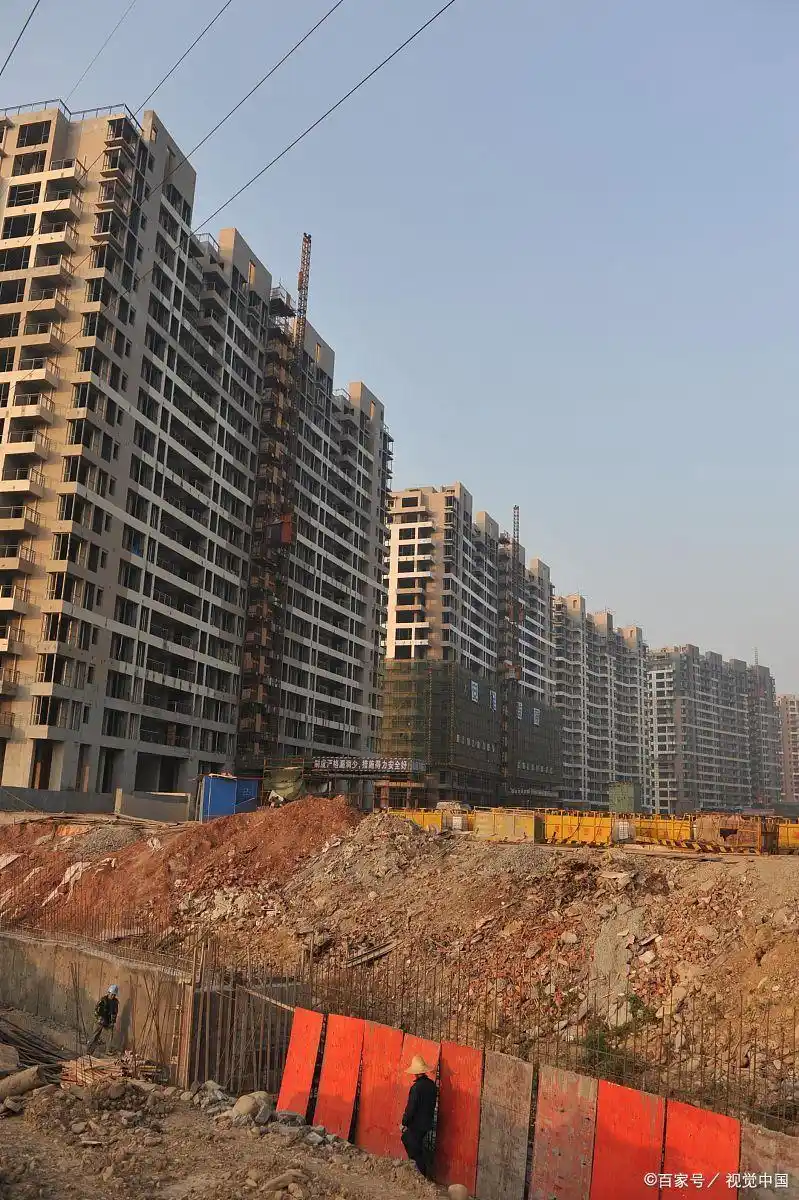
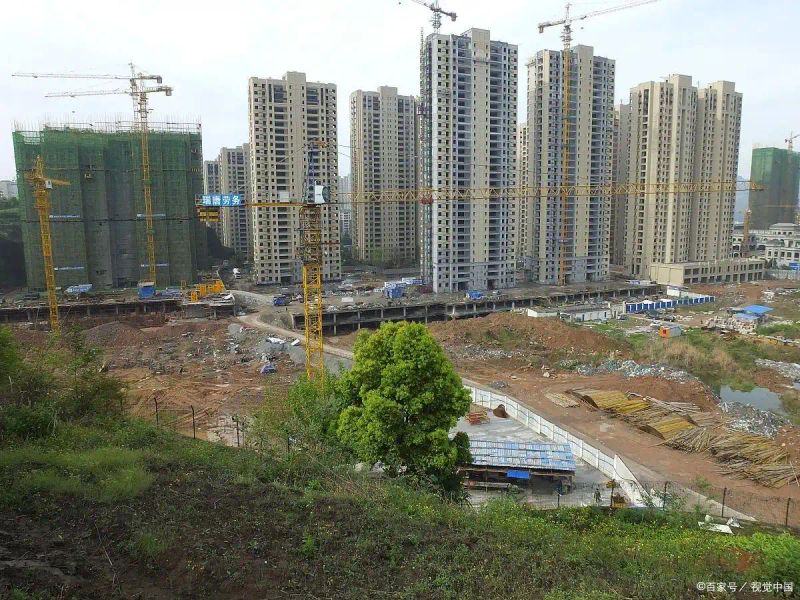
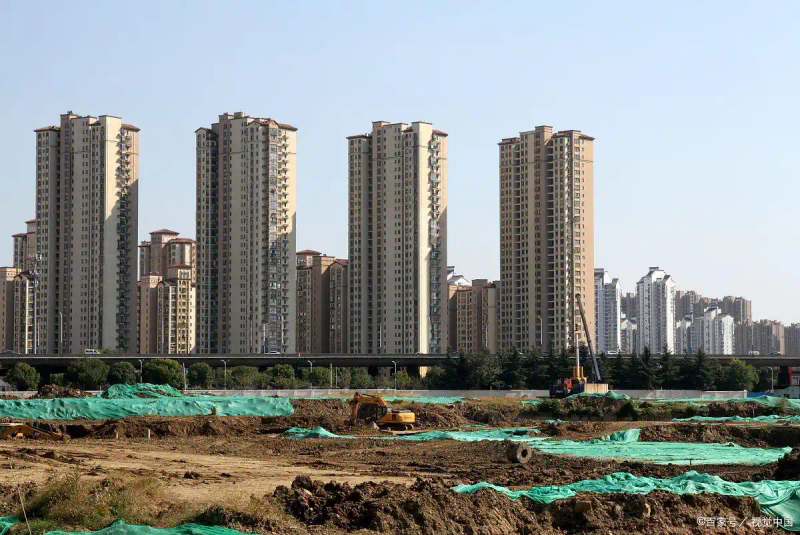
150 acres of commercial land, with a total construction area of 405,000 m2, with a total investment of 2,728 million, at a single cost of $6736/m2. When we dissect this estimate of investment in real estate, an eye-opening truth emerges: 55 per cent of the money goes to the purchase of land, 31 per cent to the construction of houses and only 3 per cent to the technical management costs of actually supporting the project to land. In the cost books for real estate in china, the land consumes profits like a greedy giant, while technology management becomes a mere “sideline”. What are the neglected survival logics of the industry hidden in this deformed cost structure
I. Land costs: 55 per cent of the “golden beast” and the “lease economy” of housing enterprises
Of this total investment of $2,728 million, land-related costs amount to $1,547 million — $1. 5 billion in land concessions, $45 million in tax returns and 2 million in land use taxes. This means that of the cost of $6736 per square metre, $3820 went directly to the land, representing 56. 7 per cent (or about 55 per cent in the original language). If the cost of financing the land is calculated (of the $9. 872 million earmarked, the land is the bulk of the financing base), the actual cost of land “ingestion” may be higher。
How can land costs take over half the country? The core lies in the logic of “land finance”. Local governments generate fiscal revenue through land concessions, and housing companies rely on land value addition for profit - over the past 20 years, the average annual increase in land prices in china's cities has been much higher than that of the cpi, and housing companies can earn money even if they do not build up their land. This “hoarding is for profit” model allows land to be alienated from “factor of production” to “financial assets”, and housing companies are naturally willing to throw most of their money into the land market。
But the data do not lie: when the cost of land is more than 50 per cent, the profit space of the enterprise is severely squeezed. Assuming a project sale price of $120,000/m2, with a total sales value of $4. 86 billion, net profits of only about $1,126 million, with a net interest rate of 23 per cent, after deduction of a total cost of $2. 728 billion, 10 per cent of marketing costs ($486 million) and 13 per cent of vat ($520 million). If the land price increases by another 10 per cent (an increase of 150 million), the net interest rate falls directly to 17 per cent. That's why housing companies are so sensitive to price fluctuations - for every 1 percentage point increase in the cost of land, net profits could fall by 2-3 percentage points。
Technology management: 3 per cent of “margins”, undervalued knowledge
In stark contrast to the “hegemonic” of land costs, the “low” costs of technology management. In the original version, $2. 97 million for consultancy services (survey, design, supervision, etc.) + $3. 42 million for management (staff salaries, operating expenses) = $637. 9 million, representing only 2. 3 per cent of total investment; even with the provision of $5. 103 million for engineering changes (basic reserve costs), the costs associated with technology management are less than 4 per cent of total investment。
This set of data breaks down an industry hypothesis: real estate as a complex project of “fund- and technology-intensive” and the value of technology management is severely underestimated. A small area of 400,000 m2, involving dozens of professions, such as geological surveying, architectural design, structural security, electromechanical installation, cost control, etc., could result in tens of millions in loss of any link. The reality, however, is that housing companies are willing to pay 1. 5 billion dollars for land, but only more than 60 million dollars for technical services — equivalent to only 157 dollars per square metre of technological input, less than 4 per cent of the land price。
Why is technology management so cheap? The root cause is the “high turnover” model of housing enterprises. In order to fast-track back-to-back funding, the design cycle for housing enterprises (six months for normal residential design and three months for high-rotation projects) and the simplification of technical processes (jumping partial survey links, reuse design templates) have been reduced to a “walking” tool. More ironically, the industry practice of “estimating 3. 5 per cent of the cost of construction” for consultancy services is essentially to bind the value of technology to the “construction cost” — the higher the cost of construction, which completely reverses the logic of “technology optimization to reduce construction costs”。
When technology management is marginalized, the consequences are emerging: in recent years, there has been a high incidence of “silent buildings” and “breeding walls” with design defects behind them and neglect of supervision; and problems such as unreasonable household sizes, excessive public distribution, greening and shrinking water have exposed the company's neglect of the “residence experience” — after all, it seems more profitable to take a piece of land than an optimal 10 million households。
Iii. Costs of financing: 3 % and 10 % torn and the survival of private enterprises
Earmarked costs (financing costs) amount to $987. 2 million, which appears to be low (3. 6 per cent), but hides the most brutal survival status quo for housing enterprises. The original text is clear: the cost of financing is less than 3 per cent, and the cost of financing is more than 5 per cent or more than 10 per cent. On this basis, if the main project financier is replaced by a private enterprise (10 per cent of the financing cost), the earmarked cost will soar from 9. 87 million to 164 million, with total investment increasing by 66 million and net interest rates falling directly from 23 per cent to 19 per cent。
Such “financing cuts” are accelerating the division of industries. Data for 2023 show that in top50 housing enterprises, the average cost of financing was 3. 2 per cent, while the average cost for private enterprises was 7. 8 per cent. For every 1 percentage point difference in the cost of financing, an additional 10 million interest is paid annually on a billion loans — almost “lifeline” for a small profit-making private enterprise. Even more deadly is the fact that when markets go down, private firms become more narrow in their access to finance, and some of them even rely on “share-equity debt” (more than 15 per cent at cost) and end up in a “new-to-old” debt trap。
Why are the costs of financing so varied? The core is “credit premiums”. The country relies on government credit and has a low risk of default; the debt problem left over from past high-leveraging expansion for private firms is seen by financial institutions as “high-risk customers”. This “identity cost” financing system not only squeezes people's living space, but also deprives the industry of its catfish effect - when conglomerates use low-cost financing to drive their way out of the market or are forced to enter high-risk areas (e. G. Three- and four-line cities), they further exacerbate the industry。
Behind the cost structure: the “value mismatch” of real estate and the transition dilemma
Dismantling an investment account of 2,728 million is not just a series of figures, but a “value mismatch” in the real estate sector: heavy land-side technologies, heavy finance management, heavy profits. This distortion is placing the industry in a circle of “extension and danger”。
In the case of the construction cost of $2,100/m2, this figure is close to the cost threshold in the first-line cities. What can i get for $2,100? Steel bands (500 yuan/m2), cement (200 yuan/m2), manual (400 yuan/m2), simple fit-out (600 yuan/m2) leave little room for technology optimization and quality control. In order to control costs, firms tend to choose a “minimum price winning” and the builder maintains a profit by “stealing down” — that is why many of the new buildings are delivered to defend themselves, essentially “low-cost to low quality”。
More alarming is the setting of “preparation costs”: basic reserve costs of 51. 13 million (work costs of 8 per cent), price differential provisions of $5. 954 million (work costs of 70 per cent x 10 per cent), totalling 110 million. This money was to be used to deal with risks such as changes in construction, material price increases, etc., but in high swing patterns, housing companies tend to compress reserve costs and even require “zero changes” — in 2022, a head of housing company project stopped work after having experienced steel price increases and lost more than $1 billion。
As the cost of land, finance and reserves squeezes technology and quality inputs, real estate is being transformed from “housing” to “shell construction”. The purchaser no longer buys a “good house” but a “space with a property certificate”; the housing company no longer fights for “product power”, but for “land acquisition” and “financing capacity”. This model may be profitable in the short run, but it is bound to be unsustainable in the long run — after all, no industry can grow on “grow” and “loaning”。
The road to closure: a turn from the “tenant economy” to the “building economy”
Data is the best sobering agent: when land costs exceed 50 per cent and technology is less than 3 per cent, the real estate sector has to answer one question: are we land operators or house builders
The key to breaking down is to make up the structure: lower land dependency and higher technical value. In particular, three directions are worth exploring:
First, local governments need to gradually move away from “land finance” and to return land prices to a reasonable level through alternative land concessions such as property taxes and excise taxes. Shenzhen has been piloting a “ground-limited price + quality test”, requiring housing firms to compare the price of land to the size, greening, intelligent configuration, and to push technical inputs — in shenzhen in 2023, in order to boost their production capacity, the company has voluntarily increased the cost of consulting services from 3 per cent to 5 per cent, and the technical value has begun to be addressed。
Second, housing enterprises should establish a “technical cost” accounting system that separates costs such as surveying, design, supervision from “indirect costs” and pays for “value contributions”. For example, if design optimization reduces construction costs by 1 per cent (8. 5 million), the designer should be rewarded with 20 per cent of the cost savings — so that the value created by technology can be seen and felt。
Thirdly, financial institutions need to break “identity discrimination” and identify financing costs in terms of “project quality” rather than “business nature”. The central bank's “quality projects special loan” launched in 2024, which grants high-quality projects for public enterprises at the same financing rate as the national corporation, has enabled 30 private enterprises to access low-cost financing through this policy — perhaps the beginning of a tearing-out of financing。
Two hundred and twenty-eight billion investment books mirror the past and future of the real estate sector. When land is no longer a “discount machine” and finance is no longer a “protector”, housing companies will eventually understand that it is never the amount of land that can cross the cycle, but the amount of good houses that make people want to pay. Technological management spans from 3 per cent to 10 per cent, and perhaps the turn of real estate from “deficient” to “practical” — a road that is difficult but left no choice。
After all, the house is used to live, not to fire; the industry is used to create value, not for free arbitrage. Data doesn't lie, and the future doesn't play with anyone."