I'm sure you'll read it
Hey, young british guys! Let's talk today about translation theories, methods and techniques that you have to know. Whether you're a beginner or a translator with some experience, it helps you improve your translation. Get the notebook ready. Let's do it
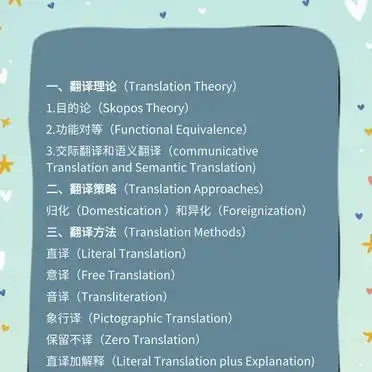
Translation of theory
Skopos theory
The central idea of this theory is that the purpose of translation is to determine the method and strategy of translation. In short, translation is done for a certain purpose. For example, literary translation and commercial translation have different purposes and methods of translation。
Function peer (funcio)I don't know, nal equivalence
Functional equivalence emphasizes functional equivalence between the original language and the translation, rather than literally. In other words, the translation conveys the meaning and spirit of the original text, rather than simply translating it。
Language and semantic translation
Interlocutory translation focuses on the communication of information, emphasizing its effectiveness in the linguistic context, while semantic translation focuses more on the form and content of the original language and maintains, to the extent possible, its structure and presentation。
Translation strategy
Naturalization
Naturalization is the expression that makes the translation compatible with the translation, making it easier for readers to understand. For example, the english sentence is translated into the chinese sentence。
Organisation
Diversion is the preservation of the cultural identity and language style of the original language, so that readers can feel the alienity of the original language. For example, some special expressions are retained in english。
Translation section
Direct translation
The translation is done literally, in order to maintain the structure and expression of the original text. For example, “run” can be translated as “run”。
Free transport
Translation is done in accordance with the meaning of the original language and is not restricted to the original language. For example, “run” can be translated as “run”。
Transliteration
The translation is the transliteration of the original language into the translation. For example, paris can be translated as paris。
Pictography transport
Like translation is the image or symbol that converts the original language into the translation. For example, translation of some trademarks or symbols。
Zero transport
The reservation means that some elements need not be translated in the translation. For example, "hello" is "hello" in chinese and no additional translation is required。
Direct interpretation
When the translation is not clear, explanations can be added to help the reader understand. For example, “game over” can be translated straight to “end of the game”, but it would be clearer to add an explanation “end of the game, means failure”。
Free transport plus exchange
The translation, together with the explanation, is usually used in situations where cultural backgrounds are very different. For example, the word “cheers” could be interpreted as “salary”, but it would be clearer to add the words “a drinking manner”。
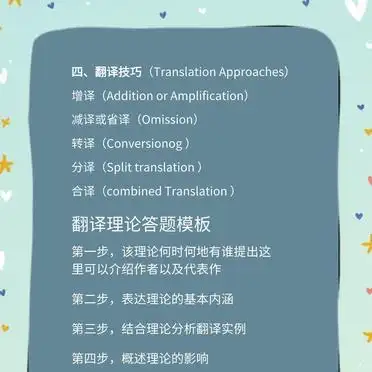
Translation skills
Add or amplification
The addition of the translation is to add something that is not in the original language and to make it more complete and clear. For example, “good morning” can be added to “good morning”。
Depreciation or translation
The reduction or omission of the translation is to omit elements from the original text, making the translation simpler and more fluid. For example, “thank you” can be saved by “thank you”。
Translation (conversionog)
Translation is the conversion of words from one language to another. For example, “look forward to” can be translated as “expected”。
Split translation
The translation is the translation of a long sentence into short sentences. For example, “i love you more than i can say” can be translated as “i love you, not in words”。
Complementation
The translation is a translation of short sentences into a long sentence. For example, "i love you. I miss you."。
Summary and outlook
Through these presentations, it is hoped that you will be better equipped with these translation theories, methods and techniques. Whether you're a beginner or a translator with some experience, it helps you improve your translation. Keep trying