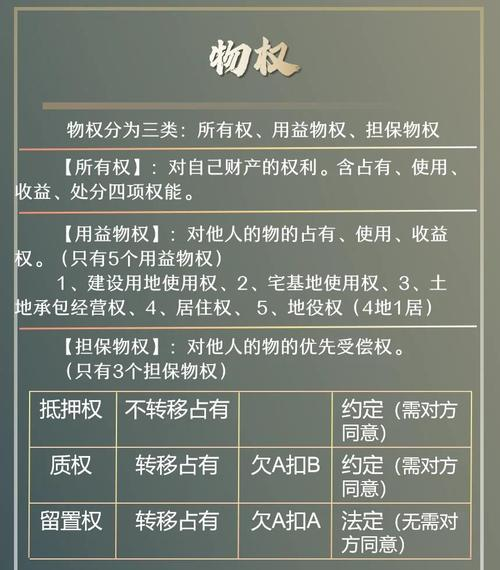
Section i. Content, composition and classification of property rights
Property rights are abbreviations of property rights (ownership of property) or property rights. For example, as we see in the great britain encyclopedia, property refers to " the object of legal rights, which combines possession and wealth and usually strongly implies individual ownership. Legally, the term refers to the synthesis of legal relationships between persons in rem”. This definition indicates that the concept is not only the object of property rights — property — but also “a synthesis of the legal relationship between the person and the person”。
In the authoritative economic lexicon, the great dictionary of new palgrave economics, alan ryan wrote the prop-erty and the famous property economist alchin wrote the property rights. Ryan wrote: "the right to property, like scarcity and reason, is the foundation of economics." he then introduced "property" in law, politics, philosophy and economics, and it was easy to see from his explanation that ryan described property rights in terms of ownership. "there is no definition of ownership that would fully satisfy all purposes: “the right to property is the right to treat things in the most arbitrary manner permitted by law”, a provision of the french civil code, which has been cited in many other codes. It captures two key points: first, i cannot stab a knife into your chest, which is not an infringement of my ownership of the knife. The law does not allow anyone to stab a knife into the chest of others, but i can use it (no one else) to do everything that anyone can legally do with any knife. Secondly, all owners must have all the rights that any person may have with regard to the matter under consideration. “property rights are a socially enforceable right to choose between the multiple uses of an economic good,” said alchin
In addition to the above-mentioned definitions, there is some consensus on the understanding of property rights because of the differences in the starting points and focus of the study of property rights by different intellectual schools, which are not able to arrive at a uniform definition of property rights because of their differing content. Property rights economists, for example, see property rights as a correlation between people's use of things, i. E. A fundamental relationship between people, not between people; they emphasize that property rights are a group of behavioural rights, or a “right beam”; they view the number and intensity of rights attached to an object as a determining factor in its economic value; they view property rights as social systems, etc。
Slaan egterson "calls the right of the individual to use his resources a property right." according to bazelle, “the individual's property rights over the assets consist of the right or power to consume them, derive income from them and transfer them. “property rights are a social tool ... The owner of the property rights has the right of his colleagues to agree with him in a particular way.” “it is important to note that property rights include the right of one person or others to benefit or be impaired.” ... It is then clear that property rights define how people benefit and how they suffer, so who must provide compensation to whom to modify the action taken. “the right to control and dispose of property is defined by alain rufus waters as the right to control and dispose of property in a manner deemed appropriate.” ... It is distinct from state ownership and the specific rights of persons arising from it. Property rights refer to the right of people to be able to deal with what they control, that is, the right of people to have a return on informed decision-making, while bearing the costs of bad luck or negligence. “we can define property rights as a group of protected rights of individuals and organizations that enable owners to hold or dispose of certain assets through acquisition, use, mortgage and transfer of assets, and to take possession of the benefits derived from their use.” of course, this also includes negative gains — losses. Thus, property rights determine responsibility for and benefits from the use of property. "in no case may property rights be confused with items owned ... Property rights are not material objects, but rights and obligations that are widely respected in society. In the view of some property economists, property rights are a set of rights to property。
Other property economists argue that property rights are not objects, not relationships between human beings, but relationships arising from the use of goods, i. E. Basic relationships between human beings. For example, filuboten and jewizi, in theory of property and economics: an overview of recent documents, made it clear: “property rights do not refer to the relationship between human beings, but rather to the existence of the object and the mutually acceptable relationship of conduct arising from its use. The property rights arrangement defines the behaviour of each person in relation to the other, and each person must observe his or her interrelationship with others or bear the cost of not complying with it. Thus, what can be described as the property rights regime prevailing in the community is a series of economic and social relations that are used to determine the position of each individual in relation to the use of scarce resources. @swetozar picovic and i. Fisher also share the same view. According to fisher: “property rights are the freedom to enjoy the benefits of wealth while bearing the costs associated with such gains or the permits obtained ... Property rights are not tangible things or things, but abstract social relationships. Property rights are not objects. “property rights are a relationship between a person and a person due to the existence of scarce items and their use.” “this definition of property rights is consistent with roman law, common law, the writings of karl marx and the economics of the new system (property rights).”
Property rights in economics studies are broader than the concept of property rights studied by jurists. Alchin stressed that “the right of individuals to use resources in any society (right to property) is regulated and supported by various norms, social customs, exclusionary power, etc., and that formal laws and regulations are upheld by the state. Many of the constraints affecting private property are related to the forces of regulation and social exclusion. According to g. D. Libecap, "property rights are social systems." these systems define or delimit the scope of privileges that individuals have over certain specific property, such as land or water. Private ownership of such property may include a wide range of rights, including the right to prevent access by non-owners, the right to divert resources from rent streams derived from their use and investment, and the right to sell or transfer resources to others. "in the legal literature, we find two meanings of property rights. First, the civil code of the continentProperty rights in the narrow sense of the term " central civil law " (e. G. German civil law derived from roman law). Here, property rights relate only to tangible goods. Next is anglo-american common law property rights in the broader sense that they relate not only to tangibles but also to intangibles, which include patents, copyrights and contractual rights ... Finally, a third type of property right could also be defined. The individual has not only the right to be protected by law, but also the rights guaranteed by tradition and other non-legal instruments such as self-execution ... The third type of property rights relates to property rights in the sense of customer relations, friendship, etc. `supported by the forces of social courtesy, custom and banishment'