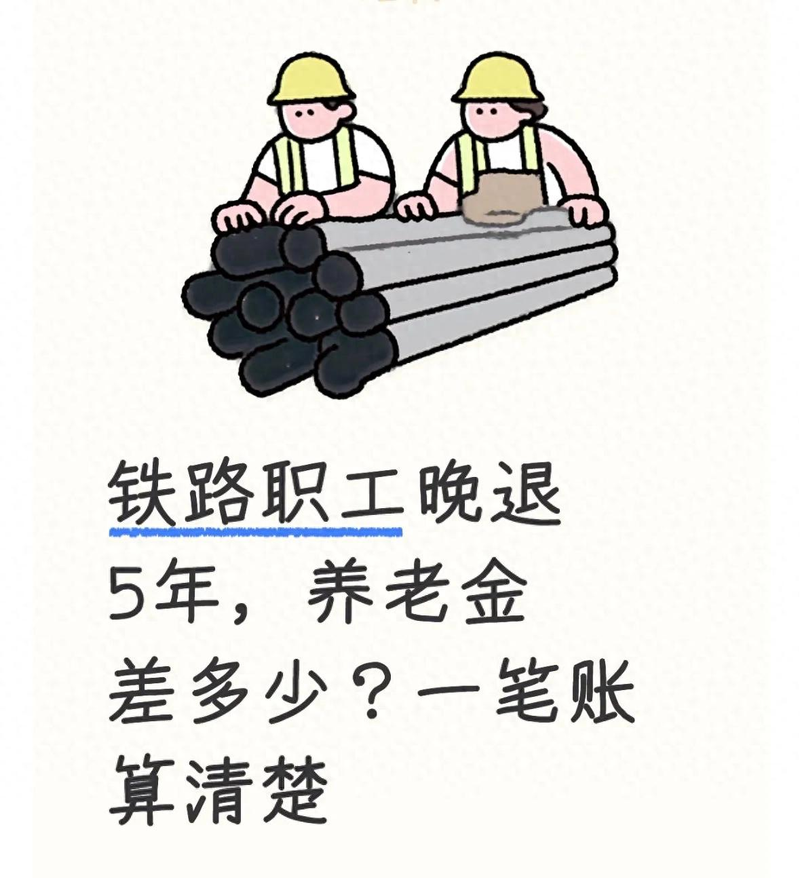
In the railway sector, retirement age and treatment have been the most important topics for workers and their families. Many first-line workers face choices: early retirement at age 55 for special work or normal retirement at age 60? Also railway workers, five years late, how much difference can a monthly pension make? This document, which combines the accounting rules for national workers ' pension insurance in 2026, the contributions to the railway industry and the company's annuities, uses real data and a uniform formula to make this account clear and clear, without ambiguity or exaggeration, so that every railway can have a bottom line。
There is a dual guarantee that railway workers will be covered by a unified state system of employee pension insurance, with a general contribution to the enterprise's pension. The pension consists of three parts: the basic pension, the personal account pension, the transitional pension, and the enterprise pension as a supplement to the old-age pension, which further increases retirement income. Five years later, the changes in treatment are mainly in four ways: five more years of contributory service, five more years of base pay, five more years of interest on personal accounts, and a reduction in the number of months of issuance, leading to an increase in personal account pensions. These four supersedings eventually create a clear gap in treatment。
First, a uniform comparison is established, which corresponds to the true situation of the majority of ordinary railway workers: men, who may retire at the age of 55 for special types of work, and at the age of 60 for normal purposes; contribution index 1. 0 (average contribution level in the railway industry); pension base of the province in 2026 8,500 yuan; contribution age 35 years at the age of 55 and contribution age 40 years at the age of 60; personal account deposit of 320,000 yuan at the age of 55 and interest rate of 420,000 yuan at the age of 60 for constant contributions; and an annual contribution of the enterprise, which is calculated on the basis of the person in the railway。
After retirement at age 55. Basic pension = 8,500 x (1+1. 0) ÷ 2 x 35 x 1 per cent = 2975 yuan. Personal account pension = 320,000 ÷ 170 (years of age 55) ≈ 1882. The transitional pension is calculated on the basis of 10 years of the same age and a coefficient of 1. 3 per cent, or approximately $1105. The three basic pensions total $5,962. Plus the company's annual pension of approximately $1,200, the monthly combined income was $7162。
The retirement treatment at age 60. Basic pension = 8,500 x (1+1. 0) ÷ 2 x 40 x 1 per cent = 3400. Personal account pension = 420,000 ÷ 139 (months of age 60) ≈ 3022. The transitional pension remains unchanged at $1105. The total of the three basic pensions is €7527. The company's annual pension has accumulated over five years, at approximately $1,600 per month. The monthly combined income is $9127。
The contrast is clear: retirement at age 60 is closer to $165 per month after retirement at age 55, the basic pension is $1565 per month higher, and the combined monthly difference is close to $165 after the enterprise's annuity. This measure, which is highly consistent with the real feedback received from retired employees at the national railways, is also in line with the “long pay and late pay” approach。
A lot of workers care about where the money they get after five years. The first is an increase in the number of years of contributory service, with an additional percentage of the basic pension for every additional year of service, and a direct increase in the level of treatment over five years. The second is a reduction in the number of days in which the 55-year-olds are 170, the 60-year-olds 139, the same personal account amounts, the number of months in which assessments have become smaller and the number of months is naturally higher. The third is the continuous accumulation of personal accounts and annuities, with five years of personal contributions, unit contributions and interest earnings, resulting in a significant increase in the total number of accounts. The fourth is the annual increase in the social wage and the base figure, and the late fall represents a further widening of the gap by higher standards of accounting。
As a large state enterprise, railways are an important guarantee of pension treatment, with contribution norms, a full base and a stable pension. Railway workers have a clear advantage in the contribution index, in the accumulation of accounts, and in supplementing old-age pensions, as compared to ordinary flexible workers and micro-entrepreneurs, as well as the increase in the benefits associated with late retirement. A number of old railway workers have received feedback that the same length of service is close, and the gap between early and late retirements generally ranges from $1,500 to $2,000 per month, with a partial high base figure and a gap of over $2,000 for high-age jobs。
In the case of special workers, early retirement means an earlier break, no more shifts, and the country's benefits for difficult jobs. Normal retirement, on the other hand, is better suited to employees who are in a better health condition and who wish to advance their later earnings. The two options are not absolutely right, depending on the individual's body, family needs and income expectations。
It needs to be made clear that, once a pension gap is created, it is a lifelong gap. Every year, the state adjusts the basic pension for retirees, using a combination of flat-rate adjustments, linkage adjustments and tilt adjustments, which are directly related to pension levels and years of contributory service. For workers with five years of late retirement and higher pay, the annual increase would be higher and the gap would be maintained over time。
In 2026, the national pension insurance system continued to deepen, making accounting rules more transparent, timely and secure. The internal procedures for processing retirements within the railway system are supported by complete documentation for the determination of the length of service, the consideration of contributions, and the accounting of the annuities, which can be accurately accounted for as long as they are complete. It is recommended that workers who are close to retirement should go to the industrial sector or the social security window one or two years in advance, print out a personal benefit list, check the number of years of contribution, contribution index, account amount and measure their treatment。
Train workers will remain at their posts for the rest of their lives, ensure transport and devote their youth to the railway line, and later treatment will be the best reward for long-term payment. The choice of early retirement to enjoy leisure time or of late years to increase earnings is a reasonable choice based on personal circumstances. A clear accounting of the difference in treatment would make it possible to make decisions that were more appropriate to one's own needs, and to make later life more stable and bottom-up。
The state has always guaranteed workers the right to legal retirement, and the railway industry has continued to implement welfare policies that enable every dedicated person to grow up and live well. It is not the slogan, but the formula that is written into the accounts and the real gains that are made。
Also retired from the railroad. How much difference does it make each month between early and late workers? You're looking more at early rest or higher pensions, and you're welcome to share。