
Being a handsome card player is exhausting, and i really know that。
I. Context
1 engine:
It is a machine that converts thermal energy released from fuel combustion into mechanical energy; a machine that converts thermal energy from fuel combustion into mechanical energy is referred to as a heat engine。
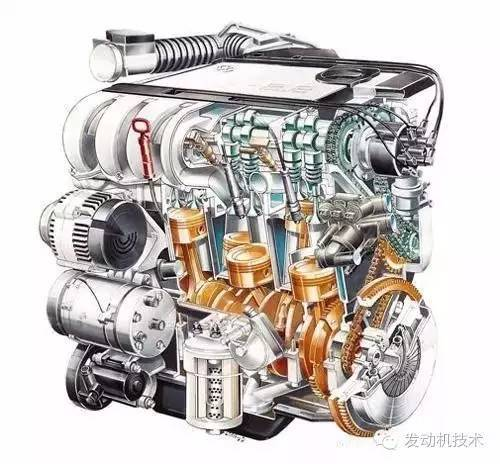
2. Heat engine classification:
Differentiated by fuel combustion
(1) external combustion engine: fuel combustion outside the engine is referred to as an external combustion engine, such as a steam engine, a motor, etc。
(2) internal combustion engine: the fuel is referred to as an internal combustion engine, such as diesel, gasoline, etc., which is burned directly within the engine
3. Characteristics of internal combustion engines:
Internal combustion engines are heat-efficient, wide-scale, adaptable, structurally compact, small in size, and operational. Advantages such as prompt start. It is therefore widely used in defence, transport, industry, agriculture, etc. Currently, tractor engines use internal combustion engines. The internal combustion engine has many advantages over the external combustion engine:
(1) high heat efficiency: thermal efficiency of diesel engines is higher than that of other power machines. Thermal efficiency of diesel presses is as high as 46 per cent
(ii) wide range of power: single power of between 10 and 50,000 kw (ship) adapted to multiple uses
(3) good start-up performance: small and medium-sized diesel engines are usually capable of operating within seconds and are fully operational
(4) operation maintenance simplicity: diesel engines use small quantities of water (except single-cylinder evaporation) and wind-cooled diesel engines do not use water at all
(5) high volume power and lower than mass (power/quality): the volume power of the high-speed pressurized multiple-cylinder diesel machine is 340 kw/m3 than the mass of 1. 6 kg/kw
(6) high fuel requirements: no direct use of poor quality and solid fuels
(7) sources of environmental pollution: harmful gases in diesel exhaust, carbon smoke and noise are hazards to the environment。
Ii: engine classification
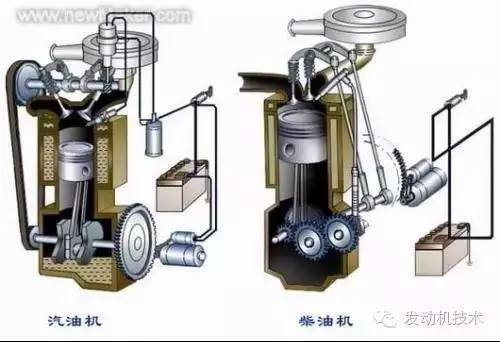
Internal combustion engines of many types are usually classified according to different characteristics as follows:
1. By fuel used: petrol, diesel, petroleum liquefied gas, biogas, etc.
2. By number of cycles: 2x2 engines, 4x4 engines
3. Points by cylinder: single-cylinder engine, multicylinder engine
4. By cooling: water cooling engines, wind cooling engines
5. Distinction by fire: ignition engine, pressure engine
6. By rotation: high speed engines, low speed engines
7 disaggregated by cylinders: stand-by engines, undercover engines, v engines, pairing engines
8- gaseous: pressurized, non-pressurized engines
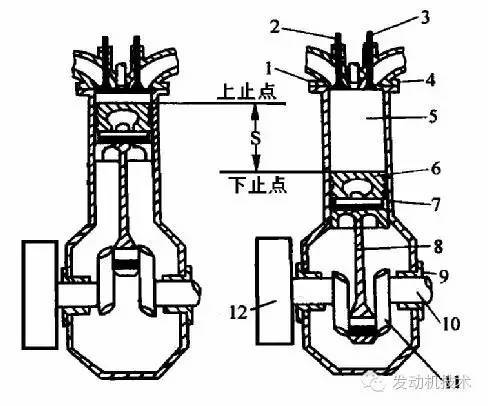
As shown in the figure, the basic structure of the internal combustion engine consists of cylinders, cylinder caps, gas entry doors, vents, jets, pistons, pistons, collages, rotors, flying wheels, etc。
Pistols are placed in gas cylinders, where the piston moves straight within the cylinders, which are connected through the poles and curves, which rotate around its axes。
Up and down: pistols are at the farthest from the centre of the arc, usually referring to the upper piston to the highest position (figures 1-1a)
2 down point: near the centre of the piston decorating axis, usually indicating the lower position of the piston to the lowest position (figures 1-1b)
3. Pistol process (s): distance between upper and lower stop points (mm)
4 the warp radius (r): the range of the warp distribution centre connected to the lower end of the pole (and the large head of the pole) to the rotor centre (mm); apparently, s=2r. The pistons move two trips each week。
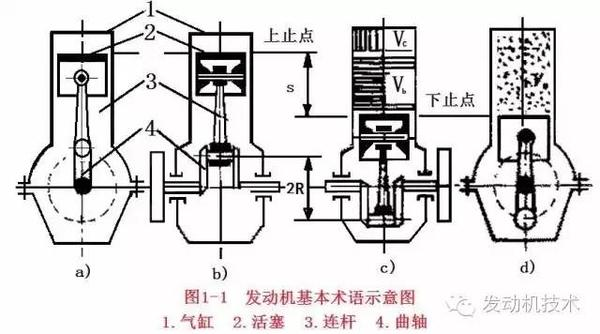
Work volume of cylinders (vh): space volume (l) through pistons from top to bottom; in formula: d-cylinder diameter (mm)。
6. Engine voltage (vl): sum of all gas cylinders (l). The number of cylinders with engines is i, then
7. Incendiary volume (vc): when the piston stops, the space above the piston is called the combustion chamber, and its volume is called the combustion chamber volume (l)
Total volume of cylinders (va): the volume above the piston is referred to as the total volume of cylinders (l) when the piston stops. It is equal to the sum of the work volume of the cylinder and the combustion chamber, i. E
9 compression ratio (ε): ratio of total tank volume to combustion chamber, i. E
It indicates the extent to which the gas in the cylinder is compressed when the piston moves from the stop point to the upper end. The larger the compression ratio, the higher the pressure and temperature of the gas in the cylinder at the end of the compression. The compression ratio for general petrol machines is 6-10 and for diesel engines 15-22。
10, work cycle of engines: a series of continuous processes (inflow, compression, operation and venting) in which thermal energy of fuel combustion is converted to mechanical energy each time it is carried out in the cylinder。
11, 2x2 engines: pistols complete a cycle of work called 2x2 engines。
12, 4-string engines: pistols complete a four-way cycle called 4-string engines。