As a result, client motivations and transformation paths are so diverse that a careful examination and improvement of each client's experience journey can provide opportunities for business growth。
Ii. Client conversion pathways for electrical platforms
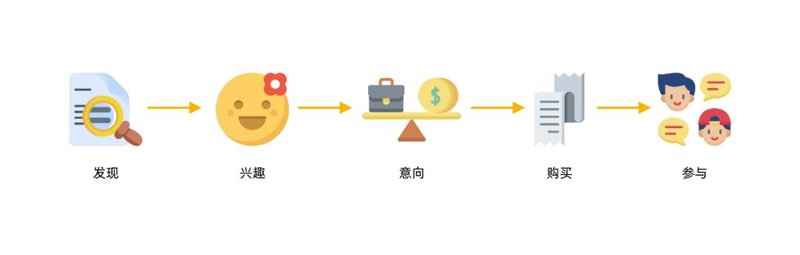
The electro-platform conversion process is a series of steps that visitors have gone through to enter the website landing page, starting with the outreach channel, to convert within the site。
In short, the transformation path is the process of becoming a customer from a visitor。
In general, there are five stages to the transformation path of the electrical platform:
Discovery: visitors log on to your website; interest: visitors look at products; intent: visitors add products to shopping vans; purchase: visitors buy products (becoming clients); participation: clients interact with brands and become faithful customers of brands。
There are differences between marketing and sales:
1. Non-linear transformation pathways for electrical platforms
Traditional concepts are linear in their understanding of the electrician transformation path。
But the real world does not always buy like this。
In fact, everyone has a unique path to purchase, and the process of transformation of each client through the channel is personal and non-linear, so you need to apply the path to the real way people actually buy in the real world。
Let's look at two hypothetical clients:
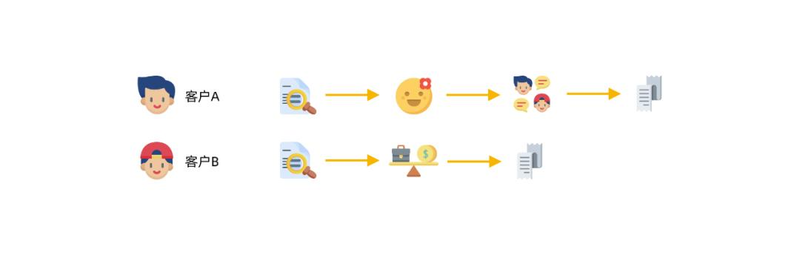
Each of your clients has different shopping habits and has different paths。
So how does it apply to all
Iii. Non-linear conversion paths optimization of clients
It would be unrealistic to try to sketch out a complete customer experience model for all, using a small sample or an oversimplified customer experience model。
Even “intentional” visitors do not necessarily “buy” directly to complete the transformation of customer identity, and the non-linear customer travel model integrates the multiple situations that visitors face at different stages from entry to exit, which are truly of commercial value in solving problems in the real world。
A non-linear conversion path for clients can be optimized by using the five stages of the transformation path of the traditional electrical platform as the blueprint for the journey, at each of the major journeys, to analyse the complexity and diversity of the different experiences of clients。
When you consider different clients going through transformation paths in a variety of ways at every stage, you can try to understand the internal and external drivers that influence clients in their decisions to purchase (e. G. Whether they are new or return visitors through user graphics or synonym maps):
Understanding and understanding of the actions of clients on your website allows insights and insights to be gained in order to improve their experience and transition rates. By mapping the situation in the real world, the transformation path of the customer electrical platform will go through the following five stages
As we repeat, each visitor's journey is unique and can be dismantled at each of the five stages of the experience journey to identify the non-linear client's journey:
1. Discovery phase
During the discovery phase, visitors simply realized who you were, what commodities you supplied and what they could solve。
The discovery phase is the beginning of the flow of visitors, and the core depends on whether you can successfully guide them through the remaining transformation routes。
From a non-linear perspective, you can see the diversity of clients' journeys, and visitors find you in several different ways, such as social media, advertising, commercial exhibitions or seos。
This phase is a gold mine that collects data on how visitors find you and how they interact with and experience the website。
At a later stage, you can analyse in greater depth the relationship between source and transformation。
At this stage, there are several ways to optimize the path:
How visitors can find your website: using feedback from visitors ' data to test which channels or marketing plans are effective and to invest more in effective channels or marketing plans. Develop a full-source marketing plan: communication with visitors across channels helps to combe user images of the website and channels for visitors to discover new brands. Read each visitor's journey: there is no so-called “right way” to attract clients, different visitors will find you from different sources, using quantitative + qualitative data to get more information about visitors. 2. Interest stage
At the level of interest, potential clients will be evaluated through your product characteristics, size, etc. They may visit your social media home page, look for your evaluation, and also visit websites and products。
At this stage, there are several ways to optimize the path:
Make sure you have a clear and visual navigation: are you able to browse from page a to page b on your website? If visitors encounter problems or obstacles in using them (e. G., error reporting on site 404, slow loading of pages or missing page elements), they are more likely to exit and close the pages before conversion. Ensure product categories focus on search intentions: can visitors find what they want on the website? Can they find the right product through the screening categories? Is there a product classification error? How can visitors become easier to convert? Through google analytics (ga statement), it is known that visitors most often jump out of this page, and whether it does not provide enough content to help them solve their problems. Create valuable content to respond to visitors ' questions: maintain visitors ' interest, address questions for visitors and promote transformation by creating presentations, case studies, operational manuals and blog articles to answer questions from visitors (i. E. Trust and remove obstacles!). 3. Intentional phase
During the intent phase, visitors showed that they had added goods to the list of shopping carts or wishes for later inspection and purchase。
At this stage, there are several ways to optimize the path:
Creating fluid shopping experiences: what elements can motivate visitors to add products or services to their shopping vans or wish lists? How are they feeling? Clients are questioned through on-site surveys, followed by reflection and optimization. Targeted e-mail is used to guide clients ' journeys: by sending targeted e-mails to inform visitors about specific products or services of the website and to guide the movement along the path that clients convert to. Personalized benefits corresponding to the list of desires: time-limited concessions or promotional activities are offered to potential customers to create a sense of urgency for them to purchase, based on the goods on the shopping van or the preferred list. 4. Purchase phase
In the purchasing phase, your visitor's official client
In order to increase the number of visitors arriving at this stage, you need to provide attractive commodity prices and a smooth payment process。
They are known to complete payments by clear appeal terms (call to action), such as “to buy immediately” (which can attempt to design the cta button, which attracts incentives for text, strong recognition of colours, or some conversion of state reactions)。
At this stage, there are several ways to optimize the path:
Create a fluid payment process: make sure that the flow of customers from the commodities page to the payment page is easy and easy, without any hindrance. For each visitor, the information on the client's preferential or promotional activities will be more sensitive than at the indicative stage, and the client's thinking can be reduced and the payment chain speeded up by proposals of maximum benefit. Various forms of payment are available: at this point, the client is in the final stages of purchase, and if you do not want the client's conversion to be terminated at this stage, please do not provide only one form of payment. 5. Participatory phase
At the participation stage, it is an opportunity for you to turn a single client into a returner and brand champion, but in reality, it is possible for visitors to interact with your brand at any stage of any transformation path。
At this stage, there is a need to maintain a strong relationship with visitors before and after conversion:
Encouraging visitors to focus on your social media and to interact: by providing valuable content to build trust with your visitors and clients, free samples or trial packages can be made available to those concerned, as required by the business model. Add visitors to your e-mail list: e-mail content that attracts potential clients and subscribes to products or services of interest to clients. Production of valuable content that attracts attention and participation: resolution of client problems and establishment of authority through sharing of video content, referrals, operational manuals and blog articles. Iv. How to analyse transformation pathways
Web-based analytical tools (e. G. Google analyticals, friends' leagues, mta) are a way to track the source of electrical platform indicators and flows, and you can use the setting of specific events to track the effects of specific pathways。
But how can the true journey of the client be reflected in the data obtained
As we explore the concept above, customer travel is not always linear。
We cannot simplify customer purchasing behaviour into a standard process in real life. Since each client's transformation path is non-linear and private, other ways of measuring client intent and experience are needed, and the way in which the transformation path is measured needs to reflect the journey of each client's real experience。
When the customer travels as a standard conversion path, you can use behavioral analysis tools to help you understand how the client goes through the transformation path by analysing qualitative data。
Qualitative + quantitative combinations, then, appear to be a good way of doing things when it comes to non-linear conversion paths。
Qualitative data can provide insight into how visitors view your website and what specific patterns of behaviour they display in the course of shopping, thereby improving their understanding of the individualized experiences of clients。
Quantitative data can be made more persuasive through behavioural analysis tools that help to answer questions about the behaviour and experience of clients on the website, such as:
The understanding of customer behaviour on the website helps to identify client pain points or barriers to client transformation, optimizes client travel on the basis of data analysis and provides clients with a more fluid and satisfactory experience。
Quantitative analysis helps you to know what's going on on the website, and qualitative analysis helps you to understand the causality behind it, helps you to optimize the client's journey and increases the conversion rate。
Summary
If you don't know how visitors experience the browsing process, then you won't be able to optimize the electrical platform's customer conversion path。
The trick of addressing low conversion rates from the root is to understand clients ' unique journeys through quantitative + qualitative analysis data and why they like (or hate) experience on your website? What are the barriers to conversion? What is the decisive factor in changing from a visitor to a client
References:
Oliver: three key questions: how does the electrician make the flow cash, increase the conversion rate, improve the performance of oosga: customer travel – definition, benefits, and the 5s framework for implementing the customer travel map know: how does the electrician website usually improve the order conversion rate? Cyber cats: what's a "customer experience journey"