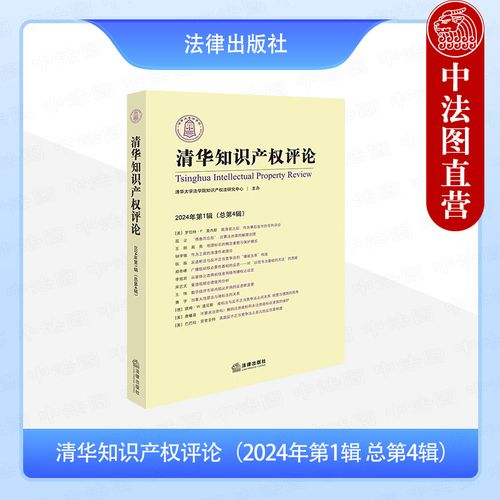
The qinghua review of intellectual property rights, with its central concept of “promoting intellectual property academic innovation to serve national innovation-driven development strategies”, is dedicated to building an interdisciplinary and cross-cutting platform for academic dialogue, with intellectual property rights at its core, radiation data protection, artificial intelligence, platform economy and other cross-cutting areas, and to exploring in depth the integration of traditional topics such as patents, trademarks and copyrights with emerging technologies. For example, a study on “advertising filtering” of the video site was published through the “web law monograph” column, which focused on the analysis of intellectual property conflicts in the internet industry in terms of technical ethics, market competition, consumer rights, and the role of patents and licences in the acquisition of external financing for innovation. The magazine emphasizes the forward-looking and realistic nature of the choice of topics, requiring that papers reflect the logic of decisions in typical judicial cases, such as the “no disturbing trademark dispute” and the “data ownership” “ai generating copyright recognition”。
The academic journal, which is a student-led editor, builds on the think tank resources of the qinghua university law school and the microsoft joint research centre and forms a collaborative innovation mechanism for “academic-student-substantive”. Its “100-chamber voices” column has been a permanent publication of the views of young scholars and senior experts, such as two papers on research on the regulatory effects of job inventions in germany and on the reform programme of the “on an ex officio review by the patent review board” system, which have been the subject of academic debate at the comparative law and institutional design levels. At the same time, the magazine promotes the deeper alignment of chinese academic discourse with the global intellectual property governance system through the translation of international frontier theories by the “voices overseas” column, such as the critical response of professor robert morjes to the intellectual property concept of utilitarianism. In addition, the magazine explicitly supports the contribution of a master's degree student, with 25 per cent of the submissions being received from young researchers over the past three years, leading to an academic legacy model of “old and new”。
Qinghua review of intellectual property rights
Studies, literature reviews, briefings, thematic studies
Subscriptions to the qinghua intellectual property review
In beijing, the city of tondai is located at no. 7 sicily
Information on contributions to the qinghua intellectual property review
1. The text should be reliable, accurate, creative, scientific and practical. It should be novel, well-argued, reliable, self-responsible (absolutely forbidden) and refined。

2. The names are listed in chronological order under the subject matter and shall be determined at the time of the submission. The name, unit, address and postal code of the author must be made clear, and the signature of the multi-author must be done with the consent of the other author, in order that it is not changed after the written notice。
3 the article requires that the 2000-2400 character be used in a format that generally includes: title, author and unit, postage, executive summary, keyword, text, references, etc. The article title character requires within 20 words。
4 the charts in the articles should be typical, as few as possible, and the three-line tables should be used; the drawings should be black-lined and the lines drawn should be smooth, smooth and fine and even; the unit of measure should be based on the legal unit of measure of the people's republic of china, recently promulgated by the state council, and should not use illegal units of measure。
In order to shorten the publication cycle and reduce errors, the presentation is always in the word format, with a detailed indication of the contact details of the person. The review cycle is normally five working days, and authors can also call in order not to prejudice normal publication。
6. The editorial department has the right to make deletions of the text and may not agree to such deletions. I am also listed in the database of various academic journals in the country and do not agree with the entries. After publication, two volumes of the current magazine are presented。
Qinghua intellectual property review model
(c) study on invalid defences in patent infringement proceedings for falcons;
Confucian ethics and weak norms — a moral ethics perspective from han yan li;
(a) the significance of the ethos of the confucian family for moral construction in a harmonious society;
The online booking of taxis for local license plates and residence restrictions is subject to review and regulation;
A comparative analysis of the term “inherent value” in the ecological theology of john cobb, jr;
(a) modern interpretation of the filial ethics of the confucian family - from the sheeps case to the sheep case and the hueju case;
(a) the bitterness of self-confidence — since the dawn of late dawn, chinese cultural conservatism has re-examined sun sung takeh;
(a) the role of patents and licences in innovative access to external financing, dietmar harhoff;
(a) the philosophies of human ethical vision — an issue of cultural self-confidence and moral construction;
On cultural criticism and reconstruction in the realm of cultural hegemony - modern thinking of the theory of the hegemonics of the granci culture;
(a) tunnel light: the three and a half years of harmony in history - a study based on the ethical dimension of harmony, liu changming;
The value of the beauties in the ethical construction of villages - one of choi kiming's research and studies in the field;
On the “secular moralism” of hobbes — a rebuttal to the ethical foundations of the hobbes political system;
(a) the study of the rationale and reform programme of the prc's “ex officio review and rebuttal” system;
Zhang yang's reflections on the causes of and responses to the current phenomenon of moral kidnappings — prompted by the events of the 100 birds of the phoenix film;
Promotion of a culture of excellence and enhancement of the moral qualities of citizens - a reflection of wang runin on “cultural self-confidence and moral building”;
(b) the assessment of the dispute over the advertising of the gadobo group v. “fear of fire” - a discussion of the attribution and protection of unregistered commercial signs;
Cultural self-confidence - the creative transformation of the traditional values of chinese culture and the establishment of the core values of socialism
On the people-centred path of china's identity democracy — a brief introduction to xi jinping's enrichment and development of china's identity's socialist democratic ideology, sun minch;
The empowerment base of property rights in the big data age information pool, starting with the “relationship” of data and information in the larger data life cycle;