


Lithium cell production is highly sensitive to humidity, and hydrologic associations react with lithium hexafluorophosphate (lipf6) in electrolytic fluids to produce hydrogen fluoride (hf), causing problems such as battery drum casings and sei membranes. For different material systems, the humidity requirements vary significantly from process to process。
Low-moisture processes: core components such as aqueous fluids, seals, need to show a temperature of thorium-40°c (corresponding to a relative humidity of 0. 6%) close to an absolute drying environment。
Different material systems: in the electrode segment and in the assembly section of the lithium phosphate system, the wetness of the workshop (20%20% rh) is lower than that of the triary system (露-35°c)。
I. Types of dehumidifiers and working principles commonly used in lithium battery plants
1. Rotating dehumidifiers (sorting dehumidifiers)
Core structure: composed of sorbent rotors (silica glue, molecular sift or lithium chloride coating), regenerators, wind processors, etc. Rotation is divided into humid and regenerative areas with continuous dewetization by rotation。
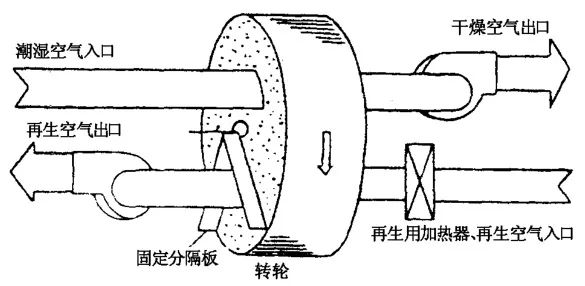
Motion of work:
Wetting phase: wet air is captured by adsorption materials and dry air is excreted through humid areas in rotors。
Regenerative phase: rotation to regenerative area, heating of high-temperature air (120 - 140°c), release of adsorbed water and discharge out of the room。
Advantages: visibility can be as low as -60°c, applicable to very low humidity requirements; high stability, suitable for large-scale production。
Applications: high-precision processes such as aphrodisiacs, seals and electric core baking。
The relatively large number of dehumidifiers currently used in the new lithium ion battery plant is the recycle dehumidifier。
Refrigerated dehumidifiers (cooled dehumidifiers)
Principle: the air is cooled below the point of depression by evaporation, the water condensation is released and the heat is reheated by the condenser. Typical equipment such as the zd-8240c series。
Limitations: presence of a minimum of 10°c is not sufficient to meet the core process needs of lithium batteries and is used more for a support area of 10% relative humidity (e. G., mixing workshop)。
3. Complex dehumidification systems
Technical pathways: phased treatment of air in combination with refrigerated pre-cold and rotor adsorption. For example, air moisture is reduced first by freezing dehumidification, then energy consumption is reduced by deep dehumidification using rotors。
Application: applies to scenarios that require a balance between energy consumption and extremely low exposures, such as three-dollar material production lines。
Ii. Discrepancies between single- and dual-rotation-wetting machines
The rotor dehumidifiers at lithium ion-cell plants are generally divided into single and double-rotation wheels based on the number of rotaryers。
1. Single-rotation dehumidifiers
The single-wheel dehumidifier is continuously dehumidized based on adsorption-regeneration cycles, with the following core processes:
(1) the humid air during the treatment of air adsorption enters the rotor treatment area (approximately 270° sector) through initial filters and surface cold segments (pre-calculation to below dew temperature). At this point, the water in the air is captured by physical adsorbing to dry air by wetting material (silica glue or molecular sifting) painted on the rotor surface. Dry air is processed and transported to the target environment, and moisture can be reduced to the point of dew - 30°c to -40°c。
(2) after recycle recycle saturation, slow transfer to regenerative areas (approximately 90° sector area) at 8-18 week/hour rotation speed via the power drive. The regenerative zone flows into the regenerative air from 120 ~140 °c (usually external new or partially dry air), which releases moisture from the humid material and removes the wet air from the regenerator. Recycled re-entry re-enters re-wetting capacity and re-enters processing areas for recycling。
(3) the dry air during the temperature-moisture control phase is adjusted to the target temperature humidity (e. G. The constant temperature and humidity required for the production of lithium batteries) after the pass-through of the surface cooling segment and the heater, and is eventually transported to the workshop through the wind transmitter。
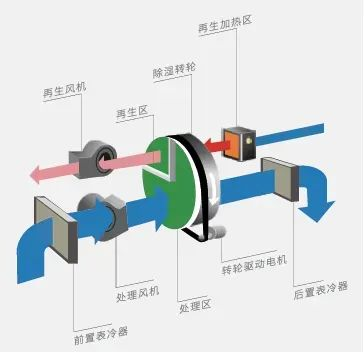
Key features of single-wheel-dehumidifiers:
The structure is simple and requires a single wheel, a surface cooler and a renewable heating system。
Regenerative energy consumption is high (extraheated and new winds are required) and the control of spot is limited (minimum -40°c)。
Scenes applicable to medium humidity requirements, e. G., front-stage processes such as coating, mixing, etc。
2. Rationale for double-rotation dehumidifiers
The process of double-rotor dehumidifiers, which achieve ultra-low spots through two-stage adsorption-regeneration, has five phases:
(1) the pre-treatment of the front cold segment uses 7 °c frozen water to cool the new or returning wind below the dew point through the copper tube aluminum fin table chiller and to disintegrate a portion of the water (reducing subsequent rotor load)。
(2) air pre-colded by first rotor adsorption (primary wetting) enters the first rotor treatment area, absorbs most of the moisture and forms the primary dry air (premise point - 30°c). At this point, the saturated portion of the rotor saturation is transferred to the regenerative zone and dehydrated by high-temperature regenerative air。
(3) the secondary cooling of primary dry air by surface coolers in the surface cooling segment in (3) further cooling and filtering to ensure clean air。
(4) the second rotor depth adsorption (sub-wetting) air enters the second rotor treatment area, adsorbs the remaining water, and may end up below -60°c. The regenerative zone uses the reverse high-temperature regenerative wind (from the high-temperature dry air following the first rotation) to reduce renewable energy consumption through heat recovery。
(5) heated wind-band processing of ultra-low-earth air by rear-surface cooler, heater adjusted for temperature and into a high-precision environment (e. G., a liquid workshop)。
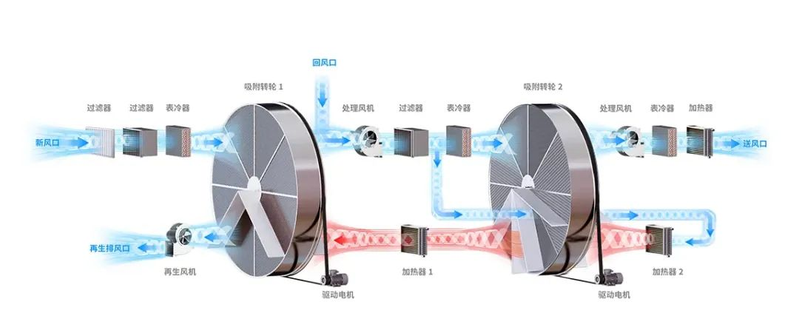
Key features of double-rotation dehumidifiers:
Double-rotation synergetic work: the first round carries the main dewet load and the second round achieves deep adsorption。
Regeneration of thermal energy: second-rotation regenerative wind comes from high-temperature dry air following first-rotation treatment, reduces external heating demand and saves 30% - 50% of energy。
The spot is even lower: it can be up to -60°c to meet very low humidity requirements such as lithium battery seals, electric core baking, etc。
Iii. Core differences between single and double-rotation dehumidifiers
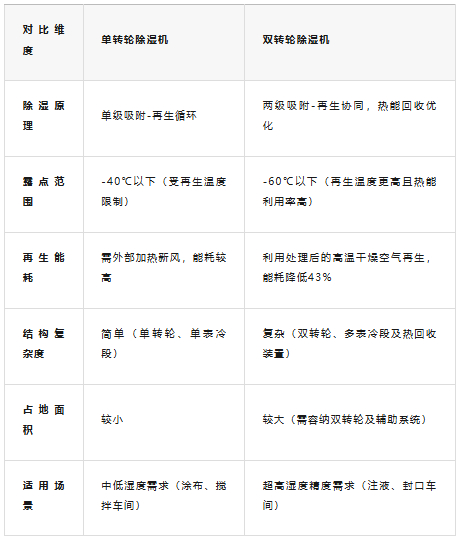
Iv. Technological extension and selection recommendations
1. Material innovation: double-rotation rounds mostly employ titanium-based molecular sifting or modified silicone, with a wetting efficiency increase of more than 20 per cent and a lifetime of 8-10 years。
2. Smart control: two-wheel system integration point sensor and dynamic adjustment algorithms, with humidity fluctuations contained within ± 2°c。
3. Energy-saving design:
Single-rotation wheel: reduce renewable energy consumption through residual heat recovery or solar-assisted heating。
Double-rotation wheel: 50% combined energy efficiency using heat storage, high-temperature dry air pre-heat and wind regeneration。
4. Selective strategies:
Single-rotation wheel: a small and medium-sized lithium battery plant with an annual capacity of 5 gwh, or a process with low humidity requirements。
Double-rotation: a large-scale plant is recommended for high-end production lines such as high nickel, solid batteries, or annual capacity 10gwh。
The core difference between single and double-rotor wetter is the adsorption hierarchy and thermal efficiency. Single rotations have simple structures and low costs, while double rotations achieve breakthroughs at very low-emission and energy-saving dimensions through two-stage adsorption and thermal recovery technologies。
Summary
The dehumidifiers at lithium battery plants achieve moisture control through technical pathways such as adsorption, condensation and so on, in which rotor dehumidifiers become the mainstream choice because they can stabilize to ultra-low point. At its core is the optimization of the performance of humid materials and the improvement of system energy efficiency, which will continue to evolve in the future in the direction of intellectualization and energy conservation to meet the higher requirements for accuracy and cost of lithium cell production。
These are my daily work, my exchanges, my reading literature, my limited capacity, and the absence of ideas in the text, and the positive interaction and progress of my colleagues in the industry
References (lithium electrocode database downloadable):
1. Consolidated german dehumidification product book
Original title: what is the working method of the wetter in the lithium battery plant



