As an important stage in developing children's learning habits and attitudes, primary schools require proper guidance and supervision from parents to help children to grow up better. What should parents do to prepare their children as they approach school? Let's look at the start-up strategy and language learning lessons that the teacher has drawn up
Foreword
School is about to start, and every grade has to move on to a new grade. How do the kids adjust? What kind of preparation do parents need? Here's what the teacher suggested:
First grade
From kindergarten to the first grade of primary school, an important turning point in children's lives. Parents need to help their children to take the first step of primary school life and adapt them more quickly to primary school life. It may be useful to refer to the following:
1. To stimulate children's interest in school attendance. Parents may hold a “family meeting” with the child and make a serious conversation with the child. Having grown up to be a primary school student, the child needs to be asked to be a primary school student and to inspire the pride and pride of the child as a primary school student。
2. Fostering awareness of child rules. In primary school, the child is subject to the discipline of the school and to the management of the teacher. Pre-school parents and their children have to stress the importance of observing the rules and adapting their children to the differences between school life and kindergarten as soon as they are enrolled。
3. Exercise child self-care. After primary school, there are many things that parents cannot do for their children, ranging from packing school bags to tying shoes. It is therefore necessary to work with the child at home in advance, starting with small things, so as to enhance the child's self-reliance。
4. Train children to sit quietly. In primary schools, formal subjects are taught, with children attending kindergarten studying in games and playing in them, and now in classes for up to 40 minutes. Parents can sit quietly when they consciously prepare their children, starting with 20 minutes and then gradually extending。
5. Adjustment of the child's time off. The family's rest time should be brought into line with the school and appropriate adjustments should be made in diet and living conditions. Every day, the child is directed to early sleep and is kept in full sleep. Adults also spend as much time as possible with their children。
Make a card for the name of the child. In order to enable teachers and classmates to know each other as soon as possible, parents can make a “name card” (or “name sticker”) for their children to enter primary school for the first time, at the corner of the school table, or not on the chest like a chest flower。
Preparation of learning aids for all sections. Supplies to be prepared: 5-8 or so hb pencils, 2 easy to erase rubber, pencil bags, straight feet, pen knives, school bags, artwork, etc。
8. Stay with the children. There is a new column in the curriculum, reading with adults. There are eight modules, each of which has one co-reading article, mainly fairy tales and fairy tales. These articles can be read to children well in advance: p17, " little white rabbit and little grey rabbit " , p39, " window flowers " , p53, " little bird book " , p65, " little squirrel for peanuts " , p78, " carrots " , p97, " who flies " , p97, " monkeys for moon " , p114, " spring sage " 。
Of course, in addition to fairy tales and fairy tales, parents and children are also advised to read the ancient poems together. There are six ancient poems in the curriculum, namely, " the goose " , " the painting of gangnam " , " the compassionate farmers " , " the wind of the ancient month " , which are interested in continuing to read together with their children。
Second grade
The second grade is an important transition period for children to learn their interest, habits and attitudes, but to move from being more plastic to becoming stereotyped. This phase needs to be prepared in these areas:
1. Continue to strengthen pacifism. Lifetime is both a guarantee for the child's growth and development and a good habit for the child's life. A man can be normal at all times, and his self-control must be very good。
2. Improved physical activity for children is all that can be achieved with health. The curriculum for the second grade is somewhat more difficult than for the first grade, and we allow children to learn while at the same time taking care of their health and their will。
3. Development of good character for children. We need a consensus that being human is always more important than learning. Don't let the child become a selfish, lazy, lying, fearless, irresponsible person。
4. Teaching children the ability to live. We all need to teach our children the skills we need to learn in life: self-care, security awareness, friendhood, human ability to live, ability to speak, ability to protect ourselves, etc。
5. Strengthen child writing training. Grades i and ii are critical periods for children's writing habits. Good writing is not only a child's way of doing things, but also enhances children's interest in learning and self-confidence in life。
6. Increasing the speed of child work. Mathematics in the second grade is mainly a simple calculation and application, and parents and friends can allow their children to do 10 computational questions per day, taking care of time limits and the method and correct rate。
7. Take more children to observe life. In the post-2020 epidemic era, it is not appropriate to travel far. Parents and friends can take their children to their own cities, go to rural homes and experience their lives, see the trees and feed the puppy chicks... And, of course, when you take the kids to the world, don't forget to talk。
8. Stay with the children in school. Both parents and children need to read, learn and progress. So let the child read! Read with the child
In any event, making use of the pre-school hours, planning learning and mentoring programmes, capturing this critical stage and developing a child's commitment, diligence and sensitivity to learning will make it easier for the child to learn in the years following the primary school。
Third grade
The third grade is the first watershed in the primary cycle, with increasing difficulty and learning in all subjects and a gradual shift from simple and repetitive transcription to more abstract understanding and analysis. In order to help the child survive this first transition period in primary school, it is necessary to:
1. Adjusting the right mindset. As parents, there is a psychological preparation: in the lower grades, our children can get more than 90 points. How can we get more than 80 points in the third grade? This is due to the addition of not only the strategy module but also the practice module, starting in the third grade. Clearly, learning is becoming more difficult。
2. Improved self-control. In the third grade, learning pressure increases, difficulty increases, recreational time decreases, and children tend to become impulsive and have high academic performances during long periods of study. At this point, parents must not be impatient, step by step and guide them slowly。
3. Clear learning goals. There are two goals here: the first is the long-term goal, the ideal. The second goal is immediate and can be achieved within a week or two through child efforts. Once a goal has been achieved, a new one will be set, giving moderate pressure to the child. Children are young, the stakes of many things are not known, learning is not well understood, and they are reluctant to invest in textbooks. That is why we need to put appropriate pressure on students, not to allow them to act with complete freedom. We need to be clear about the meaning of learning in a variety of ways and try to stimulate their learning initiatives from the positive side。
4. Knowledge of learning methods. It is important to learn to apply knowledge in a flexible manner and to transform difficult issues into well-known topics. In the case of child guidance, the child should not be told the full answer and the subject should be consciously divided into several steps, which would make it easier for the child to complete it。
Emphasis on pre-schooling. In third-grade languages, the basics are still dominated by words, vocabulary, sentences and sections, beginning to be extended to chapters, while the competency component begins to focus on analytical reading and writing. During pre-schooling, a conscious habit of using tool books is developed, the texts of which are read in advance and where they are not understood. It's hard to mark and listen in class. It is important to recall that pre-schooling does not have to be exhaustive, but that it is important to capture both the focus and the difficulty. In general, after-school subjects are the best idea for pre-learning。
6. Correct use of pens. The third grade begins with a pen, which is written in the same manner as a pencil, but with some difference in use (eye one foot from the book, chest one punch from the desktop, finger one inch from the pen)。

7. Emphasis on reading accumulation. In cases where words cannot be dropped, students are encouraged to read more and are required to accumulate, not just to read, but to take notes. It is important to develop good digestive habits, as the saying goes, “read a thousand rolls and have a god in the next pen”。
8. Adhering to read together. The ancient poems and the accumulated parts are essentially traditional cultural knowledge, which is difficult for children to understand, but are also difficult and important for the basics, which can take more time to read, recite, hear and write, and to reduce stress during normal classes。
In sum, the transition from second to third grade is a polarized phase, with the content of the curriculum shifting from fostering interest in learning to systematic learning with a great deal of knowledge。
Fourth grade
The watershed is gradually taking shape after the third to fourth grade, which, in terms of learning habits, is a stereotyped period for children, and learning habits will begin to be gradually consolidated. At this point, it is normal that the child's performance has fallen occasionally, and the key is for our parents to help them right. How do you learn languages at this stage? First of all, four graphs have a complete impression and understanding of reading, learning, oral communication, comprehensive learning, etc., on the four integrated materials。

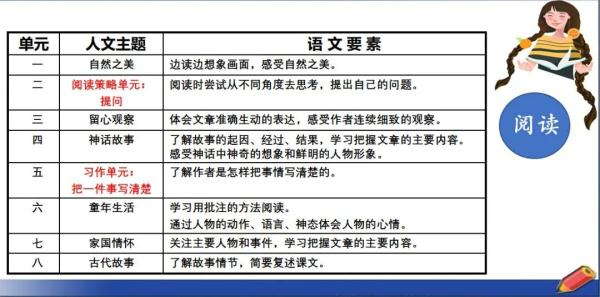
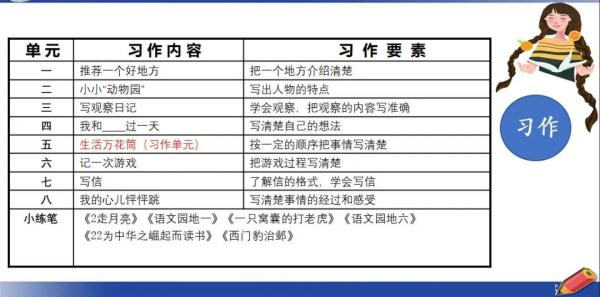
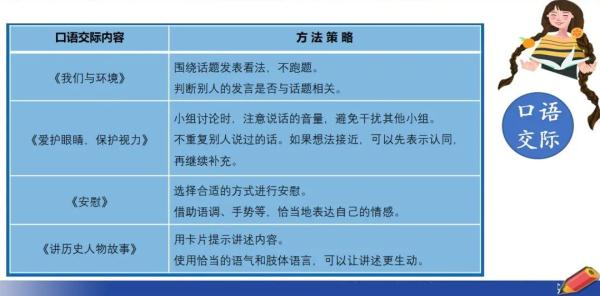
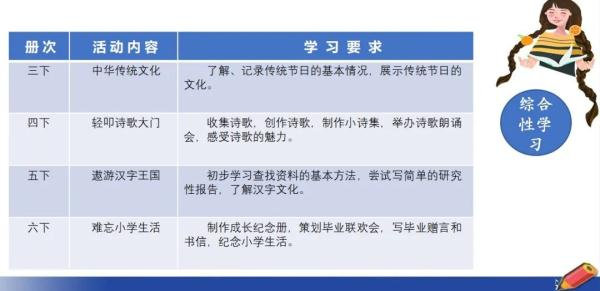
As can be seen from the specific presentation of the material, it is becoming increasingly difficult to move from third to fourth grade, and it is clearly unrealistic not to work hard to achieve good language retention。
Extracurricular reading: continuing to promote “mass reading”
In-school reading: focusing on “question strategy”
Practice teaching: the effective provision of “learning support” (design, selection, expression, modification, etc.). Focus learning: write things in order; focus on what matters。
4. Oral communication: content to communicate and express themselves vividly
5. Integrated learning: clarifying learning mandates and implementing activities as required
As learning becomes more difficult, it becomes clear to fellow students in third to fourth grade that language is no longer as easy to score as before. The fact that fourth grade students are at a stage of transition from image thinking to abstract logic thinking, that language learning is a transition from words to chapters, and that students play an initial role at the primary level, both in terms of psychological development and learning habits, is both difficult and important。
Fifth grade
In the fifth grade, this is the key to children's learning, as children in the fifth grade begin to move into the upper grades of primary school, and if basic knowledge is not solid enough, it will be hard to follow. This phase requires learning to take stock of the knowledge points and to find links between them in the process。
Good habits must be upheld. Maintain: pre-school, full pre-schooling; in class, listen carefully, think positively and work hard on notes; after school, organize exercises in a timely manner and review them regularly. Remember; it becomes content, and it remains adherence。
2. Basic knowledge needs to be consolidated. At the primary school level, regardless of the stage, basic knowledge of languages must be solid, such as four-part writings, texts, ancient poetry, and mastery of breasts。
3. Learning methods should be flexible. Parents are required to develop the most appropriate learning methods for each child according to the needs of each child and to help the child develop fully and effectively. We should, of course, take care of children's studies and help them to progress。
4. Timely organization and consolidation. It is important to have its own consolidated version, to insist on doing one question per day, to understand one question, to practice a scrambling exercise, to network knowledge points, to ask one question or another。
5. Learning plans will be developed. Everything is set aside. In order to enter the advanced years, learning autonomy must be continuously enhanced。
Sixth grade
Upon reaching the sixth grade, the child is about to start the first grade, so it is important to make full use of the time available before starting school to achieve a qualitative leap. It may be useful to refer to the following:
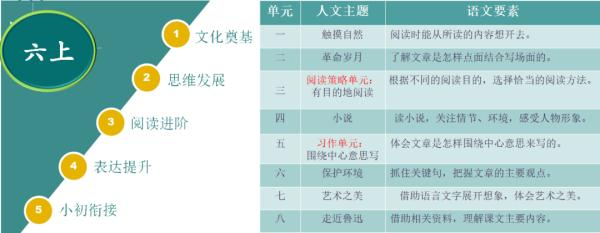
1. Good knowledge interface. To enter the sixth grade, a new round of “carpet” studies will be launched to map the knowledge threads of primary schools, which will enable students to re-integrate and integrate the knowledge of grades 1 to 6, form clear knowledge networks, establish a stable knowledge framework and conduct a systematic review of basic knowledge。
2. Maintain classroom notes. It is essential for children to have a good habit of listening, writing, thinking and writing, so that they can be better absorbed and used in the classroom, and so that they can develop good learning habits after they enter secondary school。
3. Training in speech expression. It would be preferable for the child to have a certain amount of time per day, such as reading the text loudly in the morning, and to read the main text in the language and english text books, and to be persistent and accustomed. In this way, the child speaks in a manner conducive to his interpersonal interaction。
4. Promotion of wide reading. Up to the sixth grade, “wide reading” is promoted on the basis of “heavy reading”, in addition to literature such as fairy tales, fairy tales, fairy tales, children's stories, fable myths, comic books, classics, etc. It is recommended that children should be allowed to read within the prescribed time frame and then be allowed to write “comments” directly in their books and to write “past-readers” so that they can read together and have an increase in the breadth of their ideas。
5. Selection of target secondary schools. Targeted junior secondary schools are selected well in advance, with a better understanding of the enrolment requirements of the target junior secondary schools and a more targeted increase in student capacity。