Hey, everybody, i'm signing up, i'm sharing things for you every day. Everything's a big deal. If you think it's useful, leave some attention
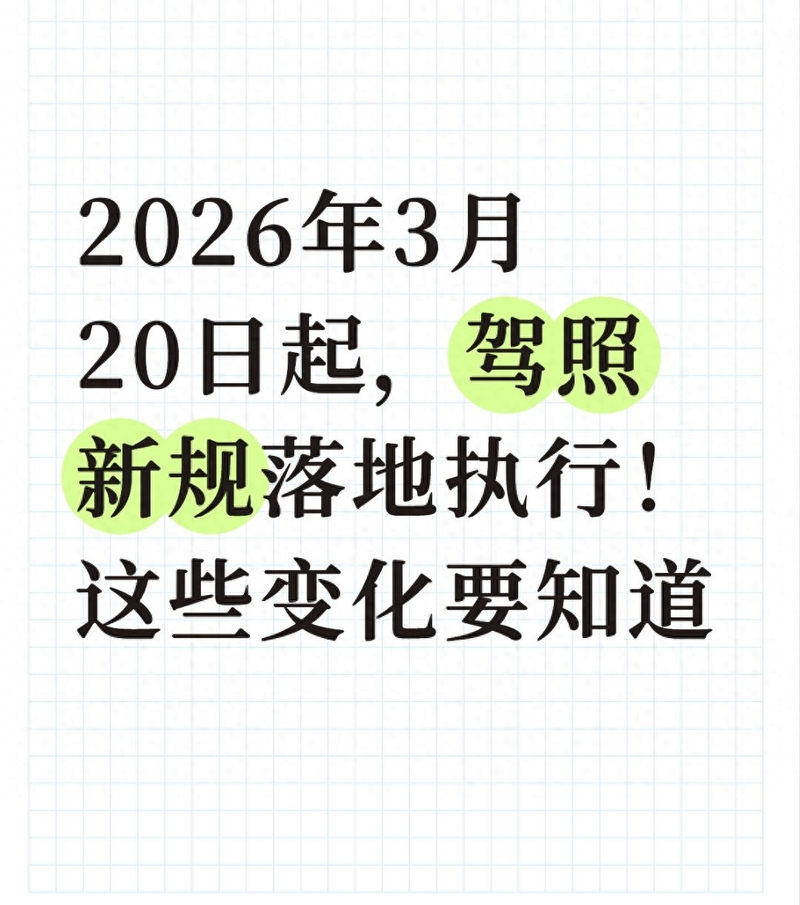
As long-term self-commuting workers in shandong, daily travel is closely linked to driver permit management policies. On 20 march 2026, the national unified driving permit management and the new rules governing road transport officially landed. The two authoritative policies were synchronized. They covered the entire spectrum of private driving, professional driving, registration for driving, document processing, age management, driving process, etc., without geographical differences or pilot differentiation, and were implemented simultaneously in municipalities in shandong province. This is an adaptation to focus on the public, scientific management and safety floors, to optimize a number of processes that have long plagued the driver, to clarify the precise rules of age and proficient driving, and to make the use, processing and examination of driving permits more efficient and humane. This document is based on decree no. 172 of the ministry of public security and official document no. 4 of 2026 of the ministry of transport and communications, which regulate all core changes in plain language and facilitate rapid mastery and compliance by each driver。
I. Basic information on the implementation of the new regulations: national unity, authoritative compliance, automatic application
This new regulation on driving permits, which was set up on 20 march 2026, contains two sets of rules for the management of driving permits in the public security sector and for road transport operators in the transport sector, all of which are subject to public consultation, ministerial review and adoption, and are national legal norms, all of which are based on ensuring road traffic safety, taking into account the needs of the population and industrial development。
At the level of public security, pursuant to the decision of the ministry of public security no. 172 of 21 december 2024 on the revision of the regulation on the application and use of motor vehicle driving permits, emphasis is placed on optimizing the age of application for a driving permit, the restrictions on the use of a driving permit, the procedures for the examination of elderly drivers, the process of relocation and the simplification of additional driving. This covers all motor drivers, and the new rules apply automatically to persons who already have a driving permit。
At the transport level, in accordance with the decision of the ministry of transport no. 4 of 2026 on the revision of regulations for road transport practitioners, issued on 6 february 2026, the upper age limit for the operation of operational road passenger and cargo transport operators, transport operators, drivers and trainers is adjusted simultaneously to bring it into line with the age limit for driving permits and to safeguard the legal rights and interests of professional drivers, which has been in force throughout the country since 20 march 2026。
The two policies cover a wide range of people, including drivers of small cars, medium and large buses, persons aged 60 to 69 who are still driving medium and large vehicles, groups over 70 years of age who wish to apply or continue to drive small cars, drivers of blue trucks, mobile persons who work, live, study cars abroad, and all drivers who need to obtain permits, exchange certificates, examine and increase their driving, each of which is directly related to daily travel, professional development。
Ii. Scientific optimization of age management: elimination of one-size-fits-all management by vehicle type and capability
The most central change in this new regulation is the adaptation of the past “one size fits all” management model to a “car-type, competency-based assessment” refined model, which relaxes reasonable limits while maintaining a safety threshold, enforces differentiated age rules for different driving models and accurately matches driving needs and physical conditions。
(i) small cars: elimination of the 70-year-old ceiling and dual management over 70 years of age
C1, c2, c5 (small auto-stop cars for persons with disabilities), a light motorcycle driver's licence, formally abolished the age limit of 70 years, and persons over 18 years of age who meet the requirements may apply and no longer lose the opportunity to study or drive because of age。
The driver of a motor vehicle over 70 years of age is subject to double management of the medical examination plus triple test. A medical examination is required every year and, within 30 days of the end of the score-taking cycle, a certificate of physical condition is submitted to a medical institution; the examination is conducted in accordance with the requirements for memory, judgement and reaction tests, both of which can pass the test and continue the legal driving. The triple test is based on basic cognitive and reactive judgement, and the process is simplified and can be handled in community health centres, district and above, without requiring a line-up to and from large hospitals。
It is also made clear that drivers over 70 years of age are not allowed to drive low-speed cargo vehicles, three-wheelers, light tractors, ordinary three-wheeled motorcycles, ordinary two-wheeled motorcycles and, if they have the relevant permit to drive, they are required to obtain a driver's licence in the form of a light motorbike or a small car in order to ensure safe travel。
(ii) truck, medium or large: the maximum age for admission and permission to drive was increased to 63 years
The maximum age limit for the granting and granting of driving permits for buses, heavy tractor trailers, urban buses, medium buses, large trucks (class a, b) is increased from 60 to 63 years of age, and drivers of 60 to 63 years of age who are qualified in physical condition and do not have a record of serious traffic violations, may continue to operate legally large and medium-sized vehicles without having to be demoted。
A driver of category a or b above the age of 63 years shall be required to obtain a small car or a small auto-stop driver's licence, in which case a heavy towed-mounted driver's licence may be retained in a light tow-truck-a-car. If an application is made for an extension of the original driver's licence, the application must be made to the place of origin or place of residence within one year of reaching the age of 63, for a maximum period of three years, in consultation with the hotline served by the local station。
(iii) road transport practitioners: the upper age limit for employment has been adjusted to 63 years
In line with the age rule for driving permits, the upper age limit for operating road passenger and cargo transport drivers, road transport operators and drivers ' trainers is adjusted from 60 years to 63 years of age. Persons over 63 years of age may not continue to engage in related road transport activities, harmonize the management of driving permits with that of the industry, avoid policy conflicts and safeguard the legal employment rights and interests of professional drivers。
Iii. Comprehensive equipment in the country: one pass, zero movement outside legs
For a long time, the problems of off-site study vehicles, replacement certificates, change of certificates, review of the need to return to the domicile, and submission of residence certificates have caused many inconveniences for mobile workers. This new system, which is designed to fully break geographical restrictions, will make it possible for all high-frequency operations to be carried out with a single driver's permit operation, with a single permit, which will be greatly simplified。
(i) one test: no residence certificate for foreign study cars
The first application for a c1, c2, c5, and light towed vehicle driver's licence is directly registered in any municipality in the country on the basis of his/her identity card, without the need to submit additional information such as a residence permit, a residence certificate, a social security guarantee, etc., and residents of hong kong/australia enjoy the same policy on the basis of their residence permit. The school may not add an additional threshold for registration, which requires only identification cards, proof of physical condition, photographs of documents, transparency throughout the course, and the elimination of any fee for non-compliance from the source。
(ii) expatriate sub-curricular examinations: the number of changes was eased to 3
The policy on the off-site division of small car driving permits has been optimized, the number of applications for change of venue has been eased from one to a maximum of three, and the results of qualified subjects have been recognized across the country on a national basis without re-registration or duplicate payment. For example, in the first subject of the civil registry, the second and third subject of the current residence can be continued with the job transfer, the remaining examination can continue with the change of residence, and the whole route can be handled through the “transfer 12123” app, without running a window, so as to fully address the problem of changes in work and the impact of alien living on the progress of the school car。
(iii) compensation, exchange of certificates, examination: available at any point throughout the country
Hf operations such as driving permit renewal, loss of replacement certificate, damage certificate exchange, information change, file transfer, examination, etc. Need not be returned to the place of origin. It can be handled by any car control office, the transfer window at the government service centre, the police post cooperation network, the self-service terminal, which can be processed on the basis of an identity card, on-the-spot closure, on-site identification, and partly in support of mail delivery. It is easier online, with applications submitted through the “turkage 12123” app, medical examination information, document photographs being automatically re-used, so that the business can be completed without sufficient household space, the electronic and paper driving permits having the same legal force and the day-to-day inspection and processing of the operation。
Iv. Significant streamlining of the additional driver process: waiver of double-checking and elimination of similar vehicle-type internships period
Driving permits are a common requirement for many drivers, and in the past they require re-examination of all subjects, internships and time and effort. This new regulation optimizes the process of driving additional vehicles of the same type, reduces the repetition of examinations and reduces learning and time costs, while maintaining the safety test bottom line。
(i) exemption from theoretical subjects, with practical learning only
C2 additional c1, c1 additional c6 (light towed vehicle) and c1 additional motorbike car-academic driving scenes of the same type, exemption from the first (road traffic safety law, regulations) and fourth (safe civil driving commons) theoretical projects, only for subjects ii (scene driving skills) and iii (road driving skills), shortening the learning cycle, reducing training costs and avoiding learning from acquired theoretical knowledge。
The basic requirements are met for additional driving: one year for the original driver's licence, 12 minutes for the most recent score cycle, physical conditions that meet the requirements of the new semi-drive model, disease, physical defects that prevent safe driving, and no serious traffic violations that are not processed。
(ii) abolition of the same type of additional driving internship period
Once driving the same type of driving permit, the 12-month internship period is no longer in place. The permit is allowed to travel normally, without the need to observe the driving restrictions during the exercise period, and the driver is allowed to travel directly to the high-speed, driver-to-drive mode to meet the immediate driving requirement. The increase in different types of vehicle is still being carried out in accordance with the original requirements, with the possibility of consulting local traffic authorities。
(iii) simplified c6 additional driving conditions
The c1 driver's licence increases the c6 light tow truck, which requires a reduction in driving age from three years to one year. The most recent score cycle has no record of 12 minutes. It is sufficient to pass the commons of security and civilization test. It is not necessary to take the first subject. It is easy for drivers who need to drive a rv to quickly obtain a permit to match the new needs of travelling and living in their homes。
V. Blue truck drivers are down: dual certificates cancelled and operating costs reduced
With regard to ordinary blue-licensed trucks of a total mass of 4. 5 tons, the new regulations provide for a reduction in the cost of transport to individuals, the formal cancellation of road transport permits and driver's qualifications and the holding of a c1 and above permit for the legal transport of ordinary goods, without the need for annual examination of the business qualification, training in the trade and payment of related fees, a significant reduction in the operating costs of individual transport, urban and rural distribution, small-scale operations, a simplified road inspection process and a more efficient journey。
Large- and medium-sized trucks and vehicles carrying dangerous goods are still required to obtain the relevant documentation, comply with industry regulations, guarantee the safety of road transport, specific documentation processing and verification requirements, and advise local transport service hotlines。
Vi. Optimization of the rules of review and exchange of certificates: simplified processes for the benefit of the people
(i) detailed rules of review with clear scope for waivers
Drivers holding category a and b permits are required to undergo an examination within 30 days of the end of each score cycle, and are exempt from the examination of this score cycle if they are not recorded in a score cycle. Drivers who hold other driving permits and who are equally liable for more than one person's death as a result of a traffic accident and have not been revoked are subject to an examination within 30 days of the end of the crediting cycle。
If a driver over the age of 70 is responsible for a serious personal injury or death due to a traffic accident, he or she must be examined within 30 days of the end of the crediting cycle, and must submit his or her medical condition certificate simultaneously and complete the triple test. The examination includes traffic violations and accident management, physical conditions, points of study and a record of attendance at no less than three hours of traffic safety studies and case alerts。
(ii) simplified process for the exchange of certificates, with no change in validity rules
Within ninety days of the expiration of the validity period of the driving permit, an exchange of certificates may be made with the driver's office at the place of issuance or residence, with proof of identity and physical condition. If the score period has not been 12 points for each six-year period, the driving permit shall be issued for another ten-year period; if the score period has not been 12 points for each ten-year period, the rules shall remain unchanged。
The operation of change of driver's licence information, change of permit for damage and voluntary reduction of the driving permit type is carried out nationwide and will be completed within one day, the original driver's licence will be withdrawn and new permits will be issued to ensure that the driver's identity information is accurate and valid。
(iii) increased flexibility in the processing of extensions
If, for reasons such as military service, departure from the country, it is not possible to carry out the scheduled change of certificate, examination or submission of proof of physical condition, an extension of up to three years may be requested from the dmv during the validity period of the driver's permit or within one year of its expiry, for the duration of which the driving officer may not drive the motor vehicle for the duration of the extension, in order to safeguard the lawful rights and interests of the driver in exceptional circumstances。
Vii. Strengthening safeguards: these rules remain the same and need to be strictly observed
The core of this new regulation is service optimization and the simplification of processes. The core provisions of road traffic safety management remain unchanged and all drivers still need to adhere strictly to the safe driving bottom line。
Traffic violation rules, standards of punishment for serious offences such as drunk driving, annual motor vehicle inspection system, requirements for the supervision of priority vehicles and drivers, highway driving regulations, practical driving restrictions (other than the same type of driving) etc. Have been implemented in accordance with the original regulations, and traffic enforcement has continued to be strengthened by the transfer services, with severe speed checks, overloads, driving fatigues and traffic violations, such as non-compliance with the regulations。
At the same time, it has strengthened the control of unusual operations by converting to on-site processing and verification of unusual situations such as frequent exchange of receipts, transfer to and from the driver's licence in the short term, by preventing violations, fraud, etc., and by ensuring that driving permits are managed in an orderly manner。
Viii. Local shandong handling tips: close and efficient
As a local commuter in shandong, driving permits are available at the nearest service point on a priority basis, and all municipal traffic agencies throughout the province, government service centres, traffic windows, police post cooperation points, self-service terminals have been able to operate nationwide without having to travel across the region。
Physical proof can be obtained at public hospitals within shandong province and above, at community health centres, at qualified medical examinations, which are automatically uploaded on the internet without the need for paper certificates. The triple test is synchronized with the older driver's medical examination and the process is completed on a one-stop basis, reducing the waiting time for queues。
In case of operational queries, policy details, call the local dmv hotline or the 12123 tpv hotline to obtain precise answers to avoid information errors affecting operations。
Ix. Comprehensive summary and performance
The new driver's licence regulation of 20 march 2026, which is the basis for the deepening of the reform of the traffic service and road transport management “discharges”, focuses on the four main directions of simplified processes, people-friendly, science-based management, safety floors. It addresses the long-term pains of cumbersomeness, age-limits, complex driving processes, heavy loads of truck operations, etc., and makes driver's permit management more responsive to the needs of the population and better suited to social development。
The optimization of the age rule reflects the concept of “competence-centred” scientific management, which guarantees the mobility rights of older people and prolongs the employment cycle of professional drivers; upgrades throughout the country to break down geographical barriers and provide mobility with equal access to services; and policies to increase driving and reduce the cost of trucks, reduce transactional and operational costs and stimulate mobility and employment. All adjustments are carried forward within the security floor to achieve a balance between people and security so that each driver can feel the real benefits of policy。
Safe driving is an eternal theme, and the new regulations simplify processes and, without any change, security responsibilities. Each driver should carefully study the content of the new regulations, comply with documentation operations, comply with traffic regulations, drive in a civilized and safe manner and work together to maintain an orderly, safe and accessible road traffic environment。
Which of the changes in the new driver's licence rules, including relocation, age optimization, simplification of driving, and the reduction of trucks, have contributed most to day-to-day travel or career development? What further details do you expect to further optimize in the day-to-day conduct of driving permits