The important role and relevance of former reincorporation in stock analysis
In the area of stock analysis, ex-remanding is an important concept that is widely used. It has an important role to play in providing investors with an accurate understanding of stock price trends and sound investment decisions。
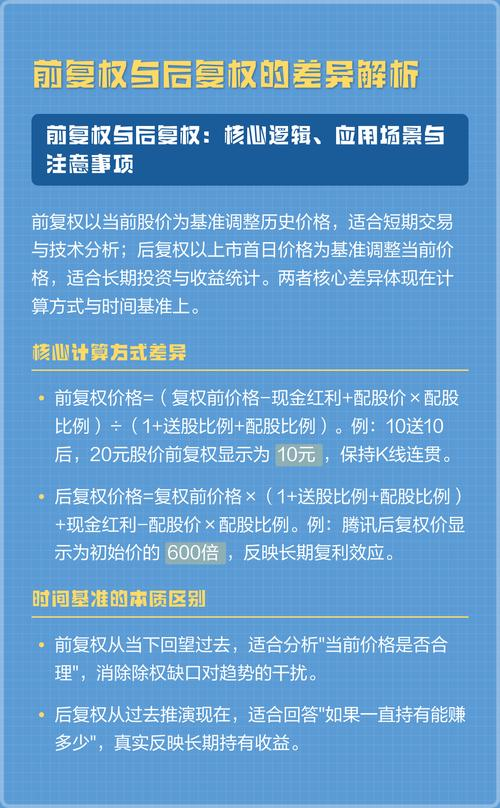
First, ex-recessions help to close the price gap resulting from, inter alia, the red-bonding of shares and the distribution of shares, thereby showing a more consistent and real trend in prices. Through ex-balancing, investors are able to see more clearly the long-term trends in stock prices and avoid being disturbed by short-term price fluctuations。
Second, ex-removation could more accurately reflect the real return on equities. In the absence of a rebalancing process, the historical price of equities is likely to undergo a larger leap, owing to factors such as dividends and stock delivery, which makes the calculation of the rate of return complex and inaccurate. The former right, on the other hand, adjusts these factors, making the calculation of rates of return more precise and reliable。
Furthermore, ex-rehabilitation allows for technical analysis. Technical analysis is a way of predicting future price trends by studying data such as stock prices and turnover. Pre-centralized price data are better aligned with the indicators and models of technical analysis and improve the accuracy and effectiveness of technical analysis。
In order to demonstrate more intuitively the role of pre-rehabilitation, we can compare pre-rehabilitation price data with a simple table:
Repossession price before time unweighted price
January 2020
50 bucks
Thirty dollars
June 2020
$60 (10 for 2 shares)
Forty-five dollars
December 2020
80 yuan (10 to 3 shares)
55 bucks
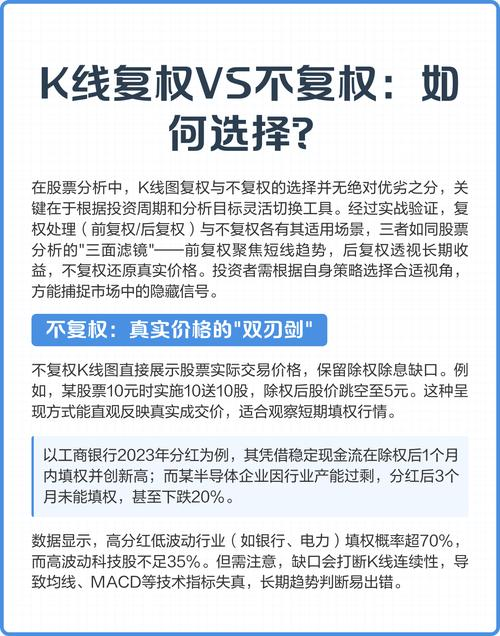
It is clear from the table above that the undisposed price has experienced a larger leap as a result of, among other things, the distribution of dividends, while the ex-removable price has shown a more smoothing trend, making it easier for investors to analyse and judge。
In addition, ex-recessions can help investors to compare more fairly between different stocks. The policies for the distribution of dividends among different equities may differ, and direct comparison of prices can result in deviations if there is no rebalancing. The former right, on the other hand, can eliminate this bias and make it more objective and accurate。
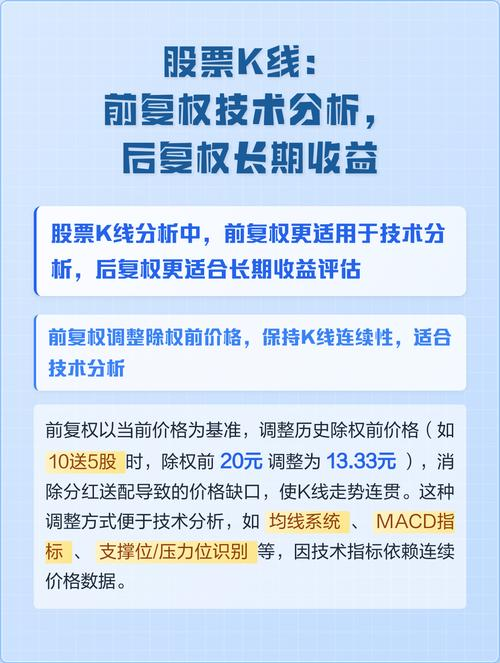
In short, ex-remand rights have many important roles and practical implications in stock analysis. Investors should take full advantage of the ex-regime function when conducting stock analyses to obtain more accurate and comprehensive information to make more informed investment decisions。