The language materials go ahead in a twist and the word “twice” is reflected in the selection of texts, mainly by replacing the language with political criteria; the word “forward” is reflected in the author's consensus on the choice of the text of the teaching materials, which is “blue and beautiful and suitable for teaching”。
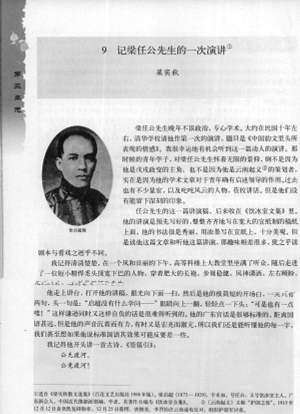
Liang sumiqiu, a speech by mr. Liang, was selected as a high school language textbook. The yangtze daily, pictures
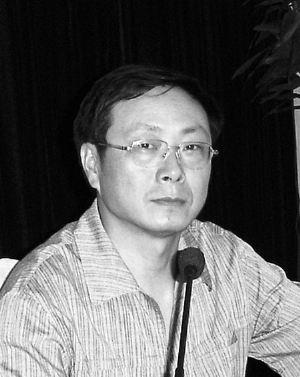
Xu linxiang (doctor of literature, professor at the faculty of literature, yangzhou university, board of editors of language teaching materials for the sino-soviet high school, vice-president of the ye santao research society, jiangsu province, permanent councillor of the specialized commission on language education of the chinese society of higher education, standing councillor of the china institute of writing and the specialized council on reading)
Chinese online news from the china daily news network: according to the yangtze journal, all new students in gaoichi, hubei province, have used new teaching materials since the autumn, including 5 mandatory and 11 optional teaching materials. The most recent revenues include liang sumiqiu's speech by mr. Liang. There has been a marked decline in the number of quick works in the new curriculum, and the absence of " medicines " and " memories to forget " . In the search of foxnet, journalists saw that two thirds of the netizens had expressed support for the change in the language teaching materials for the new curriculum of the human welfare institute。
"depoliticization" is a big deal
New kyoto: earlier, the media reported that “siuqiu liang’s work went into secondary school materials”, which public opinion considered to be a “depoliticization” signal. What do you think of the news
Tsui linxiang: this seems to be a story that is not news. Media coverage of “liang sumiqiu's work into secondary school materials” refers to the human-edged version of the standard experimental textbook for the general high school curriculum, “language (required)” of liang sumiqiu. The material has been published by the human welfare institute since may 2004 and has been in use for five years in the provinces where the new secondary school curriculum was partially implemented since autumn 2004. The so-called “news” is simply because the new high school curriculum was implemented in batches, and the province of hubei entered the new high school curriculum experiment this fall, which has just been made available to teachers and students in hubei。
As for the selection of the text as a subject, according to the content of the targeted course, mr. Yeh-tao said: “language teaching materials are examples”. Of course, the selection of teaching materials also involves the author's vision. The same is true for the new curriculum in the language of high school, where the authors of different editions can choose the same or different articles. For example, sumiqiu's " a speech by mr. Leung liang " was selected by the people, and neither the sioux, the language, the chinese nor the luang version was chosen。
The new kyoto newspaper: the so-called “depoliticization” also includes the “manifest decline in luxuan's work” ..
Xu linxiang: yes, while the media claim that the new edition of the language material was first selected for the sumiqiu work, the apparent decrease in the number of luxhou's work seems to be a sign of “depoliticization”. I would like to draw attention to the fact that, while the old high school language materials were for three years and six semesters of high school, it is normal that the new high school language curriculum, now under discussion, is mandatory for only 1. 25 academic years, i. E., two and a half semesters of high school, and that the corresponding reduction in the number of luxur works is normal。
As a matter of fact, the third module of the new curriculum for the language of high school (requirement i) is taught in lu xuan, while the second part of the curriculum includes mr. Liang's speech (identified as a short-reading text), and the second part of the curriculum for the new curriculum for the language of high school, which includes, in addition to the mandatory part, the work of lu xian's memorial liu and jinjun, is available for students. So, a signal of “depoliticization” seems to be a mirage。
It's good that public opinion is concerned about the reform of teaching materials
New kyote: since the news is not so “new”, why is it still a matter of public alarm and concern
Xu linxiang: the interest of public opinion in language materials is a good thing, demonstrating society's interest in children's development, in mother-tongue education, as well as its dissatisfaction with previous teaching materials and its surprise at the new face of new teaching materials. The new curriculum for the language of high school is indeed new and adapted to the new curriculum reform。
New kyoto: but now that it is called new teaching materials, there are bound to be new changes. Where is this change
Suh linxiang: in terms of textual content, the new curriculum for the language of high school is a good reflection of the age and modern sense of the importance of both the inheritance and the promotion of the culture of excellence of the chinese nation and of understanding and respect for multiculturalism. This is reflected in the selection of teaching materials, several new sets of high-school language materials, all of which, based on the selection of traditional titles, have made considerable efforts to develop new texts, adding many more that were not previously available。
According to statistics, language versions have been developed with the greatest number of new titles, with the traditional titles of the language versions, the chinese version, the lui version, the sioux version, and the human medium language compulsory, as compared to the new titles: 1. 2. 2; 1. 1. 4; 1:1. 3; 1:1. 1; 1:8. These include a human-edited version of mr. Liang's speech, as well as articles on heroes walking the glory, the lu's version and the sioux version of the human genome plan and its meaning, and the sioux version of the chinese expression of culture in mcdonald's。
Sixty years of revision: from two foundations to three dimensions
The new kyoto newspaper: this year marks the sixtieth anniversary of the establishment of the new china, and secondary school language materials are being revised once and for all. How can they be seen in their revised or evolving history
Suh linxiang: “language” as the name of the teaching material began in june 1950 with a set of “language textbooks” published by the editor-in-chief of the central people's government's publishing authority, from elementary to high school. Six decades of secondary school language development can be divided into two or three decades。
The first three decades can be divided into five periods: the language materials from the early stages of nation-building were developed on the basis of the chinese and chinese languages, edited by the education department of the ganning bien bing district, which promotes comprehensive learning and writing training; in the mid-fifty, the chinese language and literature experiment was introduced, the chinese language and literature were introduced in junior high schools and only literature (it was envisaged that three years of junior high school would complete the teaching of chinese)
In the latter part of the 1950s, movements such as the big step forward turned the corner; in the first half of the 1960s, teaching materials focused on tools and on “two foundations” (basic knowledge and basic capabilities); and in the period of the “change” era, political movements influenced a turn。
The next three decades can be roughly divided into three periods: from the late 1970s to the early 1980s, a period of distortion, a period of renewal of tools and “two foundations”; from the mid-1980s to the end of the 1990s, the promotion of the separation of review editors, a multiplicity of textbooks, and a gradual shift towards a plurality of teaching materials that reflect the requirements of quality education; and from the twenty-first century, the emergence of a variety of teaching materials that are compatible with the new curriculum and reflect the new curriculum spirit, with a particular focus on human literacy。
In general, over the past six decades, language teaching materials have gone from learning to reading and writing skills, to teaching in chinese and literature, to focusing on “two bases”, to emphasizing quality education, until the requirements that reflect the three-dimensional goal of the new curriculum, “knowledge and abilities, processes and methods, and emotional attitudes” have gone a little further, but in general, they have moved in the direction of twists and turns。
New kyoto: what important changes have been made to the compilation of language materials, primarily the criteria for text selection, behind this evolution
Suh linxiang: as i just said, 60 years of secondary school language teaching is ahead of the curve. This “curvature” is reflected in the choice of language texts, mainly the replacement of language standards with political standards, especially during periods of great leaps and “brothers”, both of which are simply political readings。
This “frontline” is reflected in the choice of text for the language material, which has been agreed upon by the authors of the material, namely: “the text is both good and good and suitable for teaching”. While there are different interpretations of “text” and “mass”, as well as of whether the text is both beautiful and suitable for language instruction, there are different times and writers。
The issue of “language literacy” is still unresolved
New kyoto: what are your suggestions for improving existing teaching materials
Xu linxiang: i think that knowledge of languages in teaching materials is a matter of concern。
From the time of nationhood until the end of the twentieth century, there has been no scientific definition of what is meant by “linguistic knowledge” or how it extends. Although language knowledge was usefully explored in shanghai in 1962 by the language education community of jiangsu, and summarized in eight terms as “words, words, words, words, words, words, repairs, words” and widely accepted by the national language education community as “the eight-word constitution”, the language curriculum, starting with the first introduction of the concept of “language literacy” in the secondary school language curriculum, promulgated in 1978, has either been described in terms of “linguistic knowledge” or in terms of “contents of teaching material” or “contents of teaching”. From a logical point of view, these expressions reveal neither the content of the concept nor the basic conditions necessary to reveal its outer extension, namely, “proportionality”。
New kyoto: what's the situation
Xu linxiang: since the beginning of the twenty-first century, the issue of knowledge of languages has not been adequately addressed. The only two language curriculum standards do not have a “content standard” component, in terms of the standards of the full-time compulsory education and the general upper secondary school curriculum. While in recent years there has been a conscious search for and reflection on what is meant by language knowledge and what is included in language knowledge, to date, there is still a need for further study of what is knowledge of languages, particularly language procedures, which are important for building the language skills of students. (journalist)