As the owner or financial officer, you must have experienced this difficult problem: the company pays rent to the individual landlord, but the other party is reluctant to provide an invoice. The first reaction of many may be “more than less” and, in order to avoid communication difficulties, the cost is simply not accounted for。
But is this “common sense” approach, which appears to be “saving”, really the wisest option? It might hide the extra costs you didn't expect。
This paper will clearly calculate and compare the real tax costs under three different treatments through a simple case of paying $10,000. After looking at this, you may find that this little thing is not irrelevant, it can be either a financial loophole that quietly erodes your profits or a strategic decision point that directly increases net profits。
Implicit cost of “non-recording”: how much has been overpaid
When a 10,000 dollar rent cannot be deducted as a pre-tax cost because there is no invoice, the immediate consequence is that the company's profits in the current period have been increased by a full $10,000. This is what is often referred to in accounting as “account profits” — it is not real cash in banks, but on profit statements it is taxable income. The tax authorities are taxing you on the basis of this inflated profit, resulting in a real cash outflow。
Specifically, two additional taxes and duties would be incurred:
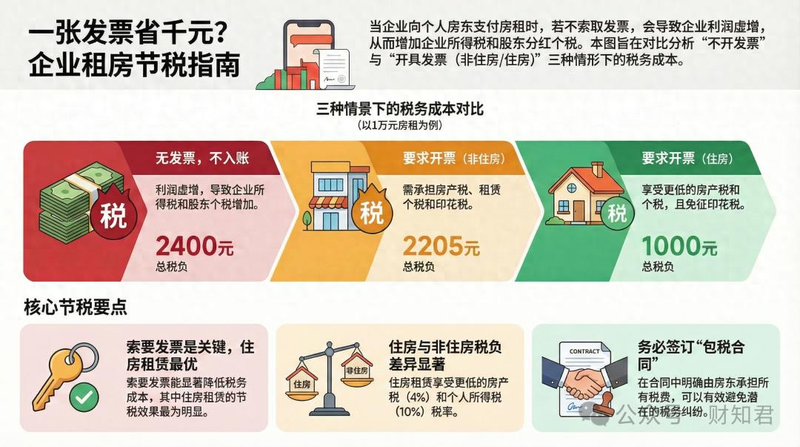
Together, this “non-recording” approach ultimately results in a total tax of up to $2,400. This means that you have paid up to 24 per cent of the “incompetence tax” for a legal sum of $10,000. This is a typical case of taxing money that was never actually earned because of poor paper management。
2. Request for billing (non-housing): an immediate economy
What happens if, in a different way, we take the initiative of consulting the landlord and leave the enterprise to bear all the taxes and charges incurred in invoicing the $10,000 rent? We take the example of renting non-housing (e. G. Shops, offices)。
A crucial step would be to formalize this agreement through the conclusion of a “charging contract” and to identify the tax and fee-paying party, thereby transforming potential disputes into clear, professional commercial transactions。
In accordance with the relevant tax policy, the tax charges incurred by landlords to invoice are as follows:
It is clear from the calculations that the total tax burden on the enterprise is $2205. This figure is clearly below the total tax of $2,400 in the first case. The conclusion was clear: even if the enterprise incurred all the taxes and fees charged by the landlord, it would be more cost-effective than abandoning the recording。
Large differences: when leased properties are “housing”
There is a better possibility. The tax policy will be more favourable and will help you to reduce costs significantly further。
In such cases, the gross tax liability for invoiced amounts to:
Add the above to the total tax of $1,000
The savings were mainly the result of two major profit-making policies for housing leases: a substantial reduction in the tax rate on property from 12 per cent to 4 per cent; and a direct reduction in the personal income tax rate of landlords from 20 per cent to 10 per cent。
Let's get this straight: by insisting on renting invoices, your tax cost dropped sharply from $2,400 (not recorded) to $1,000. You saved $1400 and reduced the tax burden by almost 60%
The conclusions are self-evident. In the case of individual landlords who do not wish to obtain tickets, the worst option is to leave the books to save time。
The central message here is that tax calculations are not just accounting, but a powerful negotiating tool. Before the next renewal of the lease, please enter the negotiating room with these figures. It is clear to the landlord that, while they receive the expected rent, it is entirely possible for you to make a “no” into “yes” and save thousands of dollars for your company。