I. Current research hotspots
1. Significance of genetics
- dna mealization clock: the apparent genetic clock (based on methylation levels at the cpg point) proposed by horvath is the most widely recognized sign of ageing, with a new generation of clocks (e. G. Grimage) further associated with disease risk and mortality。
- group protein modifications and non-coding rna: the regulatory role of mirna (e. G. Mir-34a) and incrna in ageing is gradually being revealed。
2. Particle length and end particle enzyme activity
- grain reduction is a classic sign of ageing, but individual differences are significant and are influenced by environmental factors, and studies in recent years have focused more on the dynamics of the particles (e. G. Single-cell particle length detection techniques)。
3. Inflammation and immune ageing markers objects
- inflammatory factors: chronic inflammation (inflammating) markers such as il-6, tnf-α and crp are highly correlated with ageing-related diseases。
- changes in immunocellular sub-groups, such as depletion of t-cells, decline in nk-cell function and release of the aging-related genus (sasp)。
Metabolism and proteomic markers objects
- dynamic changes in metabolites (e. G. Nad+, nematode metabolites) and protein modifications (e. G. Oxidation damage, glucose-based end products) have become the focus of research。
5. Signs associated with cell ageing objects
- sa-beta-gal (beta-si-lactose enzyme associated with ageing): classic but not specific。
- p16ink4a/p21 cyclical inhibition of proteins: a significant increase in expression in tissue ageing。
6. Intestine microbial group markings objects
- declines in intestinal group diversity and changes in the abundance of specific strains (e. G., reduction of akkermansia muciniphila) are associated with ageing processes and metabolic diseases。
7. Multimodular integration and system biology
- comprehensive ageing rating models (e. G. Aging. Ai algorithms) that combine multiple groups of data, such as genomes, watch groups, metabolisms, etc。
The way forward
1. Precision and dynamic monitoring
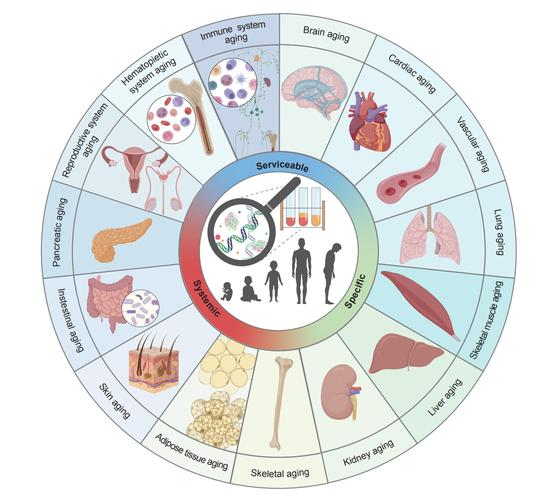
- single-cell technology and spatial fusion: reveals the heterogeneity of the ageing of different tissues/cell types (e. G., differences in the rates of ageing of the brain, liver, skin)。
- real-time monitoring techniques: development of wearable equipment or dynamic tracking of the ageing process through liquid biopsy (e. G., ctdna, excreta)。
2. Mechanism-driven marker discovery
- aging key road link signs: e. G. Mtor, ampk, sirtuins road activity changes, linear particle function disorders (mt dna copies, ros levels)。
- organ-specific markers: the exploration of tissue-specific indicators such as brain aging (e. G. Neuroinflammation marker, gfap), cardiovascular aging (e. G. Vascular elastic protein)。
3. Clinical conversion and application
- assessment of the impact of interventions: validation of the effects of anti-age therapy such as senolytics (eliminating anti-age cell drugs), nad+ supplements, and diaphragms on biomarkers。
- individualized health management: development of individual anti-age programmes based on biological markers (e. G. Nutrition, sports, drug interventions)。
4. Integration of artificial intelligence with big data
- excavating new markers from multidimensional data using in-depth learning models and predicting individual ageing trajectory and disease risks (e. G., large queue data applications such as uk biobank)。
5. Ethical and standardization challenges
- standardization of marking certification: there is a need for harmonized testing standards across laboratories and across ethnic groups。
- privacy and ethical issues: ageing markers may affect areas such as insurance, employment and require policy regulation。
Iii. China's major high schools and scientizations
(i) comprehensive higher education institutions
Qinghua university
- academy of life sciences: molecular mechanisms, stem cells and regenerative medicine with a focus on ageing。
- college of medicine/beijing concordat and college of medicine (jointly established): study of geriatric medicine, neurodegenerative diseases (such as alzheimer's disease)。
- college of medicines: development of anti-age medicines (e. G. Nad+ metabolic regulation)。
Beijing university
- institute of molecular medicine: study of aging and metabolic diseases (e. G. Cardiovascular aging)。
- college of basic medicine: inflammation and immuno-aging, apparel genetic control。
- third hospital (clinic medicine): clinical transformation of old age syndrome, skeletal aging。
University of jordan
- academy of biomedicine: particle biology, genomic stability and ageing。
Affiliated to nakayama hospital: centre for gerontology, study of aging-related diseases (e. G. Diabetes, cancer)。
- institute of brain intelligence science and technology: cross-study of brain aging and neurological disorder。
Shanghai transport university
- regin hospital, affiliated to the medical school: metabolic and aging (e. G. Anti-age mechanisms for two-accompanies)。
- bio-x institute: genetically driven study of ageing mechanisms (e. G., long-lived genetic excavation)。
Zhejiang university
- institute of life sciences: linear particle dysfunction, protein stability and ageing。
- hospital for fugitives, attached to the faculty of medicine: intestinal microbiology and intervention in the health of the elderly。
Chinese university of science and technology
- ministry of life sciences and medicine: the molecular base of ageing (e. G., end-particle enzyme regulation)。
- hospital no. 1 attached: precision medical care for aging-related diseases。
(ii) system of chinese academy of sciences
Shanghai institute for life sciences (now integrated into the shanghai institute for nutrition and health)
- a study on the correlation between genetic clocks, metabolic disorders and ageing, based on a proteomic analysis conducted by the national centre for protein sciences。
Biophysics institute
- structural biological perspectives to analyse the functional mechanisms of ageing-related proteins, such as the sirtuins family。
Institute for animal studies
- laboratory for the study of stem cells and ageing: stem cell depletion and tissue regeneration, using model animals (if flies, mice) to study longevity mechanisms。
Kunming animal institute
- national priority laboratory for genetic resources and evolution: cross-species comparative genomics (e. G., anti-age mechanisms for long-lived mammals)。
Beijing genomics institute
- multi-group integration analysis (methylation, transfer group) to model chinese signs of ageing。
(iii) professional medical research institutions
Chinese academy of medical sciences (beijing institute of medical sciences)
- institute of basic medicine: aging immunization controls, cell ageing signs (e. G. P16ink4a)。
- exterior hospital: clinical study of cardiovascular aging and artery hardening。
Academy of military medicine
- institute of radiology and radiation medicine: mechanisms to link the recovery of dna damage to ageing。
- institute of toxics and drugs: screening of anti-age compounds (e. G. Senolytics drug development)。
National centre for gerontology (beijing hospital)
- development of a clinical database on the elderly and validation of early diagnosis signs of aging-related diseases。
(iv) local priority institutions and emerging institutions
Nakayama university (guangzhou)
- nakayama medical school: mechanisms for neurodegenerative diseases (e. G. Parkinson's disease) and brain aging。
- affiliated hospital i: research on senior nutrition and metabolism intervention。
Wuhan university

- institute of medicine: cross-cutting study of the aging and tumour microenvironment。
University of west lake (hangzhou)
- institute of life sciences: single-cell technology for the analysis of organ aging heterogeneity, detection of anti-age target。
Shanghai university of technology
- institute of immunochemistry: antibody drug targets for the elimination of aging cells (sasp regulation)。
(v) joint laboratories and cross-cutting platforms
Quanzhou institute of precision medicine
- projection of individual ageing trajectories in combination with artificial intelligence and multi-group data。
Peng city laboratory (shenzhen)
- analysis of bioinformatics and the data of failings (e. G., a million-class population queue study)。
Chengdu
- focus on ageing and regenerative medicine, development of organizational engineering and cell therapy techniques。
(vi) examples of specialty research directions
- approximate genetics: beijing genomics institute, university of jorda
- immunization ageing: institute of immunology, university of qinghua, chinese academy of medical sciences
- metabolism and ageing: shanghai transport university, rigin hospital, zhejiang university
- stem cell and regenerative medicine: central institute of animals, university of west lake
- aging clinical transformation: beijing conciliator hospital, national geriatric centre
(vii) scientific support platforms
- national centre for protein sciences (beijing/shanghai): analysis of protein function associated with ageing。
- national biological information centre: integration of ageing multi-group data (e. G., human ageing database)。
- model animal platform: institute of model animals, nanjing university (little rat repository), kunming animal institute (prime decay model)。
Big data analysis
Retrieval of database: medline
Search tool: bibliography/pubmed