The total score for english is 150, of which the reading understanding component is 40, so the reading understanding component is 26. 67%。
So reading and understanding occupy an important place in the english language of the examination and is a key part of the examination score。
Today we are conducting a reading strategy analysis in conjunction with the national reading understanding in english in 2024 to improve the efficiency and accuracy of english reading in 2025。

01 generic skills analysis
(i) pre-reading skills
1. Focus on the theme and identify the type of problem
First of all, the question is whether it is objective information or subjective。
Objective questions of information can be found directly in the articles; subjective questions are examined in terms of the emotional tone of the articles, the author's unspoken views and the understanding of the central thrust of the whole text, which must go through attitudes towards the author, intent and deep reasoning about the article as a whole。
This distinction allows for a more targeted search for answers when reading articles。
For example, when it is determined that the subject is objective, the relevant information points can be located directly in the text; in the case of subjective judgements, the article as a whole needs to be captured and analysed。
2. Information on topicalities and options
Detailed information about the subject matter of the trial and the information contained in the various options, so that articles can be read in a purposeful way, the information can be quickly located, the relevant information can then be consolidated, screened, analysed, compared, and the interference items can be properly excluded and the correct answer selected。
This approach is particularly relevant to the understanding of the subject matter of the graphic tables and can increase the efficiency of the answers。
(ii) reading skills
1. Read the full text as quickly as possible and with a sense of purpose
Candidates are aware that reading issues are high in today's high examinations and that reading cannot be done within a limited period of time if it does not reach the required speed, so rapid reading is one of the important techniques。
The speed of reading in recent years has required about 60 words per minute. It is therefore important for candidates to learn the speed of reading and to use short reading, group reading, jump reading and so on for a limited period of time。
A cursory reading is a method of obtaining articles with a rough reading. A quick reading of the main contents of the article is possible. For example, articles on character events, scientific discoveries or social phenomena. A word-by-word reading is not required, but rather focuses on such important parts as the title of the article, the paragraph at the end and the first sentence of each paragraph. For example, when reading a news report, a cursory reading of the title and the first paragraph gives an idea of the broad story。
Jumping to find specific information with a clear purpose, ignoring irrelevant content. For example, when the subject is asked about the age of a person in an article, it is possible to go directly to the section containing information about the person in question to find answers without having to read the whole text that is not related to age。
Group reading is done in groups of meanings, reading and understanding, reducing the number of eye stops and increasing the speed of reading. For example, the term “this is a book” is seen as a group, not as a single word to read。
By increasing the speed of reading, it is possible to quickly search for key words, subject sentences, capture information on time and space, sequence, sequence, characters, views, etc., and to sort out the context of the article and grasp its substance。
Another important technique for quick reading of the full text and for taking care of it is to catch keywords and subject words。
The location of keywords and keywords helps us quickly to grasp the core of the article。
The subject matter sentence is usually at the beginning or end of the paragraph, and the subject matter of the article or paragraph is understood in general terms by quickly locating the subject matter sentence。
For example, in an article on environmental protection, “enviro”Nment protection "pollution" etcThis is of great significance for the future of the beginning。
The capture of the subject sentence serves as a reminder, inspiration, summary, summary, etc. For the full text。
In the case of articles written in summary form, the subject sentence is generally in the last sentence of the article; in the case of articles written in an oral manner, the subject sentence is usually the first sentence of the article. However, there are also articles that do not have clear subject words and which need to be summarized by the reader. For example, in an article on healthy lifestyles, it may be suggested at the beginning that “healthy lifestyle coThese are the main lines of the article。
2. Read the details and clarify the thinking
1) combination by article type
Most narratives are person-centred, using time or space as a clue to the event's occurrence, development and outcome, while the narrative consists of three main elements: arguments, arguments and conclusions, which are presented through explanations and examples。
Depending on the character of the article, the details are read in detail, leading to verbs, time, place, event, cause and effect, identifying key words, and using the charting method, drawing a picture of the subject matter and details of the full and clear article。
2. Long and difficult reading
In the case of long sentences, the sentence should be understood to mean no structural analysis (in the case of time-critical high examinations). This means that the meaning of the sentence should first be clarified, regardless of the grammar。
Structural analysis is done only when special circumstances such as the description of the term in terms of the technique of speech are examined, which is, after all, less common in english。
Language studies should be based on the acquisition of meanings and the accumulation of linguistic identity in order to learn grammar, since grammar is part of the language appreciation system, as the primary english language taught by high school students, from the point of view of the examination, and it is sufficient to have a basic understanding of the grammaticals of the difficult english sentence and to ascertain that the intent is a priority。
For example, “the boy, who was wearing a blue hat and driving a big bag, ran quickly towards the school.” it could be understood as “the boy in a blue hat with a big bag headed for school” without having to analyse the sentence structure。
3. Learn to extrapolate guesswords and understand the meaning of words
Reading understanding requires not only an understanding of the meaning of the letter, but also an inference of the author's intention and the underlying meaning of the article。
Context lines are used to extrapolate, as is the logical relationship between the words, the counterwords and the context, while paying attention to the tone and the words used by the author to judge his attitude and opinion。
For example, the way in which a person is described in an article is “piculiar”, from which it can be deduced a particular attitude of the author towards the way that the person is doing his or her business。
For example, the original expression “he is very happy” may be “he is quite glad”, where “happy” and “glad” are replaced by a synonym。
In the case of unfamiliar words or phrases, their meaning can be inferred by reading their context and combining their common sense. For example, the meaning of the phrase can often be inferred from the same relationship in this sentence。
4. Focus on logic
Note the logical relationship between sentences and paragraphs, such as causality, progression, interpretation, turning, comparison, comparison, etc。
This helps to understand the context of the article and the author's thinking. For example, when the word “but” was seen, it was clear that the latter part was in turn; and when it was seen as “therefore” it was the causal link。
5. Notekeeping and marking
During reading, key messages and living words are drawn out or enclosed, marked where they are not understood, and answers are found after reading。
For example, when there are words that indicate important data, key person views or not known, mark them to facilitate follow-up。
(iii) post-reading techniques
Integrate information, compare options。
The information obtained from the articles is consolidated and then compared with the options。
Select the right answer by excluding those options that are manifestly inconsistent with the content of the article, are not logical or express too categorical。
For example, an option could be excluded if it was contrary to the fact that it was clearly stated in the article, or if an option was too one-sided to cover the relevant content of the article。
02 analysis of different types of techniques
1. Factual details/understanding topic
In 2024, an english-language national book read and read d:
Solving techniques: using positioning
Finds the sentence from the original text based on the thread in the drying or the option, comparing it to the option to determine the answer。
In 2024, the english-language national volume a read and read the first paragraph of d:
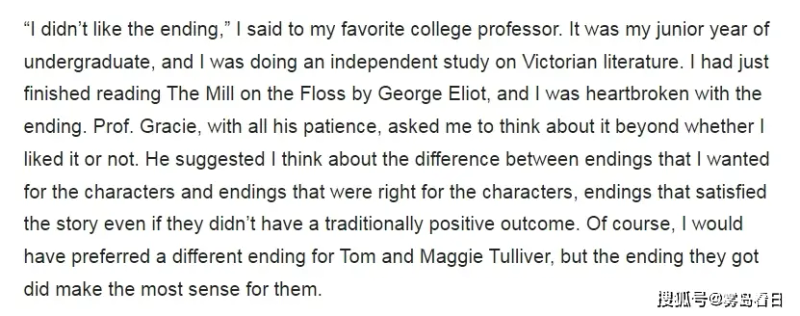
"i didn't like the ending," i said to my friend year of undergradation, and i had just finished reading the mill on the floss by george elliot, and i was hearing broke with the ending"i don't like this ending," i said. It was my third year, and i was doing an independent study of victorian literature. I just finished reading george elliott's "the mills on the flose river" and i'm sad to see the end. Professor graci patiently asked me to think about it, not just whether i like it or not." so choose item a。
In general, this type of answer does not appear on its own, and it always corresponds to the content of the preceding and subsequent paragraphs, so that it is judged in the context。
2. Word understanding
Solving techniques: understanding themes and contexts
The meaning is fully understood by understanding the word, phrase or sentence of the short text。
Words that are unfamiliar need to be avoided, read a little, read a little, and carefully refined, especially with regard to the interpretation of the language。
3. Thesis of reasoning
In 2024, an english-language national book read and read d:
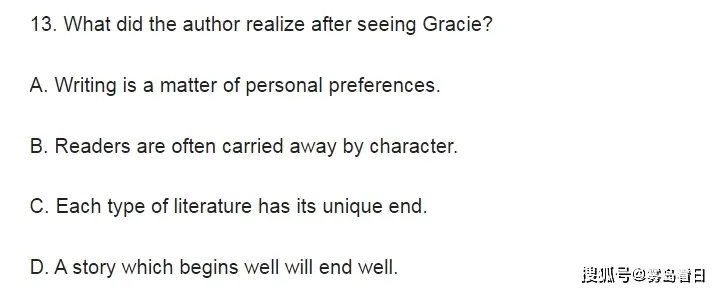
Solving techniques: focus on logic
In 2024, the english-language national volume a read and read the second paragraph of d:
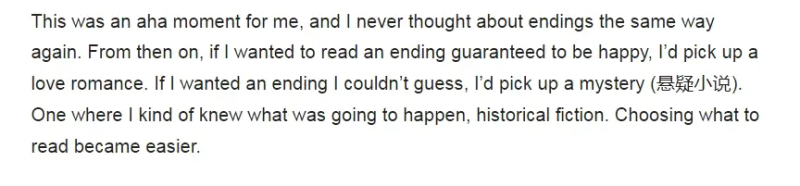
It focuses on the logic of the structure of the article, captures key words, combines the life and social commons involved, clears the structure of the article, the content of the article and the central idea, deduces the author's writing intent and purpose, and makes reasonable inferences。
"this was an aha moment for me, and i never thought aIf i wanted an ending i couldn't guess, i'd pick up a mystery. Since then, if i wanted to read a happy ending, i would have chosen a love novel. If i wanted a ending i couldn't guess, i'd pick a mystery novel. One is that i know what happens, history novels. "to choose what becomes easier to read."
You know, after seeing professor gracie, the author realized that every type of literature had its own unique ending. So pick c。
4. General
Solving techniques: looking for ideas
Many articles speak directly from the beginning and express central ideas. There are also articles whose titles or subheadings of a short text may be indicative of generalizations。
5. Chart understanding
Solving techniques: analytical logic and detail
Mainly examine the student's mindset, look at the logic, analyse the details and identify the requirements that meet the requirements of the diagram。