“holding three law enforcement letters and finding no exit.”
Consumer mariko (alias) told the red star capital bureau that in january this year she purchased a bottle of imported perfume from a live broadcast on a short video platform, which, after receiving a check, was found to be unsuited and required the vendor to produce the relevant qualifications. Upon further inquiry, mariko found that the company behind the live booth and the delivery site had no export or import qualifications. The live broadcaster claimed to have shipped goods overseas, but the platform did not play its proper regulatory role during more than 29 live broadcasts。
Maruko considered the merchant to be a fraudulent sale and required a refund of three. However, both the merchants and the platform customers indicated that mariko was required to provide her own certification of the perfume。
According to counsel, the consumer questions the non-import of perfume and the consumer is not obliged to provide proof of testing. If the seller cannot prove that the perfume sold is imported and is suspected of being fraudulently sold, the consumer has the right to claim a “refund to three”。
For $998 to buy imported perfume
Human rights defenders are required to identify them at their own expense
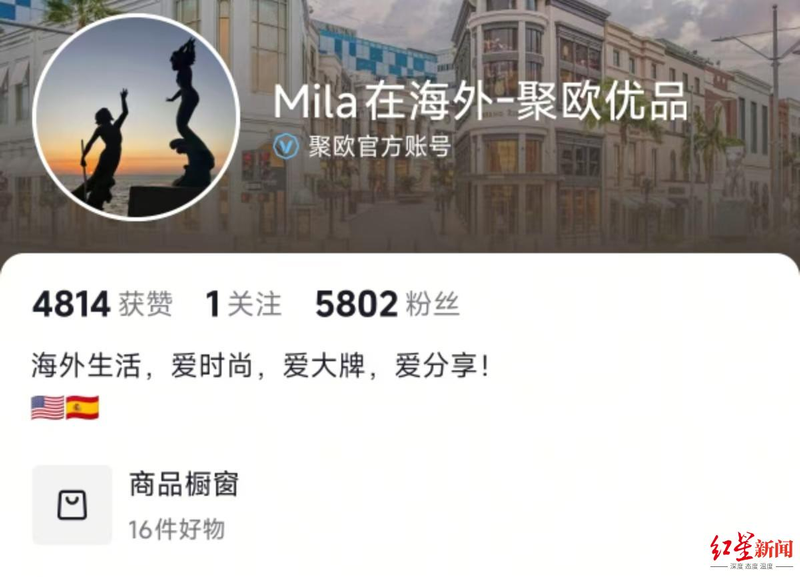
On 5 march, maruko told the red star capital bureau that in january of this year she had painted on a short video platform a blue v authentication booth called “mila overseas-polymeo” which showed that in the united states, the registered company was hangzhou mono-est e-commerce ltd. (hereinafter, hangzhou mono-emprete) and that the main broadcaster claimed that the products were purchased abroad and that she was entitled to a valentine's day exclusive discount。
The cut-off chart provided by maruko shows that it was selling roses from an uninhabited area known as byredo, a swedish fragrance, and that it was purchased at a price of $998. A few days later, mariko looked at the logistics information and found that the perfume had been shipped to guangzhou and that the shipping shop had planted a make-up in guangzhou (hereinafter referred to as “the guangzhou plant”), she looked at the operating licence and found that there was no “import/export trade” in the company's operations。
Upon receipt of the goods, mariko believed that the perfume smell was not consistent with the specialty that he had previously purchased and that there were signs of a drop in the logo at the bottom of the bottle. On 29 january, the mariko application platform intervened to initiate the arbitration process and to request a three-to-one refund from the vendor, who stated that only refunds would be provided。
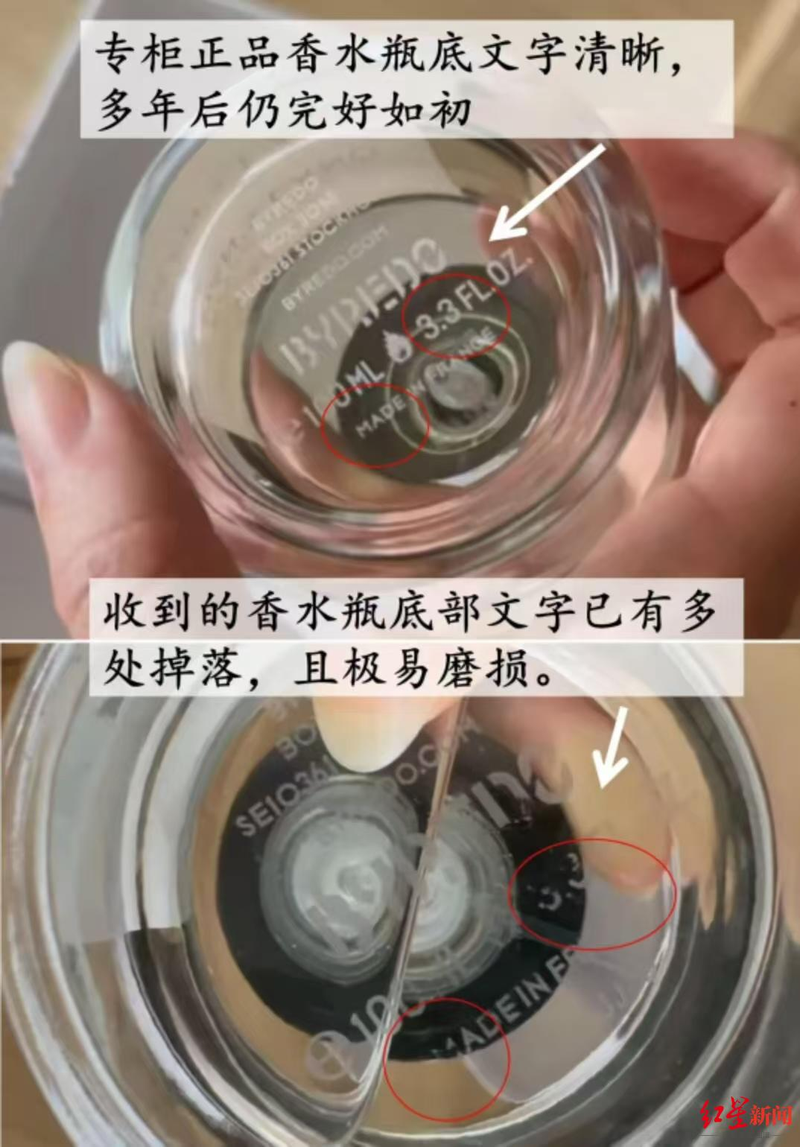
Interviewee for map
On 30 january, maruko submitted to the platform that the merchant was suspected of false propaganda and fraud and that the merchant should be punished and asked to pay the consumer first. At the same time, she requested that the platform retroactively broadcast the commercial return live and requested that the platform request vendors to provide “off-shore purchase vouchers” and “customs declarations for imported goods” to produce written findings. About an hour later, the shop in guangzhou was shut down。
Subsequently, maruko asked the platform to freeze and seize the merchants ' bonds and the money, in accordance with the regulations, and pay them first. The platform's customer service indicated that she could only refund the goods and compensate for the 100-dollar consumer coupons or asked her to consult with the merchants and make the payments. Maruko told the bureau of red star capital that a client of the platform had stated to the high commissioner that the platform could not pay for the goods because it could not prove that they were false and that it was required to provide authoritative reports。
“if an authoritative body is to obtain an accreditation report, it needs to be sent to a specialized testing centre at a cost of $1,000, and the identification criteria for products such as perfume are very complex.” mariko indicates。
On 6 march, the red star capital bureau sent a subsequent call to relevant institutions such as the institute of intermediate analysis and the food and drug inspection institute of shaanxi province to learn that similar tests were largely closed to private individuals。
On 6 march, ban shang, a lawyer at the chinese bar office in guangdong, and an arbitrator from the grand bay district of hong kong, told the red star capital bureau that the consumer protection act provided that an operator should provide a true and clear response to a consumer's inquiry about the quality of the goods. Accordingly, if the seller promotes the use of perfume as an imported commodity abroad in a live broadcast, it should be ensured that the perfume delivered is imported. In response to consumer queries, vendors should provide documentation on the origin of imports of perfume, such as import declarations, import certificates, certificates of origin, etc. Consumers question perfume as a non-imported commodity and are not obliged to provide proof of testing. If the seller cannot prove that the perfume sold is imported and is suspected of being fraudulently sold, the consumer has the right to claim a “refund to three”。
According to zhao liangsheng, a senior partner in shaanxi xingda, a businessman claims that perfume is imported overseas and that, according to article 20 of the consumer protection act, the operator should provide true and complete information on the goods without false or misleading propaganda; the seller's legal obligation to provide proof of import compliance, such as customs declarations, quarantine tests, arrival certificates, etc., cannot be proved. In accordance with the rules on the distribution of evidence for consumer defence, consumers have completed initial proof of physical incompatibilities and anomalies in the place of shipment, and merchants and platforms have directly asked consumers to produce their own authoritative test certificates, which have unreasonably increased the burden of proof on consumers and are not in accordance with the law。
4 addresses for 2 companies
After 29 shows, the business lost contact
Following unsuccessful communication with the platform's guest service, maruko sent a letter of enquiry to the relevant section of the platform, which had not yet been answered。
Mariko then complained to hangzhou 12315, to hangzhou zhou, to guangzhou 12315 and to shanghai 12315。
From 2 february to 24 february, mariko responded that he could not be contacted in hangzhou and that no operator had been seen at the site and had been placed on the list of operating anomalies. The south sand district supervisory authority of guangzhou city replied that it was not possible to reach guangzhou and that it had been added to the list of operating anomalies and sent a letter to the local administration of the platform urging the business to be closed. The yangpo district district board of shanghai replied that the complainant had expressly refused to refund the sum of one to three after the organization had failed。
On 28 february, maruko received a further response from the yangpo city inspectorate of shanghai city. It was verified that the after-sale address registered by guangzhou on the platform was actually in anhui, and the certified address of hangzhou zhou was in hunan. It was suggested that contact be made with 12315 of the two territories mentioned above and that the contact number for the two authentication messages be provided, but it was found to be unconnected。
Mariko believes that the platform should have a regulatory obligation for the sale of live booths and shops for cross-border commodities. At the same time, the blue v certification of the platform is subject to submission of business licences, legal personality identification cards, etc., which the platform should verify. The endorsement of business qualifications by the blue v certification as a platform should have meant more rigorous scrutiny。
On 6 march, the bureau of red star capital noted that the account window still existed, but that the live broadcast was hidden。
Zhao liangcheng noted that, as an electrician platform, the platform was under an obligation under articles 27 and 38 of the electronic commerce act to register information on the identity of the operator, administrative authorization, etc., knowing or being aware that the merchant had failed to take the necessary measures against consumers, and was legally liable to that merchant. At the same time, the platform is obliged to review, inspect and assist in the defence of the qualifications and marketing content of its live operators, in accordance with the direct online marketing scheme (pilot). The lack of export and import qualifications of the parties involved indicates that the platform has not fulfilled its audit and regulatory responsibilities in accordance with the law and should be held accountable accordingly。
Ban xian, for his part, believes that even if the business does not have import qualifications, it can buy and sell from the importer, for which the platform is hardly responsible。
Red star reporter
Editor, xiao qi