


1. 2. 2 current status and development of single machine technology
1. Technical status of single-piece machines
Currently, there are a wide variety of single-formula chip systems, varieties and specifications that go through several representative stages of development, including four, eight, 16, a new generation of eight and 32. The 4-bit machine is used mainly for household appliances, such as televisions, air conditioners and washing machines, but with the fall in the price of 8-bit machines, a large number of 8-bit machines have been introduced in home appliances to introduce new technologies, such as vague controls, modulation speeds, etc., to improve the intelligence, automation of household appliances and to minimize the energy consumption of systems; 16-bit machines have a strong numerical capacity and speed of reaction, often in systems requiring real-time control and real-time processing, and despite the fact that 16-bit single machines have been on the market for more than 10 years, they have not been able to replace 8-bit machines as a mainstream product, and the number of new generation 8-bit machines and 32-bit machines that have enhanced the control interface function is also increasing rapidly. The absolute value of 8-bit, 16-bit and 32-bit monolithography chips may increase to varying degrees over the coming period, but for the present and even for a considerable future period of time, such as five-year and ten-year periods, the eight-bit monolithic machines (especially the new generation of 8-bit machines, such as the 80c51, mc68hc11 series) continue to be the dominant product of the single machine. The book therefore focuses on the principles and system composition of the eight monolithic machines。
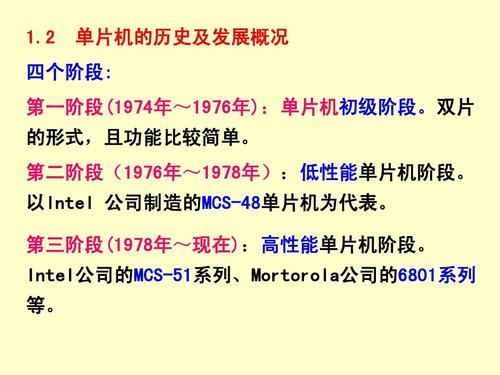
The eight single machines went through three stages of development。
The first generation single-formula system (e. G., intel's mcs-48 series) is less functional and is in fact a simple combination of eight generic cpu unit circuits and basic i/o interface circuits, small-capacity storage units, interruption control systems, no serial communication function, no a/d, d/a converters, and less control and management capability. Its scope of application is therefore significantly limited。
In order to improve the control function of the single machine and to broaden its area of application, in the early 1980s companies such as intel, motorola and others added the universal serial communication control and management interface (uart) to the first generation of 8-bit monograph circuits, enhanced interruption control, increased number of timers/calculators, extended storage capacity, updated memory types, partial systems mono-channels, some of which also incorporated the a/d, d/a conversion interface circuits, forming a second-generation eight-step single-machine system, such as the intel mcs-51 series, motoola's 6801 series, zilog's z8 series, and nec company upd7800. After the second generation of 8 mono-chip chips was put on the market, the first generation of 8 mono-chip machines was quickly replaced by the mainstream of the then mono-chip market and lasted for more than a decade。
The second generation of eight mono-machines is characterized by a high level of generality, but their individuality is not prominent and their control functions are limited and they still fail to meet the requirements of different applications and different monitoring and control systems. In the mid-1990s, major chip manufacturers (e. G. Intel, philips, motorola, temic seco)On the basis of the cpu core of the second generation, nductor technology technology, microchip and others, in addition to further enhancing the original functionality (such as the introduction of error detection and automatic address recognition in serial-crossing components), the external interface circuits for different functions and applications are embedded in the cpu of the second generation, creating a new generation of eight mono-chip chips with a wide variety of specifications, such as intel, philips, atmel, 8xc5x series, motoola's 68hc05, 68hc5x series, micro chip pic16c series, etc. The 68hc05 and 68hc11 series, with an enhanced mcs-51 kernel of 8xc5x, and a 6801 kernel of 6801, are now the mainstream mono-chip chip。
2. Trends in single-piece machines
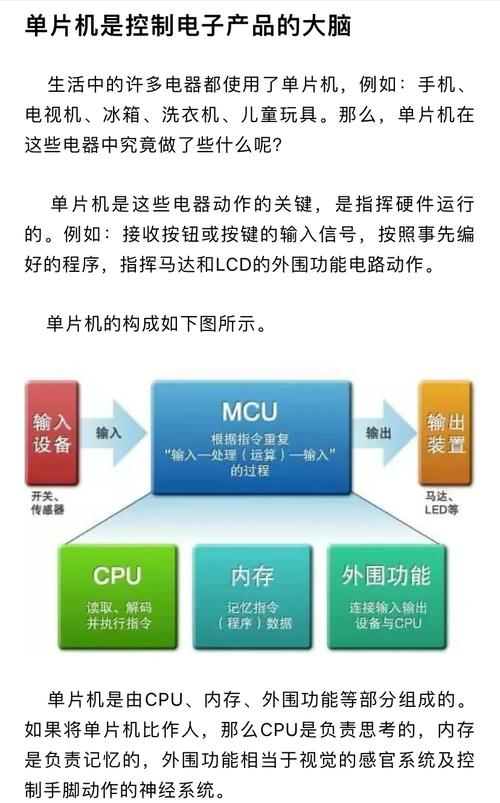
The trend for single-piece machines is towards high performance, large capacity, miniaturization, and internalizing peripheral circuits。
(1) cpu improvements
1 two cpu structures to improve processing speed and capacity。
2 increase in data bus width to increase data processing speed and capacity。
3 adopt flow-line structures. The command appears as a queue in the cpu and has a fast operating speed, especially for real-time digital signal processing。
4 line bus structure. Philips has developed a new type of bus, intel-icbus, which uses three data lines instead of the current eight-digit data bus, thereby significantly reducing the external locomotives of single-piece machines and reducing the cost of single-piece machines, especially for miniaturization of electronic instruments。
(2) development of storage
1 increase storage capacity. New types of single-filamented roms can typically reach 4-8 kb or even 128 kb. One kb in a single ram. The increase in the storage capacity of the amphibious amplifiers has facilitated the simplification of peripheral extension circuits, thereby increasing the stability of products and reducing their cost。
2 eprom started eepromization. Eprom in the film requires high pressure programming input, ultraviolet wiring and many inconveniences at the time of use. Eeprom, which is electrocuted, is not required to remove ultraviolet light, but is simply rewritten. In particular, eeprom, which can be read and written under +5 v, has both the advantage of simplicity in static ram reading and writing and the advantage that data will not lose this rom in case of power failure. The use of eeprom in the film will not only have an impact on the single-piece structure, but will also greatly simplify the structure of the application system, thereby increasing the stability of the product and reducing its cost. Because the data in eeprom are permanently maintained, some single machines use it as an internal ram, and some even use eeprom as an internal general repository。
3. Confidentiality of proceedings. In order to prevent replication, some companies have started to use keprom (keyed access eprom) programming and lock-in of the film. The lock-in does not allow for the reading of the application and prevents the application system from being copied。
(3) improvement of the i/o mouth in the film
Generally, single machines have a larger number of parallel vents to meet the need for peripheral equipment, chip extensions, and are equipped with serial access to meet the requirements for multi-machine communications functions。
1 improved driver capacity at parallel outlets. This reduces the outer drive chips. Some single machines directly export large currents and high voltage so that they can drive directly leds and vfds, etc。
2 add logical control function to i/o mouth. The location processing system for medium- and high-end single machine sets up the location and location of i/o lines, which enhances the flexibility of i/o controls。
3 special serial interface function. To make it easier for single-stage institutions to network。
(4) external circuit internalization
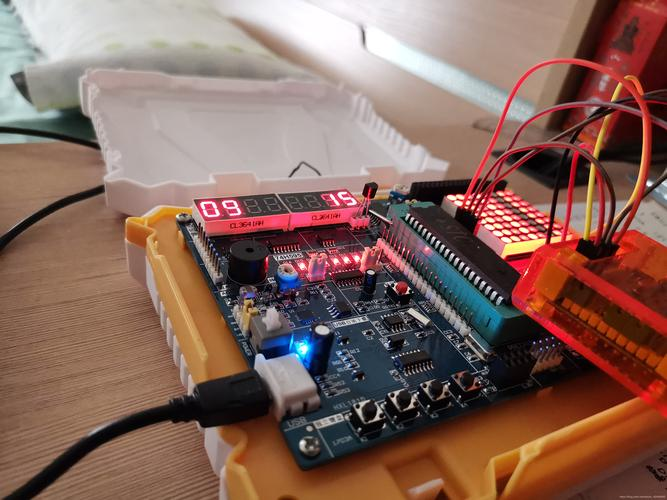
With the increasing integration of integrated circuits, it is possible to integrate a large number of peripheral functional circuits into single-cot chips. In addition to generally available roms, rams, timers/calculators, interruption systems, and to meet the requirements of higher detection and control functions, inner-integrated components can also include a/d converters, d/a converters, dma controllers, lock links, frequency synthesisers, character generators, voice generators, crt controllers, etc. Because of the continuous improvement and upgrading of the integration process, it can also be large-scale to integrate the outer circuits that are needed in a single machine (i. E., one-sided of the system), which is the current trend of single machine development。
(5) low power consumption and wider work voltage range
More than half of the products of the eight single machines have been cmosized, and the ccmos single machines have the advantage of having a low cost. In order to take full advantage of low-capacity characteristics, such single machines generally operate in two ways: idle and power outage. In the case of the single machine (mcs-51) series of 80c51bh/80c31/87c51 using chmos process, the current is 16ma at normal operation (5v,12mhz); under the same conditions, the current is 3. 7ma at idle working hours; and the current at work is only 50 na at the time of loss (2v)。
For single tablet machines made using nmos processes, working voltages typically range from 4. 5 to 5. 5 v. Single-piece machines using the ccos process can generally work under conditions ranging from 3 to 6 v. There is a lower working voltage for single machines, for example, for the ti msp430x11x series, which is 2. 2 v。
(6) low noise and high reliability technology
In order to improve the resilience of single-piece systems to electromagnetic interference, to adapt products to adverse working conditions and to meet the requirements of higher standards of electromagnetic compatibility, the individual plant has taken a number of new technical measures in the internal circuits of single-piece machines. For example, a number of series single machines have added a watch dog timer to the film, and motoola's mmc68hc08 series single machine uses eft (electric fast transient) anti-interference techniques。
(7) isp and iap
The online programming technology (isp) and the application medium programming technology (iap) are programmed to program downloads of single machines via simultaneous or serial computers. The programming lines from the single machine are shared with the i/o line and do not add additional thrusts to the single machine. The isp has facilitated the development, commissioning and realization of remote debugging and upgrading of single-piece systems. The iap allows for the reprogramming of single-piece machines in applications and provides an important technical tool for the intellectualization of instrument instruments。



