


First of all, we're going to do an age-sensitive physics question, "a common crt display that uses electronic guns to blast the fluorescent layer of the screen, thereby showing images." so, what's the direction of the current
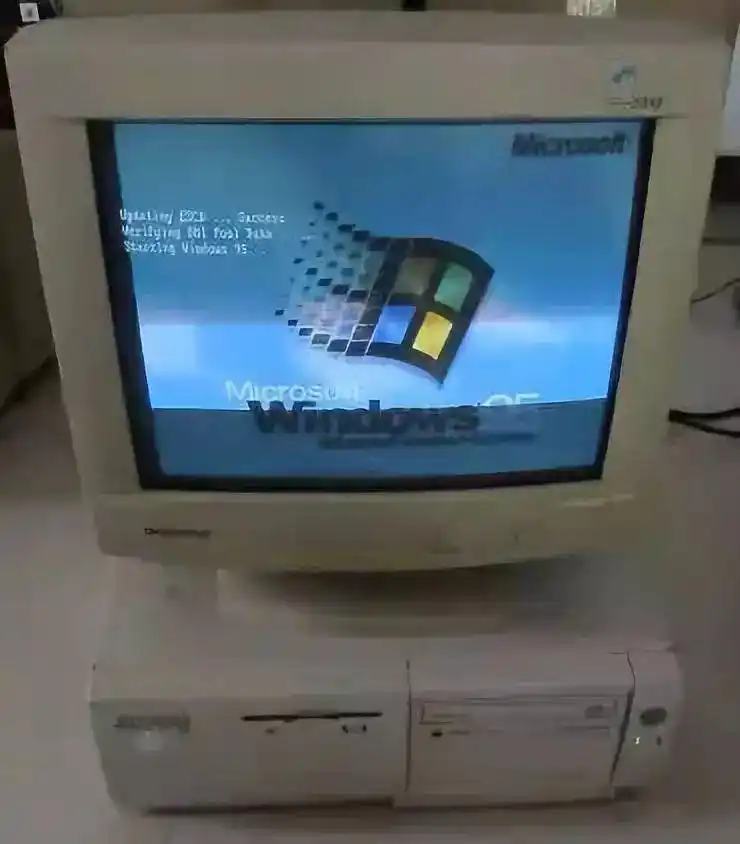
The answer is the direction of the screen to the electronic gun. Because electronics are going in the opposite direction。
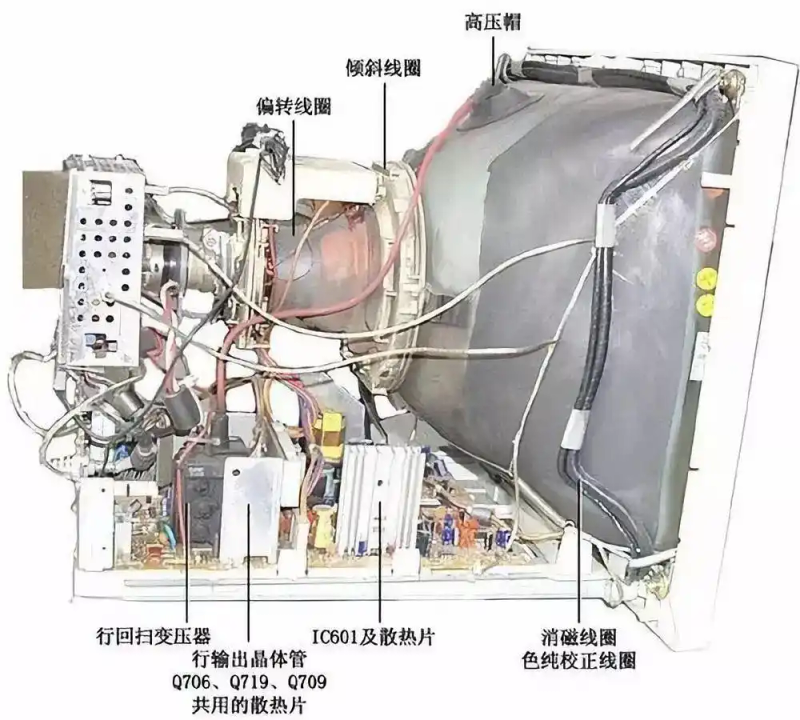
Well, it's not a question of high school physics, it's just a question of telling the young darlings how great the changes in my life have been. By the way, even if it's in your head, it'll use it to get lost... It's a middle school physics question...
When i went to primary school, home-based televisions and computer monitors had such thick buttocks and, of course, there was a stage of back-to-back television, plasma television. But it's the liquid crystal screen that smiles until now, and because of the fact that costs are so much lower, it's becoming the most beautiful kid on the market, and it's widely applied to electronic devices, significantly reducing the size of the screen and making laptops, paddyes, mobile phones more portable on a day-to-day basis (and making work infinite and sighs)。
Liquid crystal screen construction
Lcd is a short name for the liquid crystal display lcd screen, and is now the dominant technology for tft-lcd. Looking at the dismantling of the chart, the lcd screen consists of a backlight source, oscillation, most importantly, the placement of lcds in two parallel glass panels, the installation of tft thin film transistors on the lower plate (you can understand that there are many circuits in the canvas) and the setting up of cf colour filters on the upper plate (with three-coloured blues of the rgb)。
Color theory
Because cf colour filters print three colours of the rgb, so when the light from the back of the screen passes, let's see the order: the light goes first through the transparent tft thin membrane transistor panel, then through the liquid crystal molecule, then through the cf colour filter, influenced by the different penetration rates of the liquid crystal molecules under each color, the colour strip sends out this bright, dark, different blue, three colours that mix into the colours required for display。
If, of course, this one is small enough to accumulate a lot of color-rich images, which we call pixels
What's a lcd
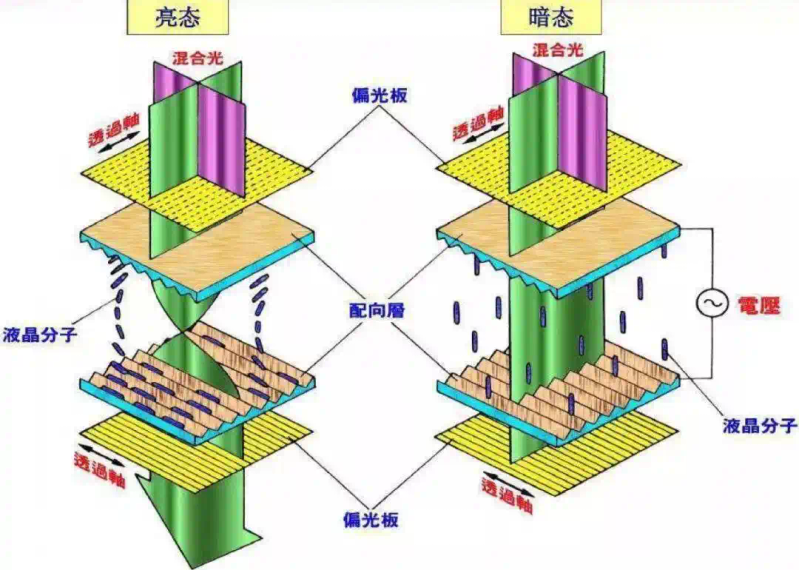
Please come out of our main character, lcd, which is a special material state. The so-called material state, which we know most about, is gas, liquid, solid, and the other one that's always heard is plasma. This time again, it is familiar with the substance of the liquid crystal, which has all the opposite properties of the crystal and liquid mobility. Most liquid crystal molecules are “stick-like molecules”, originally liquid crystals in different directions, which display different light properties under different voltages, like metals in the magnetic field, and produce some direction when influenced by external electric fields。
So, if we have proper control over the configuration of the liquid crystal molecules, we can manipulate the liquid crystal molecules to allow some light to pass, some not, and that creates a difference in radiance
It's good for light
Then look at the two migraines of the liquid crystal screen, the direction of which is vertical, and generally cannot go through the light. But we have liquid crystals! The liquid crystal molecules in the left figure below form a spiral line, so they rotate the light, so that it can pass through the second layer of light and appear in front of the screen。
And it's a microcosm of pure theory, and it's on a large liquid crystal screen that we see in our eyes. Operating in different areas is out of power, but the light is over, and finally the macro comes together to show what the image is。
It's all over. Don't have a headache. Let's see what's interesting
Manufacture of liquid crystals
Let's start by looking at the liquid crystals that have changed electronics for half a century! Usually our domestic lcd factory is a direct purchase of lcd material, but since i found the video... I can't waste it. Workers pour chemical materials into tanks and, after a series of reactions, eventually obtain liquid-type substances。
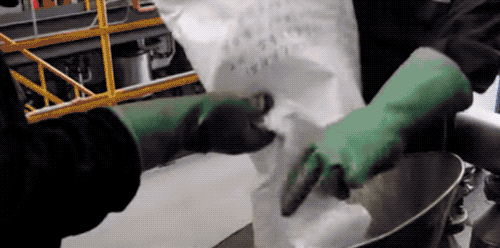
It's the liquid crystal that's warming the bottle, and now it's cleaning up。
The liquid crystal solution is then sent for purification and then thrown out for drying。
When the liquid crystal solution is slowly crystallized, it will form a crystal of white flowers, and different crystals will appear in different states, like milk or ice cream =
The liquid crystals used for the liquid crystal screen were then broken into powders, made up of many of these singles. As for the chinese name... It's not like we used to show off or anything, but we really didn't know what it was.
By the way, the process of making liquid crystals tastes like a breaking bad.
Production steps
It's not enough to have a liquid crystal. In addition to passing through the light, there is a need to control the brightness and color of the light. The lcd production streaming process, probably divided between array arrays, cell panels, and finally module module assembly。
Optical technology
At array array plant, the most central part of the tft thin membrane transistor plate is the "photographic process". The "light carving" is the engraving of the light-sensitive protective layer, which is the light-sensitive material. Ahem. Moorsch's fire knife might have a lot to say...
Japan is no longer the lcd, but the engraved carrier, the luen gela, is still firmly in hand, so once the exit is restricted, the korea's three stars and lg will jump and yell...
Array manufacture
Remember what we said about tft, the thin membrane transistor, which could be used as a circuit board
When it is made, the patterned "light mask" is covered with photoresisting material, irradiated with ultraviolet light, and then "light solidification" occurs in the part of the light, soluble in the "light-resistance film" that we need. When heated after the visible, the film layer that is not protected by photo-retardation can be etched, the film removed and the photo-retardation drop, which will preserve the part that is protected by photo-retardation and complete the manufacture of a thin-film transistor。
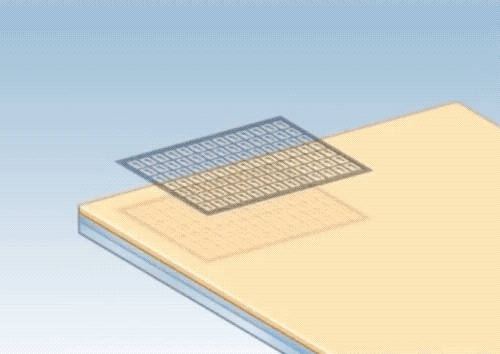
Repeating these steps of sedimentation, photoresisting, exposure, visualization, completes the light of the tft thin transistor
Panel production
First, the base plate is cleaned, first a smooth coating of fluids on the large drum to the right, then printed on the glass plate, and after heating and solidification, a "direction film" is formed. Then, using this groove-along friction cloth to roll out the gutter on the diagonal membrane, the crystals were regularly arranged on the base plate, forming a certain pre-push angle. Without the membranes, the liquid crystals are scattered over the base plate, and we can't control the direction of the light。
For cf colour filters, the same pattern is applied。
To mention a point of knowledge, it's "box tape." the aim is to make tft and cf more secure and secure the altitude of the gap between them, while also preventing leakage of liquid crystals. The man who missed the lcd screen means he's got a heart...
Spacing is then sprayed to control the thickness of the liquid crystal layer and the space between the two plates。
And then, in a vacuum environment, drop the liquid crystal and press the tft and cf to the parent plate of the liquid crystal panel. The re-use of ultraviolet light and heating processes hardened the frame. Finally, it is cut to make a liquid crystal panel。
Look at a close-up shot of actual production! Finish some crystal work on the tft thin transistor plate. No doubt, it'll only make the machine work, and it won't be able to show grandpa's grandmother's hands, controlling the amount of fluid drops and the position of drops。
The brown bottle contains a liquid crystal, extracts it from the tube and drops it to the base plate。
Overwrite light
Now we're going to have to place the diagonal panel, in a certain direction, on both sides of the liquid crystal panel, with an animated presentation。
Here's a picture of the actual process. That's how the lcd panel is done。
Model assembly
Finally, the liquid crystal panels and backlight components are assembled into a module, and the plant can be released after testing. The figure below is for the lcd lcd liquid crystal-forming panel (cell), the iso-directive conductor (acf), the driver ic, the flexible circuit board (fpc) and the pcb circuit board to be used together。
It will be followed by the assembly of finished products with backlights, lights, iron frames。
And finally, it's an aging test and a quality check, and then it's all packed with a delicate, fragile packaging. Over-module production lines are less automated than panels and arrays, but this precision is also automated by machines, and only "test" and "point glue" are done manually。
You see most of this article is animated by animated images, also because of the extreme precision of the production chain, which is almost closed。
Wait a minute
I always felt like i was chosen by fate to see so much change in just 20 years, and then my parents said they were...
This post is part of our special coverage egypt protests 2011



