In contemporary society, the value of art collections has become more pronounced. It is a combination of material and spiritual properties, which are both special commodities carrying historical, cultural and artistic information, whose value tends to rise over time as a whole, and which can bring spiritual satisfaction and cultural upbringing to the collectors. As a result, collections have become an important means of investment, attracting an increasing number of knowledgeable people to participate, gradually shifting from the small hobbies of humanists to part of the general economy and spiritual life。
Globally, investment in works of art has become globally recognized as a quality investment industry, alongside finance and real estate. Compared to other areas of investment, art investment is less risky and allows investors to enjoy spirituality while reaping economic gains. The chinese art market, which started late, has grown rapidly. With the rapid rise of the chinese economy, the rise in the standard of living of the population and the increase in cultural self-confidence, a growing number of businesses and capitalists have entered the field of investment in art collections, which have become the third hotspot of investment after stocks, real estate, and have injected continuous dynamism into the development of cultural industries。
I. A market situational analysis
The global art market has continued to expand in recent years. According to relevant data, the global art market sales in 2024 amounted to $57. 5 billion, which, despite a decline of 12 per cent over the same period, was reversed to 40. 5 million, reflecting a significant increase in the activity of medium- and low-price art transactions. The chinese market has assumed an important place in the global art market pattern, with the chinese art market taking first place in 2024 at a turnover of 12. 14 million pieces and $6. 892 billion, accounting for 39. 6 per cent of the world’s market share, well above the united states and britain. China’s art collection assets are expected to reach 500 trillion dollars, with an average annual growth rate of 13. 7 per cent, significantly higher than equities (4. 3 per cent) and real estate (3. 5 per cent). At the same time, however, the domestic art market faces a number of challenges. In 2024, china’s auction market for cultural works went through a difficult year, marked by difficulties in collection, difficulties in auctioning, lack of confidence on the part of tibetans, high prevalence rates, and weak markets。
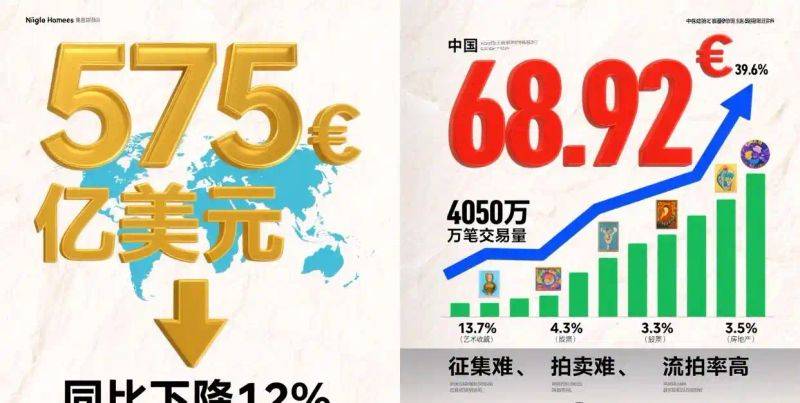
In terms of market structure, high-end markets have maintained resilience based on risk avoidance attributes, and while the number of tens of millions of united states dollars in the world declined by 39% in 2024, the top collection, like rene maglet’s empire of light, continues to record auctions at $121. 2 million. At the same time, the market at the middle end (between 100,000 and 1 million yuan) collapsed significantly, with the rate rising to 17. 2 per cent; and the market at the lower end (see table 2)
Ii. Performance facilities
(i) the increasing support of the government for the cultural industry through policy support provides strong policy guarantees for the art collection market. Taking the example of the newly amended law of the people's republic of china on the protection of cultural objects, which came into force on 1 march 2025, for the first time in a systematic and clear definition and classification of cultural objects, the inclusion of valuable works of art in the scope of protection and the strengthening of protective measures for ungraded immovable objects. This not only sets a stricter red line for the protection of cultural objects, but also breathes life into the art collection market. For example, severe penalties for the unauthorized removal of immovable cultural objects, forgery and so forth, as well as the imposition of the costs of repairing them, have greatly enhanced the legal deterrent; clearly encourage citizens, the organization of legal collections, the regulation of transactions, the prohibition of false propaganda and trafficking, and provide a firm safeguard of the rights and interests of tibetans; and require collection units to rigorously verify the legality of the origin of cultural objects, promote the establishment of a credit system and effectively curb industry disorders such as “set-up” “false identification”. It is foreseen that future policies will play a more proactive role in guiding the normative and healthy development of collection markets。

(ii) as china's economy continues to grow and the wealth of its inhabitants accumulates, economic development-driven demand increases the interest of the high net value population in art collections and their willingness to allocate more assets to art. At the same time, the growing awareness of cultural heritage and the rise in consumption have led to a constant rise in demand for spiritual and cultural products, the number of visitors to museums, art exhibitions and the growing consumer group of art markets. According to the relevant data, the total turnover of the chinese art market in the first half of 2024 amounted to 200 million yuan, an increase of 20 per cent over the previous year, and it is expected that the double-digit growth rate will be maintained in the coming years, with market size expected to exceed 500 million yuan by the end of 2025. It can be expected that, in the future, china will be expected to take a more prominent place in the global art market, one of the world’s largest art and luxury markets, which will continue to expand in size and value for investment。
Iii. Analysis of challenges
(i) imbalances exist in the development of first-level markets (art galleries, art fairs, etc.) and second-level markets (auction companies, etc.) in the market structure of works of art. In my country, the secondary market, represented by auction companies, has become more volatile and has attracted considerable funding and attention, while the first market, represented by galleries, is relatively cold and lacks effective support and guidance. This uneven market structure is not conducive to the healthy and sustainable development of the art market and may lead to unreasonable mechanisms for the price of art and limited conditions for the growth of artists。
(ii) regulatory and integrity issues
There are many shortcomings in the regulation of the art market. The laws and regulations are incomplete, the definition, classification, identification, evaluation, registration and circulation of works of art are not clearly defined, the rights and obligations of the operators are unclear and dispute resolution is difficult. Standards are not uniform, standards for the identification and management of works of art vary across functions, and there is a lack of consistency in their implementation. Industrial associations are weak, lack authority and credibility to effectively perform their role as self-regulatory and service providers. At the same time, the lack of integrity in the market is serious, the authenticity of works of art is incontrovertible, the identification of works of art is inadequate, the expert opinion is subject to a variety of factors and inconsistencies; prices are not transparent, interfered with by a variety of factors, and there is a lack of uniform and objective criteria; transactions are not regulated, and the lack of the necessary documents, such as contracts, invoices, certificates, etc., increases the risk of transactions and the difficulty of defending rights。
Future trends
The global art market tends to shift eastward, and more attention will be paid to asian art, especially in china. This will not only facilitate the process of internationalization of chinese works of art and raise their visibility and influence on international markets, but will also provide a wider platform for displaying chinese artists and promote the exchange and integration of chinese and foreign art and culture. At the same time, the trend towards the rejuvenation of the art market will become more evident. Young tibetans are becoming new to the market, and their aesthetic and collection preferences differ from those of traditional collectors, paying more attention to the story of the collection, its innovativeness and its value on social media. This will increase the focus of the art market on the diversity and individualization of collections, as well as the increased attention and recognition of young contemporary artists, whose work will bring new dynamism and creativity to the market and promote innovative development of artistic styles and expressions。