It's the dream of many people to have a pair of beautiful teeth. But binbin's mother was upset about the child's teeth, and eight-year-old bin had a star face, but the tooth bows had a narrow mouth, the jaws had been shrunk and the front teeth were prominent。
The child's deformed teeth not only affect his/her oral health, he/she is afraid to laugh in front of his/her classmates and is reluctant to communicate with many people。
Even though she wanted to give her child a bad tooth, she felt that a pair of "cronic teeth" would make the child more humble。
In august last year, binbin's mother saw the children's hospital in shanghai introducing invisibility therapy in the oral section and bringing her children to the clinic。
Invisibility is what we often call a “transparent tooth set”, a series of braces designed for the movement of teeth using flexible high-molecular material through computer simulation processes, with very small volumes of each set of teeth, lower pain levels than traditional ones, and eventually the teeth move to a neatly organized position。
The “child-friendly” services offered by the children's dental department of the shanghai city children's hospital are not limited to making children less afraid to look at their teeth, but are more important in building psychological comfort. With the "unseen toothbrush" of the invisible orthotic technique, the child is allowed to say goodbye to the fearsome "iron and steel teeth"。
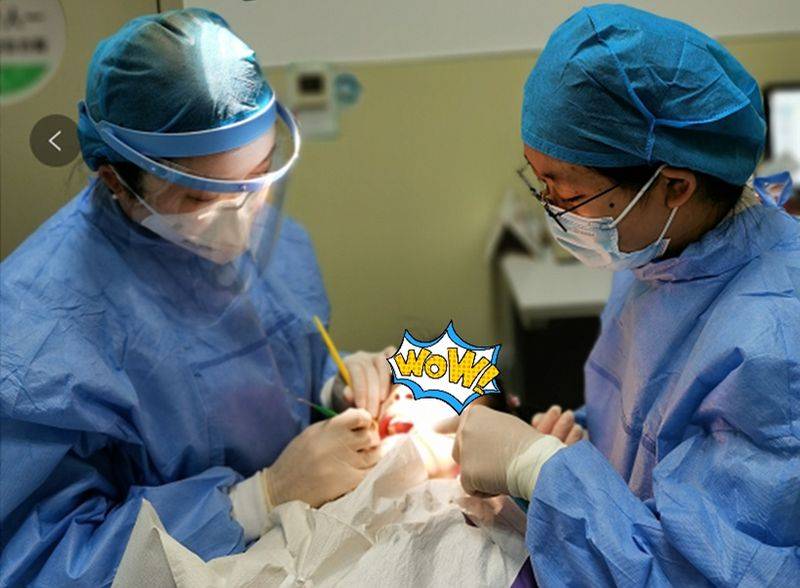
The oral department has developed a special corrective programme for binbin, which first expands the bow, directs the jaw forward and then wears a transparent dental set. Over 30 sets of toothbrushes are needed throughout the treatment cycle from half a year to one year, and after a period of treatment, binbin's tooth malformations have improved markedly, and once marked “rabbit teeth” have almost disappeared, and children dare to laugh。
In a self-confident halo, children are not only willing to cooperate with the treatment, but are also empowered to take care of themselves, and every time they re-enter, they are able to brush their teeth and clean their teeth。
According to the former director of dental services of the children's hospital, the invisible orthopaedic treatment carried out by the children's hospital was aimed primarily at children aged 7 to 9, and in 2020 120 cases of invisible orthopaedic care for children aged 7 to 9 were completed. Some parents believe that the child needs urgent treatment because of the change of teeth. In response, the former engineer indicated that special conditions such as severe gaps, mouth-to-mouth breathing, retorture (land-coverage) and trauma bites still required corrective treatment, and that, beginning this year, invisibility therapy would extend to children aged 3-5。
Despite the fact that many people recognize the importance of orthodontics, they are greedy to buy them on the internet and to wear them, choosing “diy malformations”, which is not desirable。
The teeth are not as hard in their mouths as they are in steel cement, but are wrapped around the membranes of the teeth, with a degree of resilience. The principle of correction is that the teeth move in a particular direction, using the characteristics of dental movement, restoration and regeneration of the cavity, and using external force to add to the teeth or jaws。
The teeth are pressured on one side of the dent bone absorbs, while on the other side (the tension side) there is reconstruction of the chute bone. At the same time, soft tissues such as muscles around the oral cavity and upper and lower cheekbones are subject to corresponding changes due to the presence of a pull force, bringing a new balance to the overall oral environment。
"the toothbrush is just a tool. No one can do it." according to the original engineer, the corrective “power track” is determined by the patient's teeth, which are neither large enough to cause the tooth to relax, nor small enough to hold the tooth。
Tissue therapy is a systematic project in which dental correction is carried out through a professional orthodontist, a dental examination, a model measurement, a headography, an examination of the arctic joints, arctic trajectories, growth and development, etc., and specific corrective programmes are developed after a specific analysis of each individual case。
During the half-year period of corrective care, the child visits every month, each time the doctor assesses the situation with regard to the transfer of the child's teeth during the previous period, develops the next stage of the programme, adjusts the braces and sometimes adds additional attachments and assistive devices, provides oral muscle training, etc。
While the diy approach may appear to reduce costs, it is difficult for parents to find that treatment is more time-consuming when problems arise, such as exposure to the roots of their teeth as a result of excessive movement, and when injury to their teeth is not properly corrected。