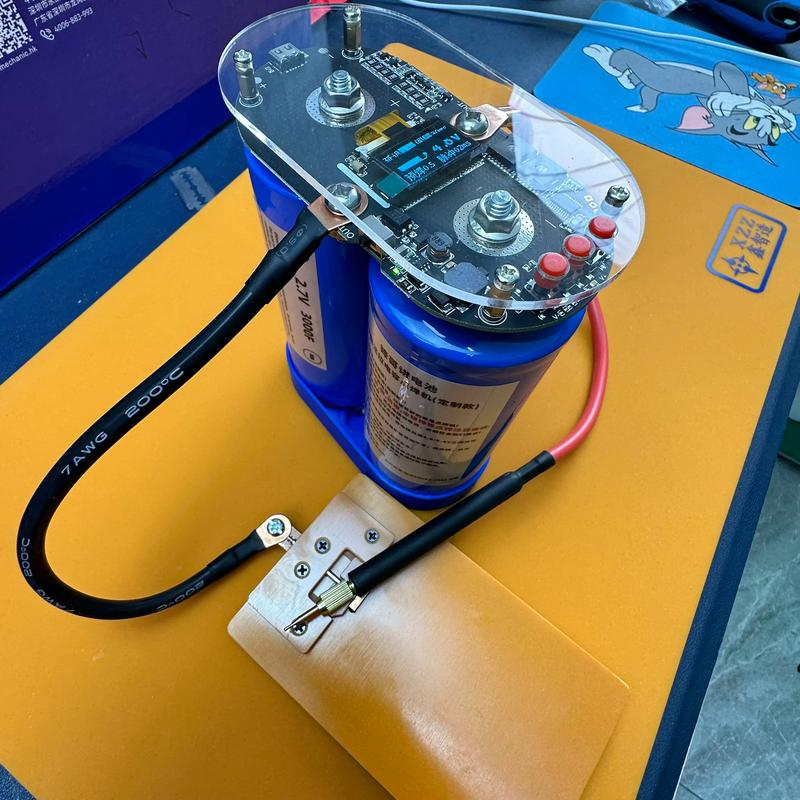
It is inevitable that welding battery poles or thin steel plates will be encountered during the production and maintenance of our off-the-shelf electronics for the exchange of ourlders by the home-made mini-communicators and that welding machines will not be available to ensure the success of this task. Welders can normally be divided into direct and communication welders, which are described here as communication welders, consisting of pressure-relief transformers, current regulators and heat-dispersion systems, as well as welding guidance lines, handles, etc. Welding does not involve the use of welding bars, except that the two pieces of work that are to be welded are to be used as two electrodes of the circuit, using the high temperature generated by exposure to electrical resistance to melt the metal in an instant, so that the pieces are welded together. Since the purchase of finished welders is expensive, if you think you're not too weak, you can use the dey spirit as well as pens to make a functional mini-welder. As figure 1 shows, b2 is a pressure-relief transformer. It's also the core of the welder. Ab2 whole-stream bridge, one-way controlled silicon scr, single crystal tube ujt, electrical resistance r2, r3, r4, r5, capacitor c2 and electrical level rp constitute welding current failure regulators. Direct current form a is used to indirectly indicate current size for welding. Just formed power-directed circuits with led. The small transformer b1, the whole stream bridge ab1, the capacitor c1 and the fan m constitute the radiator system. The diagram shows that the equipment circuits are very simple and that complexity can only be considered a current regulator. It uses the negative properties of a single crystal tube to form a oscillator to act as a one-way, controlled silicon trigger circuit. As a result of the single-crystal tube, the power of the oscillator is derived from the full-wave pulse current voltage of the full-flow circuit output. When the controlled silicon is not wired, the cap c2 of an oscillator is charged with r2, r5 and rp, and the capacitive voltage vc2 rises exponentially. At the peak voltage vp of a single crystal tube. The single transistor tube ujt suddenly leads to a sharp reduction in resistance to rb1 in the base area. The capacitor c2 transferred through the pn to resist the rapid discharge of r4, causing a positive jump at both ends of the r4 voltage vg. A steep pulse rises along which the vc2 drops exponentially with the capacitor c2 discharge, and the monocrystal tube closes when it is below the valley voltage v. On both ends of the r4 is the tipping trigger pulse. Make a controlled silicon scr channel. Communication currents are present in primary b2 circuits, while controlled silicon pressure drops are small, forcing the zhang oscillator to stop working and the controlled silicon** off when the exchange voltage is over zero. The zhang oscillator is re-electrified and the cap c2 is recharging, which is repeated over and over again. The rp, which regulates the level, can change the recharge time of the capacitor c2, i. E. The convulsion cycle. Nature also changes the moment when each exchange voltage reaches zero and the oscillator triggers the first pulse. Correspondingly, the conductor control angle of the controlled silicon scr was changed, resulting in a change in the voltage at both ends of the primary b2 rounding. The purpose of regulating secondary output currents is ultimately achieved. The device selection and testing the pressure-relief transformer b2 selects the filament transformer for the fu-720f, the end-of-screen color television transmitter. Primary communication voltage 220v. Secondary communication voltage 4v. Stable output currents can reach 80a. If such a suitable low voltage large current transformer could not be found at once, it would also be perfectly self-manufacturing to first find a 220v power-exchange power transformer above 300 w and remove the original secondary circuit. In addition, copper cables above 0,5 square centimetres orbit transformers from 6 to 10 kilometers to ensure that the output voltage is approximately 4v. The single transistor tube uses bt33f, the one-way controlled silicon selects cr10am, and the test for good and bad, and the extracting electrodes, before actual production. A single crystal tube. First, when it was decided to place a pointer-based, universal form of electrical resistance in the r x 1k slot, and when two graphs measured positive and reverse resistance between any of the two electrodes were equal about 2-1ok, the two poles were b1 and b2, and the remaining one was extremely ejected, and then distinguished between the first and the second base level b2, followed by the black chart pen to the e pole, followed by the red table pen to contact the other two electrodes and measured the positive electrical resistance values. Due to the construction of the tube, the second cylindrical b2 near the pn knot, the positive resistance between the polar e and b2 should be slightly smaller than the positive resistance between e and b1, in the range of several to a dozen k. Thus, the electrodes taken by the red counter when the resistance was measured were b2. When the barrier is greater, the red counter is b1. But even if b1, b2 goes upside down. The pipes would not normally be damaged. It only affects the output pulse; the range in which the output is found to be pulsed over hours. It's just two basic poles. One-way controlled silicon in a shape similar to a high power triode. Distinguishing the anode a, cathode k and control pole g when the three electrodes are induced. You're going to have to use a pointer for table rx10. Both the measured resistance and the remaining two feet are not in line, and the positive anti-resistance value is over hundreds of thousands of euros in the a extreme. The remaining two foot barriers are measured. Less resistance is about dozens or hundreds of euros at a time. The black pen takes the g pole. The other foot is the k pole. If the test results do not match the above. Indicates that the widget is broken. Direct current form a may be replaced by a ready-to-purchase milligram table followed by a long lead line. The route is equivalent to a small resistance to diversion. The exact length is to be determined by an appropriate cut based on the actual use of the display. The dispersing fan uses the usual straight-flow 12v computer fan, and the transformer b1 takes 10v. For resistance above 2w, fu selects 250v, 4a fuses. Considering that the secondary output has a large current, welding guides should use a purple core line and have sufficient cross-sections to ensure that they are not overloaded during use. Finally, attention is drawn to the fact that the circuit is fully assembled and placed in suitable metal casings, and that, in addition to ensuring good ventilation, the entire circuit is well insulated from the shell while the shell is reliable