



Emotional 3d theory
Before the twentieth century, the main problem facing humankind was survival, and thus its commitment to understanding and grasping the natural world, emphasizing reason and awareness, which were the needs of that time; and after the twentieth century, the main problem facing and to be addressed was no longer survival, but development, which included both the dimensions of social and individual development, namely, understanding and grasping society and the individual himself, and hence the urgent need for a deeper understanding and understanding of psychological factors such as emotional and emotional factors。
In fact, emotions are a very complex psychological factor, not simply divided into happiness and discomfort, but they contain very rich elements. It is believed that the word "controlling" is not new to everyone, and that there have been times when there has been little or no emotional control in learning. The epidemic, with more stringent external conditions, and how to manage emotions without emotional control and become a slave to them, has become a subject that needs to be explored in depth。
Today, in keeping with its emotional dimensions, the editor has learned to discuss how to become an emotionally stable adult。

Emotional dimensions
2022
5/20

Emotional classification has been a difficult issue for emotional researchers, and human emotions have changed so much that their variety is difficult to determine. In emotional studies, the traditional categorization is to divide a large number of emotions into separate, specific emotions, such as anxiety, fear, pleasure, etc. However, the problem of this emotional classification is becoming more apparent, the most serious of which is the fact that the measurement of different emotions is often highly relevant, such as the positive correlation between fear and anger, the positive correlation between vitality and pleasure, and the fact that there is a correlation between different emotions: emotions can be classified by some basic dimension, so that emotional researchers shift to a dimension model。
The dimensions theory suggests that all human emotions consist of several basic dimensions, that the similarities and differences between different emotions are based on the distance from each other in space, and that different emotions are gradual and smooth。
The dimension of emotion, which implies that there is a variable measure of the nature of the emotions that are inherent to it, and the change of emotions and emotions in each dimension, has a bipolar character. That is to say, there are two opposing states for each emotional and emotional change, which is the bipolarity of emotions and emotions. Different studies have different views on the emotional dimensions。




Emotional 3d theory
The three-dimensional theory is mainly represented by feng, schloberg and plucek。
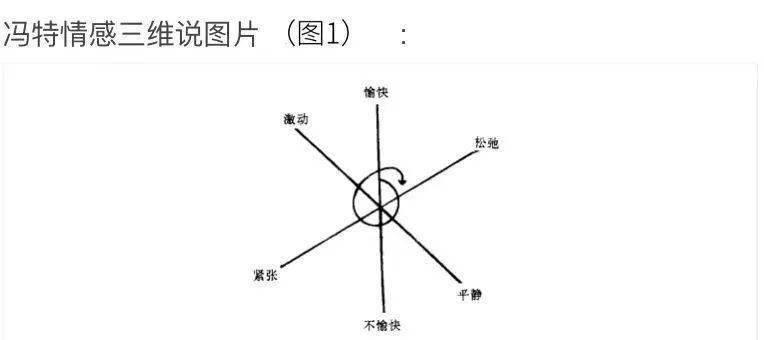
Font first put forward an emotional dimension in 1986, arguing that emotions could not be described solely on the basis of pleasure and discomfort, but that they required three latitudes (happy — unpleasant, tense — relaxed, excited — calm) to be described effectively。
They are independent and distinct, each of which is distributed in different places between the three dimensions, each of which is combined in different ways. Emotions are dynamic, and different emotional elements combine to create specific emotions. At that time, his view had aroused interest in the study of emotional problems, had had a positive impact on the promotion of emotional studies and had laid the foundation for a later three-dimensional pattern of emotions。
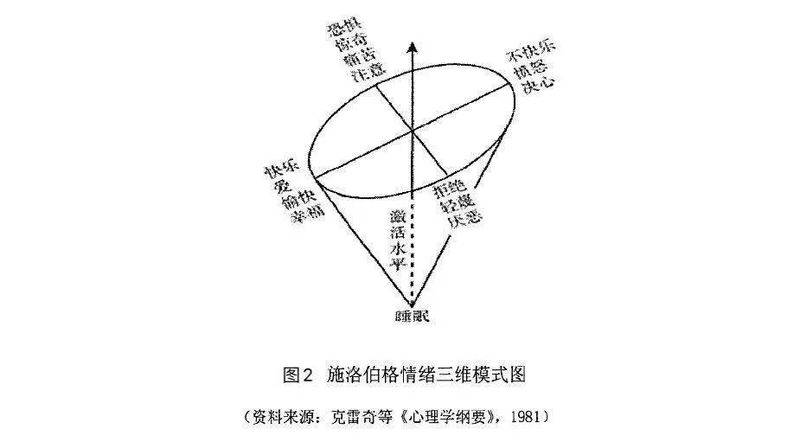
Based on a study of facial expressions, american psychologist schlobberg introduced the three-dimensional theory of emotions in the 1950s, following a happy-unhappy-noticing level of refusal and activation to rank specific emotions in a reverse ellipse. The long axes of elliptical tangents are the dimensions of happiness, and the short axes are the dimensions of attention, suggesting that emotional pleasure can be distinguished more precisely than attention. An axis vertically on the elliptical plane is the strength dimension of the activation level. A combination of these three dimensions gives rise to emotions。
Prachek believes that emotions have three dimensions, one of strength, similarity and bipolarity. He used one invertebrate to illustrate the relationship between the three dimensions. The vertebrae is divided into eight primitive emotions, the adjacent emotions are similar, the emotions at the opposite angle are opposed, and the vertebrae from top to bottom shows a change in emotions from weakness to strength. The centre of the cross-section indicates that the conflict was created by mixed motives。
According to prachek, all emotions show different intensity, ranging from depression to grief; any sentiment is more similar to other emotions, such as hatred and anger than disgust and surprise; and any emotion has two opposite poles: hatred and love, happiness and grief。
Pad emotional 3d theory
The pad emotional three-d theory is a dimension observation model developed by mehrabian and russell in 1974, which considers emotion to have three dimensions of pleasure, activation and strength, among which:
P represents pleasure-displeasure, which expresses both positive and negative aspects of the emotional state of the subject, i. E., the degree to which the emotion is positive or negative, and the degree to which it likes or does not like it, and which reflects the essence of the emotion
A for arousal-nonarousal, indicating the level of neurophysiological activation and vigilance of the subject. Relates to the degree of activation of the body energy associated with the emotional state
D represents the degree of superiority (dominance-subm condition), which indicates the state of control of the subject over the situation and others, primarily the degree of subjective control by the individual over the emotional state, distinguishing between individual subjective or objective environmental impacts。
Studies have shown that the three dimensions of p, a and d can effectively explain human feelings。
For example, mehrabian and others use these three dimensions to explain the vast majority of the variations in the other 42 emotional tables, and these three dimensions are not limited to describing subjective emotional experiences, which have a better mapping relationship to emotional external performance and physical awakening。
It is worth noting that past emotional studies have focused more on pleasure and activation, but these two dimensions do not effectively distinguish between some emotions (e. G. Anger and fear), while the pad three-dimensional emotional model distinguishes between anger and fear, both of which are low pleasure and high activation, but they have the opposite advantage, anger is high and fear is low。
Research suggests that the pad 3d emotional model can adequately express and quantify human emotions and emotions and is the basis for emotional computing research。
Thus, human emotions are diverse, complex and diverse, and if you always feel that your emotions are merely happy and unhappy, that human emotions are monotonous and not very different, then perhaps you need to increase your “emotional particles”。
Temperature
Academicly, the ability to identify one's own or others' emotions is called an emotional particle size, an ability to build a more detailed emotional experience. The higher the amount of emotional particles, the greater the ability to distinguish between emotions, the lower the amount of emotional particles, the lower the ability to distinguish between emotions。
People with high levels of emotion are able to describe their emotions in rich words or to sense others' emotions, such as “excellent” — happiness, satisfaction, excitement, relief, joy, hope, inspiration, pride, worship, gratitude, exultation — while individuals with low levels of particles may simply say they feel happy。
Emotional particle size is the key to emotional intelligence, and the higher a person's emotional particle size, the higher his ability to communicate, the less likely he is to be ill and the more likely he is to have a happy life. By contrast, people with low emotional levels are vulnerable to diseases such as depression, anxiety, eating disorders, autism, marginal personality disorders, etc。
Many studies show that people with high emotional granularity are less likely to collapse under pressure or adopt negative strategies, have lower levels of depression and anxiety than revenge or aggression。

So, how do we increase our emotional levels
We can actively learn new words, read more, or even invent new emotional words, so that the brain can predict more accurately the body's response。
In addition, you can document your positive experiences every day or occasionally deliberately build some negative emotions. For example, before major competitions, you can create anger by shouting, jumping and waving in the air, thereby stimulating yourself。
Just keep your mind on it
In fact, what the three-dimensional theory of emotion is trying to say is, if we can keep our emotions in a more stable state and keep our emotions in a stable range, it's better than getting our emotions up and down. We do not have to look forward to that particularly extreme pleasure, nor to be in the midst of that painful and profound sorrow, but we can experience it more and feel it all: it's all there and it's all there, but it's all there, it's all there, it's the way we know ourselves, it's the way we feel the world。
When something is lost, there will be a slight sadness
When you're afraid of something, you can allow your little nervousness
When achieved, you can feel the light joy
When you don't like something, you can have the ability to refuse
When you feel someone's love, you embrace the warmth of happiness
And that's actually what we need to do to develop a positive mood, which means not to judge any of the emotions that have developed, not the good and the bad of each。
When it comes to judging emotions that are good and bad, it is natural to follow them as happy and happy. And to avoid resisting bad emotions, like depression, irritating. Both stubborn and resistant will consume your energy and trigger more emotional volatility and conflict. Puts you in a pattern of emotional spiral。
Keep your mind straight and don't divide emotions into good and bad, i. E. Don't divide emotions into two different camps, thereby reducing internal contradictions and struggles。
That way you can treat emotions superbly, and their influence on you is weak. That's when you have real control over emotions。
Understanding emotions, managing emotions — it is indeed a big task — and it is a problem that we need to face and address. Only when we have a deeper and more comprehensive understanding and understanding of emotions will we be better able to live with them。


The epidemic is currently affecting lives more or less, with scientific and life-stressed pressures on them, and in the absence of schooling and with fewer emotional outlets, it is advisable to try to stay the course and be an emotional bystander rather than a participant or even a controlled one. The environment of the epidemic cannot be changed, but life is ours, and different environments should have different lifestyles and emotional controls。
After all, dark clouds cover the moon, but cannot steal it。
Finally, it is to be hoped that during this difficult period, all of you will learn from each other. All the experiences, all the growth, hold on, maybe tomorrow is the sun。



