The author has combined the project experience of the bank's foreign exchange system and international remittance products, which he has been involved in, particularly with the tender engine. The articles are aimed primarily at foreign exchange entry readers and at colleagues interested in the design of the quotation engine. This article may be simpler for you if you are a senior foreign exchange practitioner。

I. Explanation of terminology
Quote: the price of money. There are two forms of quotation in the foreign exchange market, direct and indirect。
Direct quotation: also known as giving quotaiton, is the method by which a country converts a number of units into local currency, such as usd/cny=6. 8773, based on the foreign currency of an integer unit。
Indirect quotation (indirect quotation): also known as receiving quotaitón) means the price of a foreign currency converted by a state to certain amounts, such as eur/usd = 1. 1212, based on the local currency of the unit integer. With the exception of the united kingdom, the united states, australia and the euro zone, the majority of countries at the international level now use direct pricing。
Currency versus (currency pairs): currency against exchange rates of foreign exchange transactions consisting of two currencies is expressed by two iso codes plus a separator, e. G. Gbp/ usd, with the first code representing “basic currency” and the second “secondary currency”。
Immediate rate of exchange (spot rate): also known as the current exchange rate is the foreign currency that must be delivered on a sale at two business days (business day, also known as working day, working day, or trading day, t+2)。
Forward rate of exchange (forward rate): also known as forward exchange rate, is the foreign currency that must be delivered at a time to be agreed upon by the parties after the foreign exchange transaction has been concluded。
Point difference (spread): the smallest floating unit, with a difference of `points' when exchange rates change。
Marketing (market maker): a business in the inter-bank foreign exchange market is a member of the inter-bank foreign exchange market who, with the approval of the local monetary authorities, has the obligation to provide the market member with a continuous sale and sale price and to provide liquidity to the market through his own sale。
Money flows (almount of an amount in total): refers to the total amount of money actually in circulation on the market。
Ii. Processing mechanisms for the quotation engine system
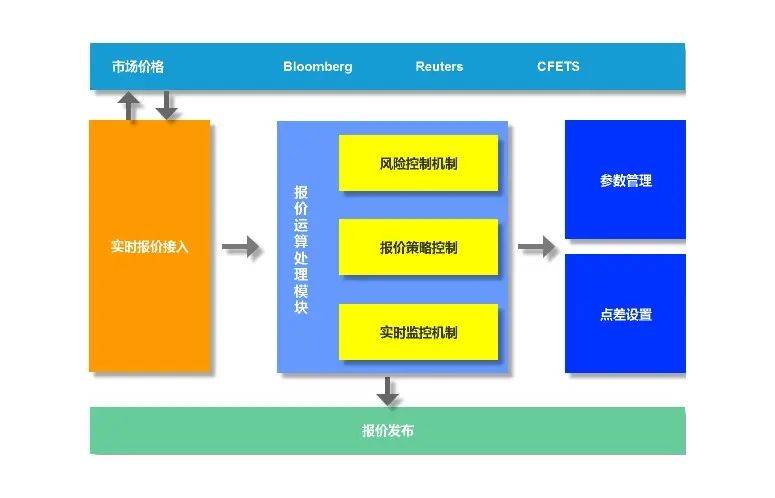
The client initiates a request for quotation from the quoting engine system through the business subsystem, which provides real-time access from the international market to one or more sources of quotations (both manual and system) and then uses the system's own processing mechanisms to process card prices and then issue a consolidated offer to the business subsystem at which the client deals。
1. Quoting access module
Currency exchange rates, which are used mainly to collect different sources of quotations on the market, such as vents, flags, etc., also support manual importation。
2. Request for quotation processing module
The quoting operations module is at the core of the quoting engine and can be divided into a risk control mechanism, an offer strategy control and a real-time monitoring mechanism。
Of which:
The formulation of an offer strategy depends on market factors and operational objectives. A mature system would access multiple sources of quotations and adopt an average price based on all offers, plus margin's post-offer, and the system would then choose the best price channel to deliver as its counterparty。
Of course, if the operational objective is to maximize returns, then the offer strategy can also be designed to select the worst offer + point for the customer, using the best price as the transaction price。
In addition, the design of the quote system as a marketer would be more complex and specialized and, in addition to the quotation engine system, there would be a need to increase the money flow system in order to monitor and update in real time the volume of money in the market. In the quoting model, in addition to the purchase and sale price, the maximum value of the buy-in and sell-out transactions is returned to the customer。
The real-time monitoring mechanism is used mainly for price source anomalies, including price source overtime, ask/bid being zero or inverted. When an anomaly occurs in one source of quotations, the system alerts and supports automatic or manual switching to another source of quotations to ensure that the system operates reliably。
3. Quote release module
Accomplish the offer to customers or business subsystems。
4. Parameter management
It is primarily used to maintain the parameters of the system, such as currency matching, cut-off periods, holiday parameters, quotation groups, frequency of quotations, conversion price setting, etc。
5. Disparities
It is mainly used to maintain poor systems, poor access, poor client status and poor client group。