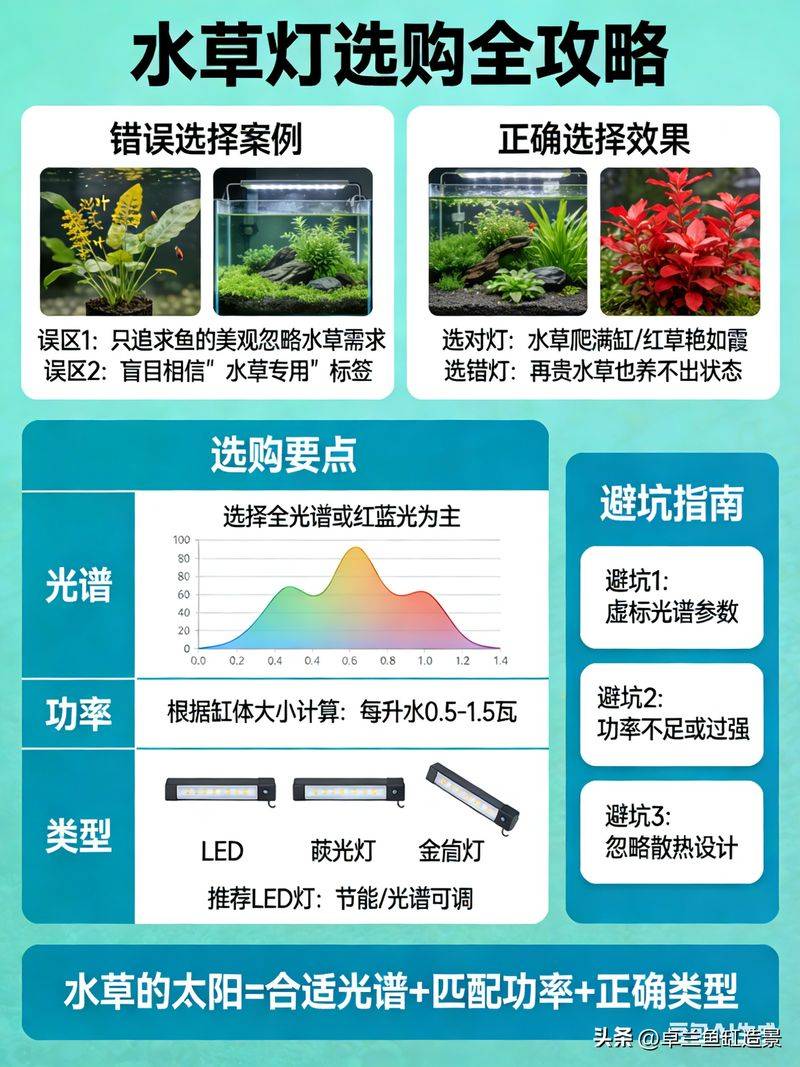
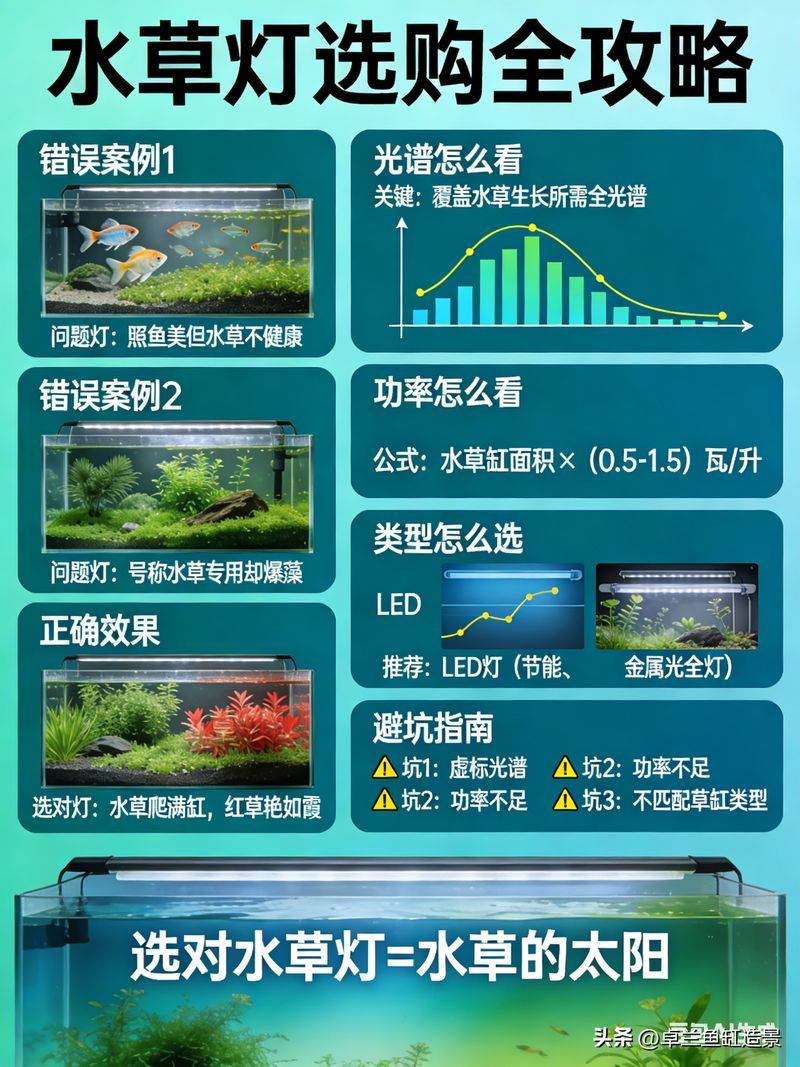
The lamps in the casks are not “lighted” — some of them are beautiful fish, while the weeds give yellow leaves; others are called “waterweeds” and the algae are used constantly. The water is the right lamp, the water is the full cask, the red grass is the most glamorous; the wrong one is the most expensive one。
Today, the selection of water and grass lamps is broken down: spectroscopy, power, type. What kind of lamp should we use for different casks? Avoiding the pits that three merchants won't say, the newcomers can also choose the “sun of waterweed”。
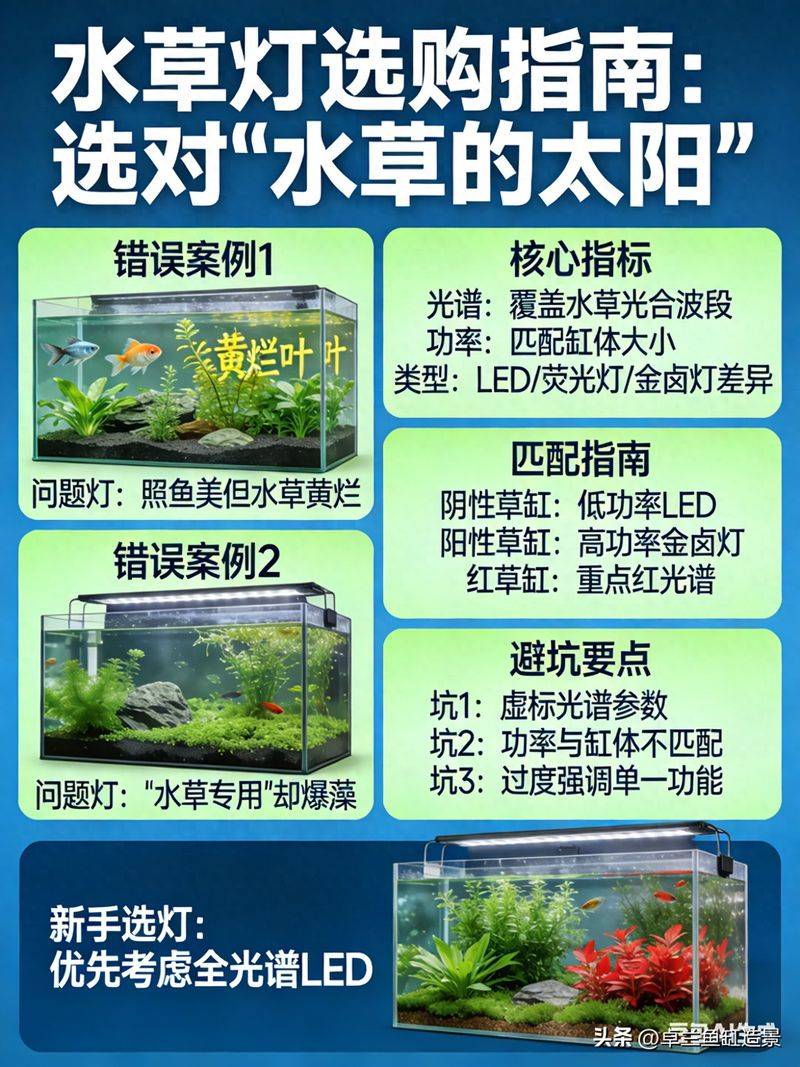
I. Understanding: the core of the hydro-grass lamps is “grass feeding”, not “lighting”
People look at the light and see if it's bright or not, and the watergrass looks at the light to see if it can be converted to nutrients. That's why domestic lights don't work – wrong spectrum, white light。
Spectra: watergrass "eating" is both light and the rest is wasted
- “nutrient light” necessary:
The chlorophyll of the water herbs loves the blue light of 430 to 450 nm (promoting thick leaves and well-developed roots) and the red light of 640 to 660 nm (helping with water herbs synthesized colours, on which weed becomes red). The two bands are not well-represented, and the waterweeds are “hungry” — yellow, thin and long。
- trader slips, "all spectral = all good":
Many lights promote “full spectra coverage”, but the share of red and blue light may be less than 30 per cent, while the remaining green and yellow light is not useful for waterweed, but rather gives the impression that it is “light”. Lights must be bought with a spectroscopy, with clear peaks in the red and blue band (like two hills) and not just with the word "full spectra"。
- avoiding pits: ordinary led lamps (e. G., domestic lamps) account for less than 10 per cent of the red and blue light, which can only be used as “watching lights” and which, in the long run, can cause the watergrass to slowly decay and never buy。
Power: not as large as possible, look at water depths “as needed”
- at water depth, greater power than “how many watts per litre”:
- a shallow tank ( < 30 cm deep, for example, 30 cm small): 0. 5 w per cent deep (30 cm deep, 15 w) enough to climb short, moss and so forth。
- mid-deep tank (30-40 cm, e. G. 60 cm): 0. 8 w per cent water depth (32 w per 40 cm depth) to satisfy meadow grass, aquelon etc。
- deep tank (>40cm, e. G. 90cm): above 1 w per cent water depth (50cm, 50w+), otherwise the bottom grass will rot。
- why doesn't "0. 5 w per litre" count? The same 50 litres of water, 30 cm deep and 50 cm deep. The depth of the water determines the permeability of the light, and the deep tank must have greater power, otherwise the bottom grass will not light。
Par value: more scientific “watergrass consumption” indicator
– what is the par value? For example, the same 15w light, good enough to get the par value at the bottom of the tank to 50, possibly only 20。
- “eat” of different water herbs:
- negative grass (mos, water): par at 30-50 on the bottom of the tank, too high to explode algae。
- positive grass (red palace, butterflygrass): par at least 80 on the bottom of the tank, otherwise unred and perishable leaves。
High-quality lamps mark par values at different water depths (e. G., “40 cm water depth par= 80”) and are purchased at 10 times the power of their own cask depth and water grass type。
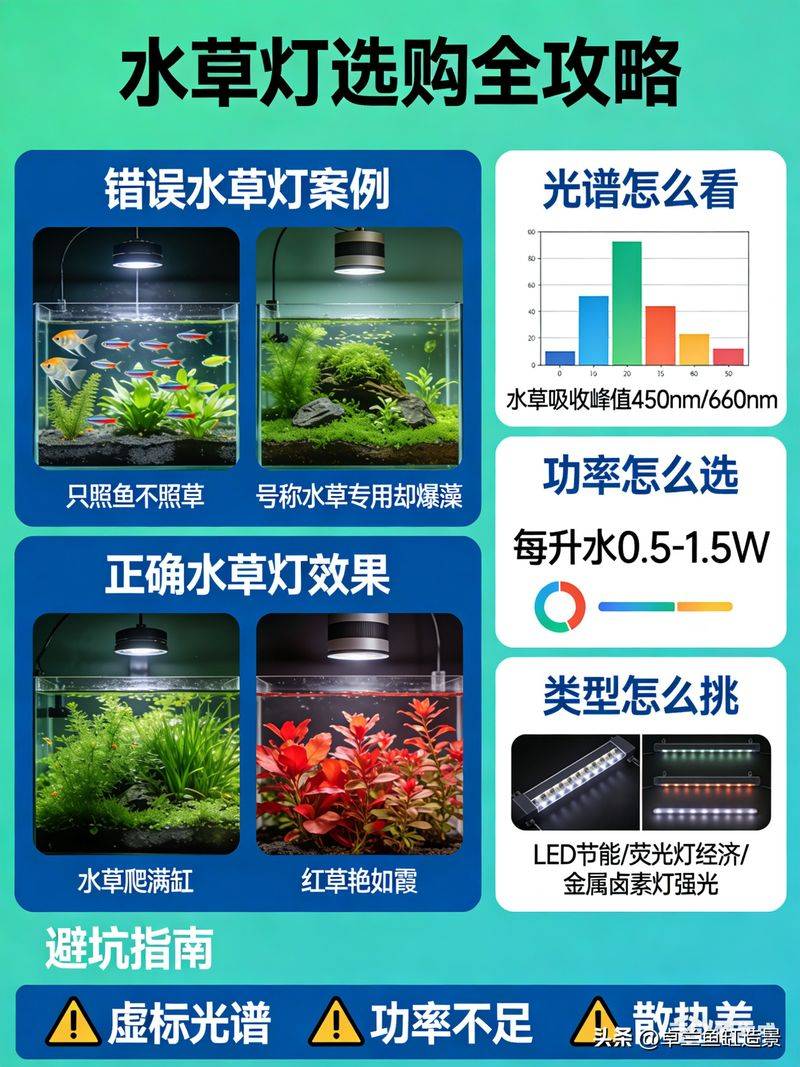
Ii. 4 watergrass lamps: leds are the mainstream, but these are not the same. Select
There are four main types of water herb lamps on the market, each with advantages and disadvantages, and not all of them are suitable for leds。
Led lamps: 90 per cent of the grass tank preferences, especially for beginners
- advantages:
Energy efficiency (also 50% less electricity than fluorescent lamps), long life (more than 5,000 hours), low heat (not increasing water temperature) and precision control of the red and blue light ratio (e. G. Special “red grass model”). Now smart leds can also use time switches, simulations of sunrise and sunset (e. G. Blue light in the morning, red light in the morning and light in the evening)。
- disadvantages:
Cheap leds (<50 yuan) are not spectrally accurate, light decays (half months darker); good leds are expensive (100-500 yuan)。
- suitable scene: all grass-cylinders, especially positive ones, red-cylinders, selected for the lighting function (which allows for brightening in accordance with the water-grass growth phase)。
T5/t8 fluorescent lamps: the old player's “soft choice”, but almost eliminated
- advantages:
Lights are smooth and suitable for large grass-cylinders (e. G. 1. 2 metres) and water grasses are not easily “sunburned” at a moderate price (a set of $100-200)。
- disadvantages:
Electricity consumption (30 per cent higher than led costs), short life expectancy (lights are replaced by a year, otherwise light decay is severe), and penetration is weak (deep tank bottom grass is not available)。
- suitable scenarios: shallow casks (<30cm), pure vaginal casks (moss, water plumes), or auxiliary lamps for leds (supplementing soft and light)。
Halogen lamps: deep-basket “penetrating king”, but too expensive
- advantages:
The light is extremely permeable, and 50 cm deep can also have enough light at the bottom, suitable for super-high cylinders (e. G. 80 cm deep view)。
- disadvantages:
Large power consumption (100w start), heat terror (which increases water temperature by 2-3°c, with fans in the summer) and a single spectrum (red grass) are rarely used。
- suitable scenario: ultra-deep tank (>60cm) and player willing to bear the cost of high electricity and cooling。
Lights/lights: never be a water-grass lamp, waste of money
- pipepoint:
They are designed for “watching fish”, and the red and blue light is extremely low, and the fish is beautiful, but the waterweed is slowly aging. Many newcomers were misled by the propaganda of the “screechlights”, which resulted in the death of the grass without knowing why。
- method of judgement: to see if the parameters are marked with red and blue wavelengths, and if not, pass。
Iii. A different "light formula" for the casks: negative grass, red grass, small casks
1. Negative casks (mos, aqueouss, peppers): not too bright, just enough to live
- demand: too much light explodes algae and not too much red or blue light (30%)。
- recommended: 15-30w led lamps (lightable), 6-8 hours per day, par values 30-50。
- cost-saving programme: t5 fluorescent lamps (2-4 tubes), light is soft, algae is not easy to explode, suitable for new hands。
2. Positive green grass-cylinders (magic grasses, oxen furs, waterland): sufficient brightness to promote growth
- demand: there is a need for more blue light (promoting green and green leaves) with sufficient power to ensure that the bottom grass reaches the light。
- led lamps for 30-60w (40% red blue light) for 8 hours per day with par values of 60-80 at the bottom of the tank。
- note: the light is strong and the water is exchanged (1/3 per week) or the algae is explosive。
Carbage casks (red palace, heartland, sangaris): red light should be sufficient or not red
- demand: red light must be high (over 40 per cent) and power is 20 per cent higher than the green grass tank in order to stimulate phenol。
- recommendations: led lamps with a “redgrass mode” (red light band enhancement), power 60-100w, par values 80-100 at the bottom of the tank, 7-8 hours per day (the long light makes redgrass green)。
- key: co2 must be matched, otherwise red grass is not red enough (carbon is not synthetic colour)。
4. Pills (30-40cm): don't buy big lights, waste money
- recommendations: mini-led lamps (e. G., lamps, stand-up lamps) of 15-20w can cover the whole tank without pursuing multiple models。
- avoiding pits: the use of large power lamps (>30w) in a small tank can cause local light to be too strong and, instead, algae to explode。
Four, three pits that merchants won't talk about. 90% of the new ones
Pipe 1: "the higher the watt, the better the water and grass" - wrong, the "burn" water shit
- consequences: “tan spots” (transparent spots), yellow on the edges, even direct solution of leaves, with severe algal blooms。
- reason: the strong light that exceeds the demand for water and grass makes it “overload” as if people are sunburned。
- correct approach: new grass-to-cylinder power is calculated by water depth and grass type, with 50% brightness and two weeks to lighten。
Pipe 2: "bring a remote control = smart light" -- too much power to use new hands
- business: the promotion of the “10 spectrospectral models” “performance app control”, which is twice as expensive。
- truth: all new hands can use is the three functions of “triggering” “time”, while other models (such as the “rain forest model” “blue-light model”) are purely chicken ribs, making it more difficult to operate。
- cost-saving advice: the selection of the basis for timing and brightness reconciliation is sufficient。
Pipe 3: "the water herblight removes the algae" - pure nonsense, even more so. Shit
- lies: certain lamps promote “special spectra to suppress algae”。
- truth: algae need red and blue as much as weeds, and the light that allows them to grow, as well as the algae to grow, is different from “the length of the light and the state of the water and the grass” (goodly grown water and the nutrients of the algae)。
- correct protection against algae: control of light (not more than 10 hours) and change of water, 100 times more than “algae removal” by light。
V. Operational techniques: 3 details for “utilizing” water and grass lamps
Long periods of light: fixed time, do not “see the mood”
- fixed daily light opening hours (e. G., from 9 a. M. To 5 p. M.) with a fixed plug for an error of not more than 30 minutes。
- reason: the water grass has a “biological clock” and the long and short light leads to growth disorders (e. G. 8 hours today and 12 hours tomorrow)。
2. Position of the light: not too high, otherwise light failure is severe
- led lamps are the best 10-15 cm from the water surface and are too high (> 20 cm) to cause 30 per cent loss of light (especially when blue light is less permeable and more lost)。
- installation: light in the small casks, light in the large casks, light in the canisters or suspensions (to ensure that the light covers the whole cask, without shadow)。
3. Periodic clean-up: dust reduces brightness by 50 per cent
- a weekly dry cloth with light beads and balconies, where the dust covers the light, and especially the heat hole ash of led lamps affects the heat, resulting in accelerated light decay。
Conclusion: the essence of the light selection is to understand what you need
An old player said, "the best water and grass lights are the ones that make the grass grow well, and you almost forget it exists." the newcomers were always confused by parameters and functions, but forgot that the core — moss — needed soft light, red grass needed enough red light, and deep tanks needed strong penetrating lights。
The three principles of "red and blue light ratio, power depth, type preference led" in spectra, can avoid 90 per cent of pits, even if they are first bought. When weeds grow in a state, you'll find that the light is not expensive, it's just right; it's not rare, it's the best view。