Since the 1990s, shared services have gradually gained prominence among european and american enterprises by helping them to reduce their efficiency and achieve rapid transformation. After 30 years of development, a more mature set of concepts and tools has been developed, with a more mature service model and a growing number of operational areas involved. Common shared services include finance, human resources, procurement, etc., where human resources shared service centres are the most valuable and difficult to build。
01, hr shared services definition
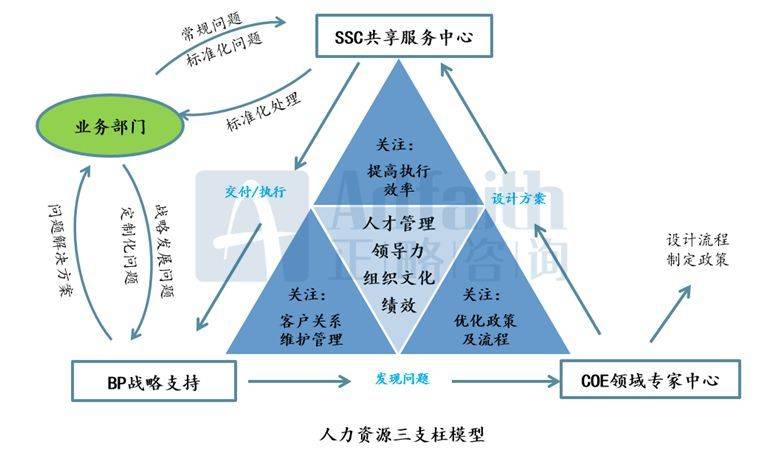
Human resources-sharing services are a new management model and an operating entity operating independently. To serve all members within the enterprise by introducing market-based operational mechanisms. It is derived from the three-pillar model of hr presented by david yurich in 1997, which includes three elements: coe (centre of experts), hrbp (human resources operating partners) and ssc (sharing service centres). Through the reorganization of the organizational capacity of the three pillars, hr is better able to create value for the organization。
02. Distinction between emerging patterns and traditional hr
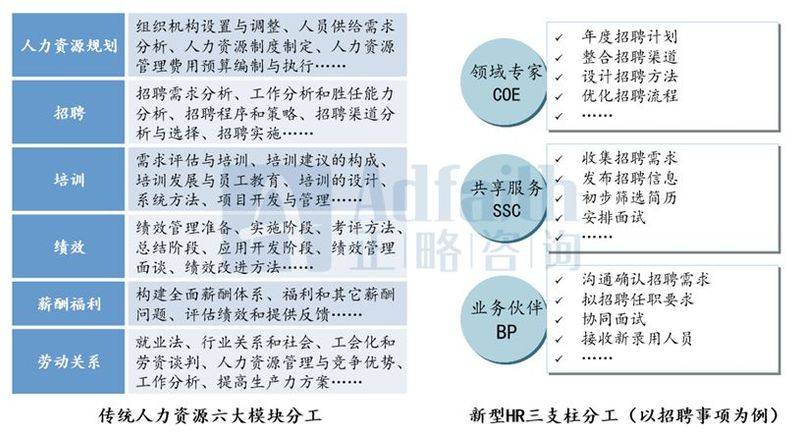
What is the difference between the emerging three pillars of hr and the traditional six human resources modules? It's not really the same in terms of content. It's just the different dimensions of the problem. The traditional hr organizational structure is a horizontal division of professional functions, with human resources planning, recruitment, training, performance, pay benefits, and labour relations as different functional blocks, the six main modules commonly referred to。
The three pillars of hr provide an integrated and vertical distinction between what is being done in each module: coe, a field expert, drawing on the expertise and mastery of leading practices in the field, is responsible for designing business orientation, innovative human resources policies, processes and programmes, such as expert consultants, providing technical support to business systems and other sections of human resources; bp, an operational partner, is a policy implementer, identifies operational problems, makes recommendations, provides advisory services and solutions to internal client needs; bp, which is key to ensuring that hr is aligned with business needs, is more like a product manager, influences business sector needs, analyses them and translates them into an internal human resources work plan; ssc is the provider of hr standardized services, performs day-to-day operational services, answers queries from managers and staff, helps bp and coe to disengage from business-like work and is responsible for client satisfaction and excellence. The three pillars of hr are therefore relevant to the substance of the six human resources modules, but are based only on innovations in the organizational and control models of enterprise human resources。
03. Reasons for hr transition
So why would an enterprise make such a human resource transition
The human resources shared service centre was designed to better serve the enterprise based on business orientation and to integrate professional resources, reduce operating costs, improve operational efficiency and provide streamlined services. Hr operates as an enterprise, with a person responsible for customer management, a person responsible for professional skills and a person responsible for service delivery. The effective division of labour and assistance across the three pillars ensures the smooth running of human resources management, which not only reflects client orientation and serves internal client purposes, but also effectively supports internal client demands for human resources management and enhances the value of human resources management。
04. Hr key elements of transition
If the strategic transformation of the human resources of an enterprise is to capture the key elements, as is the need for small tree seedlings to take root, bathe in the sun, extract nutrients and adapt to the changes in the surrounding environment in order to grow into a tree, hr also needs to focus on the following:
Clear strategic positioning of human resources. The strategic positioning of human resources determines the success or failure of the three pillars of the transition, and the human resources policy concept must be closely aligned with the firm, which needs to reposition its human resources work first, move its human resources from administrative to strategic management, align its human resources architecture and management systems with the direction of change and human resources orientation of the three pillars. There must be a proper understanding and ownership of corporate strategies。
2. Centralization and individualization of management. Shared resources and services need to be standardized while achieving convergence. Through access to shared resources, standardized platforms are established, and then, subject to universal access standards and centralized controls, are identified which operations fall under the category of “great convergence” and how to preserve them to accommodate individual differences in different business models, ultimately meeting the goal of establishing shared centres, providing the highest possible level of standard, quality and unified services, thus bringing together and professionalizing human resources services and enhancing the overall effectiveness of human resources work。
3. Clarify the direction of system processes. The optimization of systems processes is the focus of the human resources three-pillar effort to determine and identify which processes can be shared and severed and which internal communication problems the team faces. The goal of shared services requires process control and data integration. The process can be screened and classified by the enterprise on the basis of the work content of the different processes, the core principles of the process screening are remote operation, standardization and high-yield sharing, and the human resources shared service centre must be built with a corresponding workforce workflow reorganization and re-engineering。
4. Professional human resources team. People and organizations are key to the long-term success of the enterprise, with human resource teams that can inspire and drive change among their members. The results of the real-time inspection of kpi are assessed while assessing and adjusting, not only with professional familiarity with human resources, but also with business-end knowledge, innovation, design of a three-pillar system appropriate to business characteristics. There is also a need to re-engineer the hiring mechanism and to maximize the value of the individual competencies of the staff through appropriate appraisals and incentives。
5. A better information base. Information-building is the foundation and premise for the implementation of shared services, and enterprises need to establish an hrssc information service list that clearly shares the demand for the services provided by the centres and for it construction, which is difficult to implement in a phased manner, with a high degree of standardization and standardization, easy to see benefits, stable change and less resistance。
6. Business culture adapted to change. Business culture is a powerful assistant for the construction of shared services and a prerequisite for doing anything, integrating the human spirit of enterprises into the construction of shared centres, facilitating the introduction and landing of shared services and increasing the acceptance of the entire workforce。
05. Shared service construction thinking
The entire process of transformation of the three pillars of human resources is likely to be arduous, but this is where human resources are most valuable, where shared services can harmonize basic enterprise data, ensure data accuracy and transparency, improve corporate control capacity, strengthen oversight and reduce risk. This allows enterprises to consolidate their limited resources, focus on their main industries and build core competitiveness。
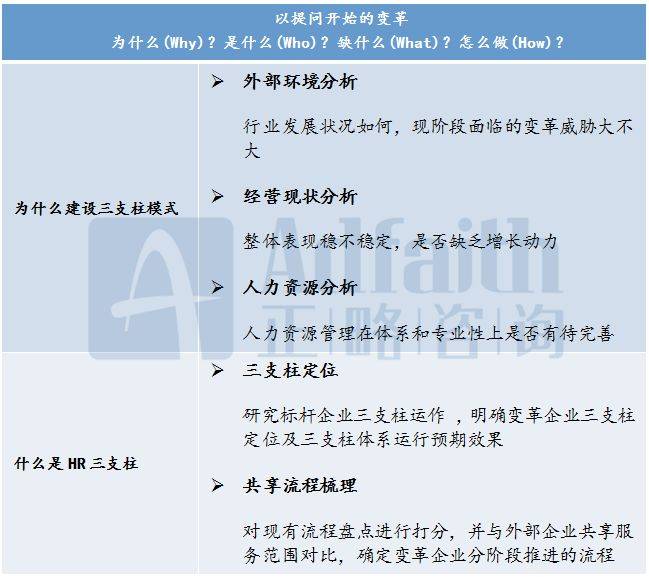
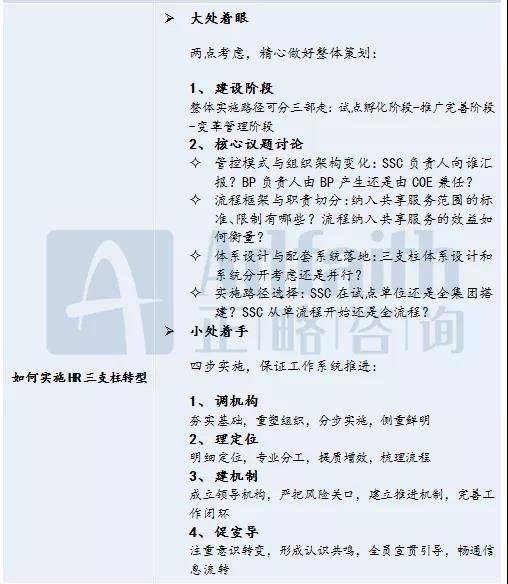
How can enterprises build shared centres when transition is so significant? We can use the following framework of thinking to ask questions about the changes that have begun to guide the transformation of the business hr。

06. Work with different roles in shared services
What kind of staff will be able to do the job of a new position after the successful transformation of the enterprise has taken place with the dedication of the staff and the establishment of a shared service platform? In order to provide hr products and services that are relevant to business needs, professional development is best done in the first line of practice of the enterprise, in order to learn about practical processes, upgrade the level of business knowledge and understand the operating system of the business. Efforts are made to encourage human resources managers to become involved in business and to give staff a way to learn and develop。
Coe, an expert in the field, equivalent to a consultant within the enterprise, whose name is well known for its diverse position in human resources, also implies that the threshold behind it is high, with hard expertise, enough experience in the field, clear solutions, ready access to the enterprise's context, medication, human resources research reports and programme design, and that many company coe recruitment requires background in counselling or extensive hr project experience. The coe needs not only real talent, but also the demands of different stakeholders, and it is normal to do research, coordinate data and write materials. The ability to solve problems is the key to determining whether or not they are capable of doing so. In a word, those who are able to live with it, those who do it are easy to perform, those who have the leadership to appreciate, those who can afford it are only tired and vulnerable, and they are always eliminated by the organization. It is equally important to have a wealth of experience in the field of hr and a capacity for programme analysis and advocacy。
Bp, as a representative of human resources in the department, like accredited ambassadors, defends the interests of the enterprise as a whole, has overall responsibility for the relationship between human resources management and business development, collects information, determines personnel and provides services to a minimum. And like corporate pr, bp is very selective and needs your personality to be able to quickly establish good relationships with the people around you and to handle complex personnel communication. The bp is often described as a hand-held hamburger, which the ministry of human resources has not been able to resolve by arguing that it lacks decisiveness and a sense of service, that it lacks enforcement, that it pursues weak policies and that it has set up poor corridors. In general, the bp is a highly emotional work, not only in terms of its psychological qualities, but also in terms of its strong psychological skills, its well-developed psychological skills, its human resources management problems in the employing sector, the irregularities involved in the operation, the historical legacy of the prior assignment, and the handling of labour disputes. At the same time, the professional competence of the bp must be manageable, enabling him to translate the fragmented demands of the business sector and the management difficulties of the department of operations into a human resources internal worklist。
Ssc, hr, whose newcomers must work on a rotational basis, standardized processes, running water lines, professional qualifications and qualifications, work at the grass-roots level with good work, hard work and enthusiasm for service, the position of supervisor requires basic process optimization, problem resolution, staff development and project management capacity. The ssc can be said to be the easiest position, but this does not mean that it has three products (no gold, no performance, no development prospects). The traditional ssc service is mostly offline, and today it is all online, with a service platform (service number or ap) for internal clients, which is extremely convenient for staff members to book their cell phones or directly online, save their working hours and increase their satisfaction, while at the same time creating benefits for companies. In addition, because of the frequent personnel services work of the ssc, there is a great deal of data advantage, a greater awareness of the staff's demands and a greater ability to find solutions from the perspective of the staff. Even if it is not possible to solve the problem entirely on its own, coe can be advised to meet the actual needs of its staff. Thus, coe also has enough room to play, and can do so in the right direction。
In summary, coe, bp, ssc each has advantages and disadvantages. How can shared services be celebrated? Work in peace, long-term commitment, good working conditions, active working attitude, innovative working spirit, hard work and learning. It is not a situation that creates man, but a situation that is created by man。