Ways to improve the effectiveness of the transfer of scientific and technological results
Oh su-in
Deputy director, professorial senior, shanghai institute of science
Figure 1 encapsulation of the original version of the study global think tank dynamics (2023 vol., no. 162) published on 24 august 2023
The conversion of scientific and technological results refers to follow-up experiments, the development, application and diffusion of scientific and technological results to improve productivity levels until new technologies, new processes, new materials, new products and the development of new industries. The transformation of scientific and technological results involves nine main elements。
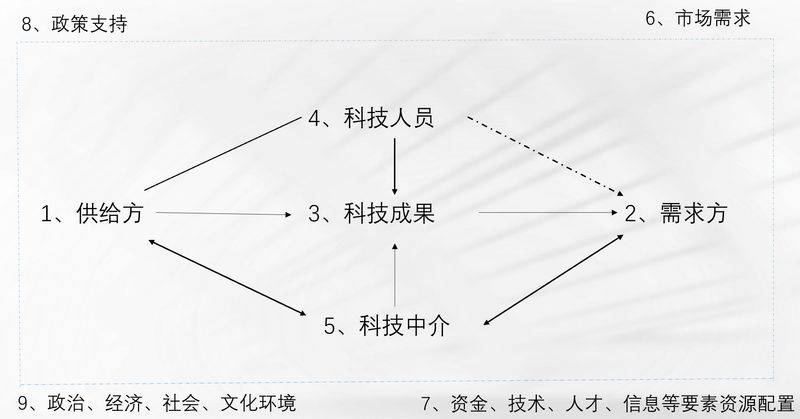
Figure 2
I. Supply side: the majority of institutions of higher education
Higher education institutions, as the main providers of scientific and technological results, must constantly export high-level scientific and technological results. At the same time, its scientific and technological achievements need to be integrated with the transformation of science and technology in the following areas:
1. Establish a sound science and technology results transfer system, including a sound system of responsibilities and a science and technology results transfer process。
2. A sound system of distribution of benefits and appraisal systems, in which young teachers are selected for their job titles, insufficient attention is paid to the transformation of results and a greater focus on dissertation outputs。
3. A robust due diligence mechanism is in place, and the research also contains questions about the low motivation of universities to translate results。
Improving the management of the assets of science and technology results, including the recording, management and disposal of scientific and technological results。
5. Sound pricing mechanisms for science and technology results and open the way to pricing methods。
Demand-side: business-based
The study concluded that technology transfer could improve 60 per cent of enterprise r & d efficiency while saving 40 per cent of r & d funding. By transforming scientific and technological achievements, enterprises can enhance their market competitiveness by developing new products or services, entering new markets, improving their management, optimizing their production management processes and enhancing their control. Improving the ability to convert science and technology requires enterprises to:
1. Establish strategic positioning for sti for development, with a strong will to implement the transformation of outcomes and a high level of investment in sti
2. The development of open and innovative mechanisms for combining productive research and development
3. Enterprises need to be sensitive to market demand, especially for the future
4. Strong capacity for resource integration (including innovative resources such as talent, technology, finance, information, data). In response, businesses need to adopt an open and innovative approach to breaking organizational boundaries and to find and integrate resources within and outside the organization。
In obtaining scientific and technological results, enterprises are required to present their needs in the light of their current state of development, but the accuracy of the needs is assessed by professional bodies. If demand is inaccurate, the demand is resubmitted and, if accurate, access programmes are tailored to demand。
Scientific and technical results: producing results of practical value through scientific research and technology development
There are three conditions for good science and technology outcomes: high technology, strong legal protection, and good market prospects. It is high-quality science and technology that is satisfied, and it is high-value science and technology that is satisfied. Scientific and technological results can be divided into three categories according to their commercial value: those of high commercial value, which can apply for intellectual property rights; those of low commercial value, which can be scientific secrets limiting communication; and those of no commercial value, which can be general results or academic papers。
The results of science and technology are not all transformational, judging by the five types of products:
1. The comparative advantage of new products, i. E., what are the advantages of new products as compared to old ones, so that consumers can accept new products
2. Compatibility of new products with existing ones, i. E. Whether new products complement existing ones
3. The simplicity of the new product, i. E. Its rapid adaptation to consumers
4. Observability of the effects of new products, i. E., whether consumers can quickly observe the effects of new products
5. Testability of new products, i. E. Whether new products can be tested for application。
The results of scientific and technological work carried out by institutions of research and development, institutions of higher learning and enterprises, or by using, inter alia, the material and technical conditions of the institutions. The mobility of staff has led to a more complex delineation of ownership of job science and technology results, such as issues of attribution of scientific and technological results arising from staff departures. This, coupled with the fact that investors often do not want to become involved in conflicts between employees and enterprises, has led to difficulties in financing job science and technology results。
In this regard, the washington hospital and sichuan university provide a better precedent, where doctors serving at both the washington hospital and sichuan university can apply for intellectual property on their own initiative, either as a washington hospital or sichuan university, but the resulting benefits are shared between the washington hospital and sichuan university。
Scientific and technical personnel
The transformation of science and technology results requires a team of scientists to be mature, willing to transform and capable of scientific research and product development。
When transforming results, scientists and technologists can choose between job placement (e. G. Active start-up and part-time pay) and lay-off. However, when science and technology personnel choose to implement the conversion of science and technology results in their posts, they need to be clear about their relationship to their unit, and part-time work should not affect their own job and there should be no conflict of interest with theirs. The establishment of an out-of-house scientific and technological staff requires the approval of the unit, which also strengthens its supervision。
Empowerment is one way for science and technology people to share benefits, and for science and technology people the empowerment of functional science and technology results can increase their incomes. The state council's office's circular on the promotion of the second series of reforms in support of innovation also indicated the need to convert the results given to scientists and technicians after the event into a former state-owned intellectual property ownership incentive. Empowerment, however, requires clear ownership of science and technology results, a clear vision of their application, a clear target audience and a proactive application by scientists。
At present, shanghai university of transport has established two different mechanisms of empowerment before and during conversion: prior to conversion, the science and technology staff enter into agreements with the school and change their intellectual property certificates in accordance with those agreements; and during conversion, the science and technology staff take ownership of 70 per cent of the results when they start a business using the results of their job science and technology; 30 per cent of the ownership retained in the school is converted into a school-to-school debt relationship between the science and technology staff or the enterprises they set up, which can be forgiven if they fail to start a business。
Technology intermediation
In the process of technology transformation, intermediaries are needed to provide supply-and-demand matching services, facilitate integration of productive research and development, and increase conversion efficiency。
The intermediary structure is divided into three types: the first, the shanghai university of transport, serves the scientific research of the school; the second, the eastern centre for state technology transfer, can be commissioned by universities and enterprises to serve the client; and third, such as the shanghai technology exchange, facilitates transactions between the parties to the transaction, may be commissioned by the other party, but also takes into account the second。
Intermediaries also fall into three categories depending on the target audience: “systems for the transformation of science and technology”, which serve the unfinished science and technology, which provide services such as laboratory tests, the establishment of a mid-test base and the adaptation of scientific and technological results; “systems for the transfer of technology”, which serve the mature science and technology, which provide pricing, evaluation services for scientific and technological results; and “systems for innovative entrepreneurship”, which serve business enterprises, such as incubators。
Market demand
Businesses need not only a keen sense of smell but also the ability to nurture market demand. Market types are divided into completely new markets, subdivisions and existing markets, and for different markets, firms face different risks。
Vii. Elemental resource allocation
Element allocation refers to the allocation of financial, technical, human resources, etc., in the process of technological transformation. At different stages of product development, transformation and industrialization, there are different demands on the type, quantity and quality of resources, and it is important that both producers find suitable configurations。
At the same time, the configuration of the elements is strongly linked to the dismantling of the science-technology transformation valley of death, the three main means of doing so being to enhance initial investment and financing, reduce expenditure and achieve profit as soon as possible。
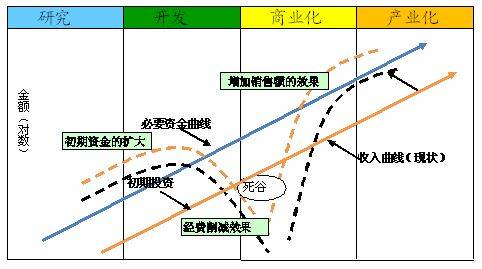
Figure 3 technological conversion of the valley of death (note: photo from ppt)
Viii. Policy support
The transformation of science and technology results needs to be supported by functional sectoral policies. Policies influence the behaviour of r & d, converts and scientists in the process of technological transformation, as well as market demand and resource allocation. The shanghai sti policy service chain includes policy collection and interpretation, policy advocacy training, policy advocacy, policy implementation coordination, policy statistical analysis, policy performance assessment, and policy research。
Environmental factors
The environment for scientific and technological transformation includes the political, economic, social, legal and cultural environment。
Businesses need first to analyse the environmental factors in the organization, including external environmental factors and internal capacity factors, in their technological transformation. The factors analysed are then constructed in the swot matrix according to order of priority or impact. Finally, a strategic analysis of the four different types of combinations is undertaken to develop viable alternative strategies。
Editor: chen moe moe