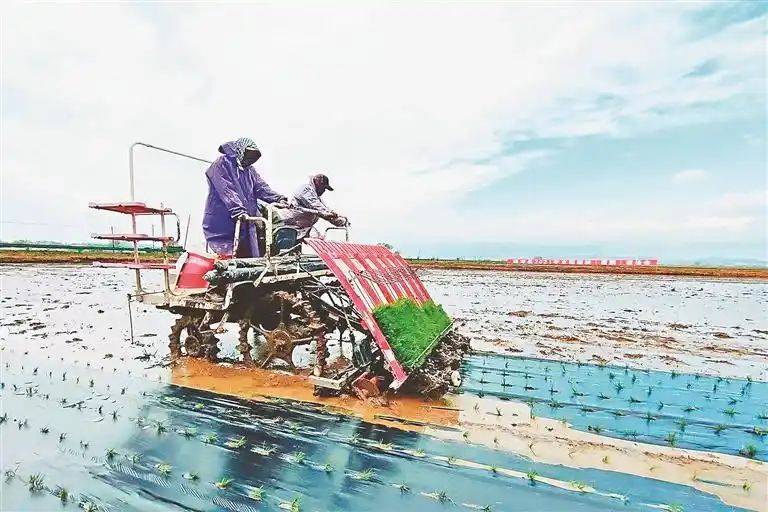
The membrane plug-in is operational。
Before the day of the news of may 17th, the yensu county sinyin organic rice professional co-operative opened an organic rice field with a light-drived rembranding machine slowly moving forward, full of a bowl of paddy seedlings, and in the vicinity of the paddy rembrandt and paddy plugged in, drawing a beautiful straight line extending far away. Not far away, small-climate instrumentation tests in real time, wetness, temperature, rainfall, wind speed, etc., and growth throughout the life cycle of rice through large meteorological data
At a live meeting on the application of new technologies for organic rice diaphragms in yenju county, the first-to-earth organic rice cultivation was excellent, and a new, modern agricultural technology was introduced. It was during the good spring season that the syndicate cooperative for pyramid organic rice, aimed at greater economic and ecological efficiency, opened a 5,000-acre “smart spring cultivation” of organic rice。
Duplicate plug-in to achieve process organic
By the side of the paddy field, journalists saw that, unlike the usual plug-in machine, which would plant the seedling directly in the field, the membrane interpolation machine would first cover the paddy field with a thin membrane, then perforate the membrane and then insert the seedling through a hole. The completion of a complex set of interpolation processes has laid the foundation for the organic cultivation of the entire process of rice。
“the owner of the cooperative fights the membrane field, producing membrane.” yao hong jianli, the director of the yuensu county cooperative for organic organic rice, and the inventor of organic rice membrane cover cultivation, said that the rice field was given a physical isolation to inhibit the growth of weeds and pests and that herbicides and deworming agents were no longer needed to assist in the total organication and safer quality of rice membrane cultivation. At the same time, the membrane is also a “temperature reserve” that can increase the temperature of rice by 200°c throughout the year, and is located in the second temperate zone. It can grow high-quality rice varieties in the first temperate zone and boost farmers' incomes. In addition, the membrane is a “water saver” that saves 30 per cent of irrigation water。
“in 2012, i led the invention of a membrane interpolator, with five invention patents. Over the past few years, the equipment has become more and more powerful.” yao hong liang has described the critical technical difficulties of growing organic rice on a large scale, as a result of a six-part replete interpolation machine that combines “beds, beds, membranes, holes, plugs, membranes”。
Biodural degradation releases ecological benefits
“this year, cooperatives grow approximately 5,000 acres of organic membrane fields as ordered.” yao hsiung said that the organic rice in the membrane field, which had been tested by the eu agency for 510 agricultural residues, had not been detected and met the eu export criteria, and that the more the brand of delayed life of “rembrane rice” became louder and the order had increased over the years. To ensure continued improvement in the quality of rice, greater attention needs to be paid to eco-efficiency。
“a thin biodegradable membrane, which can be `melted' by sinking the land itself, does not cause problems in environmental ecology.” yao hong-ryung told journalists that the cooperative's “repeated fields” are all biodegradable membrane, with top techniques from germany, allowing the membrane to start degrading in about 80 days, and that the resulting water, carbon dioxide and decompositions will be absorbed by plants in about three months。
“with this layer of degradable membrane, it will facilitate the pre-literation of rice by 9-11 days, allowing consumers to `smoking' early and increasing organic rice acre production from 350 kg to nearly 500 kg.” yao hong-ryong wrote to journalists two books: the biodegradable membrane not only helps to protect water from fertilizers, increases in temperature and production, but also overcomes pollution from membrane residues. High-quality rice was grown while protecting black land and achieving economic and ecological gains。
From “sweat agriculture” to “smart agriculture”
“5,000 acres of organic rice, all of which are under real-time monitoring of visualized, fully controlled and intelligent agrometeorological service platforms.” yao hong-ryang said that the cooperative has now established a demonstration base for high standards of provincial goods networking, refined the product quality tracking system, completed the implementation of the smart weather monitoring system and, through the analysis of agrometeorological data collection, transformed agriculture from “food by day” to “food by day”。
Not only does the rice produced by cooperatives have a higher price, but the cashbags of the members have become more popular. “... This year, with the application of new technologies, it is expected that the income of community workers from the cultivation of membranes will increase by $200 per acre compared to last year. Yao hong is proud of his words。
Yao hong-ryong and his co-operative are a microcosm of the transition from “sweat agriculture” to “smart agriculture” in yensu county. In order to make rice articles, yen su county has been working to integrate the rice industry and brand development strategy, and has been deeply engaged in the development of science and technology to promote the rice industry through market-based branding, the consolidation of resource-based and platform-based branding. Journalists have learned from the sunsu county market supervisory authority that to date the value of the “lovering rice” brand has reached 7,248 million yuan。