It's a short history
Double mushroom cultivation originated in france. As early as 1550, the cultivation of double mushrooms from unfertilized stables on the outskirts of paris was documented, along with garden mushrooms psalliota hortensis cooke (cuiochon, 1953). For over a century, however, the seeding of horse fats on melon hotbeds continued to be the result of drifting fluid from mature sub-entities. During the louis xiv era (1643-1715), the cultivation of double mushrooms was developed, and in 1707 the botanist d. Tournefort published his first paper on double mushroom cultivation, which dealt with mushrooms as “from horses”, which was transplanted to stables by horse dung with fuzzy wires, and began to use tectonic cultivation. Another french horticulturalist, chambry (1870), began to grow in the ground, believing that in the dark underground tunnels and caves environment, mushrooms were more suitable for growth and an important sign in the history of mushroom cultivation. The earth-tom plant is widely used in france and continues to this day, with holes of up to 2,500 km in 1900 (robinson et al., 1959). Until the outbreak of the second world war in 1939, france was the world's leading producer of mushrooms. At the beginning of the eighteenth century, mushroom cultivation was introduced into the united kingdom and the netherlands, then via poland, south russia, ukraine to the balkans and in 1865 to the united states. After a decline in the production of double mushrooms after world war ii, it began to develop again after 1950, with the united states replacing france. Prior to the ninth international mushroom science conference in 1974, double mushrooms were the most important species of mushroom cultivation in over 70 countries and regions。
The cultivation of double mushrooms has been improving for more than 200 years. In 1894, constantin and matruchot were successful in developing pure bacterial species by separating them with spores, and in 1905 dwgur in the united states began to produce pure bacteria with tissue blocks; in 1936 pizer began to use fermented compost; in 1754, lundberg in sweden first planted mushrooms in a warmhouse; in 1910, the first typical “standard mushroom mushroom house” was built for use in the united states; and in 1968, a modern mushroom factory emerged, and mushroom production evolved into a compatible multidisciplinary industrial sector。
In china, double mushroom production began in the 1930s, with several foreign-run mushroom plantations in shanghai and suzhou planting an area of 2,000 to 3,000 square metres. During this period, small-scale cultivation studies were carried out by pan chinon and sun hua. In 1958, the shanghai suburbs promoted the production of double mushrooms. Yang qingyou (1961, 1962) researched the success of pure bacterial species, ending the history of importing brick species to the united kingdom, while promoting pig and cow dung instead of horse dung composting, in accordance with chinese conditions, with the department of horticulture at zhejiang university college of agriculture at the centre of which was the establishment of a mushroom production group in the six provinces of china, which promoted mushroom production in the south-east coast。
Main features
Form characteristics
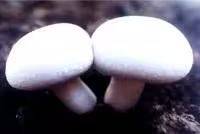
Double mushrooms are medium-sized, brevity 5-12 cm, first hemispheric, back-sliding, white, smooth, slightly dry and gradually yellow, with an incisor on the edge. The fungus is white, thick, slightly faded red after injury, and smells like mushrooms. The bacterium is then turned to black and brown, dense, narrow, non-living, with varying lengths of 4. 5 to 9 cm, thick 1. 5 to 3. 5 cm, white, smooth, silky, near-circle, internal soft or solid, membrane, central and easily defunct. Forest land, grassland, fields, parks, sidewalks, etc. The distribution is very wide and widespread in china。
Sub-entity: the sub-entity is a structure formed by the twisting of mycelium. A single-born, usually single-born, sometimes multi-gauge, fresh, fresh and smellless, dry and shredded; a hemispheric shape, mature and proximate, sometimes condensed, sometimes in the middle, up to 10 centimetres in diameter and up to 10 mm thick in the centre; a white, lactating, smooth, post-late brown on the surface of the fungus, when fresh; a blunt or sharp edge, dry inner-coloured; a pink, brown, dry, then black to black on the bacterium surface; a thicker fungus, varying in length, usually off-site, precipitous, fragile, fragile, fragile; fresh in the fungus, with an uncoated belt, with a dry soft wooden cord of up to 0. 8 centimetres in thick; short bile, collage, fibre, coming with the fungus, with a white ring in the centre; thin, muscular, easily distilling; and six centimetres, straight to 20 mm。
Myceloids: fungus filamental, tube-like, multicellular, separated, branched, unlocked. Young filament cells, 4-7 micrometres in diameter, old filament cells, 7-10 micrometres in diameter. On the pda culture (the potato glucose glucose glucose culturer), the young fungus is white, and the old age is slightly yellow. The velvet form, which varies according to the species. Based on the culture of the fungus, the species of double mushrooms can be divided into three types, namely, aerobics, scavengers and hybrids。
Bacillus: bacillus filaments, thin walls, frequent branchings, bends, mycelitis swells into irregular forms, interwoven, usually 6-9 micrometres in diameter, and 25 micrometres in diameter。
(b) bacillus: fungal fungi filaments, thin walls to a slightly thick wall, occasional branching, frequent partitioning, slightly parallel to the bacterium formation, with a diameter of 3 to 6 micrometres; some microfilms swelling up to 10 micrometres in diameter; no cysts in the sub-story; a stretcher stick in the form of a 2-bit bar and with a simple separation in the base, with a size of 15 to 26 micrometres x 6-10 micrometres; and the shape of the strain is similar to that of the burden, but small。
Spectrums: an ellipse of spores, tan, thick walls of 6. 2-8 (~8) micrometres of 5-6 (~4. 9~7), mean length l = 7. 27 micrometres, average width w = 5. 73 micrometres, length ratio q = 1. 26 (n = 30/1)。
Biological characteristics
Twin mushrooms
The fungus covers 5-12 cm wide, the first hemispheric shape, the lateral flat, white, smooth and slightly dry, and the yellow, marginal brown roll. The fungus is white, thick, slightly faded red after injury, and smells like mushrooms. Molybdenum pink, then brown to black, dense, narrow, live, and not long. It is 4. 5-9 cm long, 1. 5-3. 5 cm thick, white, smooth, silky, near-cylinder, soft or solid inside. Cyclops, white, membrane, central, easily detached. The spores are dark brown. A brunette, elliptical, smooth, and a twin fungus of a sprawl emerges with its own robustness. During the formation of the sub-entity, two different mating cell nuclei were fusionled in the original burden, forming a double cell nuclei. Double-reduced cores split into four single-body cores, two different mating cell nuclei paired within the burden, and eventually developed into an amphibious double-nuclear spores, thus completing the entire life history. Unpregnant singles, triples and four singles are also occasionally produced on the load. Twin mushrooms are fungus of faeces. A suitable mix of well fermented compost meets the carbon, nitrogen, mineral elements (phosphorus, potassium, magnesium, iron, sulphur, calcium, copper, boron, etc.) and vitamins required for their growth and development. Appropriate carbon and nitrogen ratios are essential for mycous growth and for the enrichment of sub-entities. Carbon and nitrogen ratio of manure culture is appropriate 33:1 before fermentation and 17-18:1 after fermentation. The temperature of the stun bullet is 18-20°c and that of the onset is 24-26°c. The growth temperature of the fungus is 4 - 32 °c, with a maximum temperature of 24 - 26 °c, and the temperature of the sub-entity development of 7 - 22 °c, with a maximum temperature of 14 - 16 °c. During the growth phase of the fungus, the nutrients should contain about 65% water and the relative humidity of the air should be 60-70%. At the sub-entity development stage, the water content of the soil is required to be around 20 per cent, while the relative humidity of the air should be 85-90 per cent. Mushrooms are aerobic fungus, and prolonged depression can affect mycous growth and the development of sub-entities. The appropriate ph for the growth and development of fungus fungus filaments is 7-7. 6 and the ph is above 8. 5 or below 5. The filamental growth of mushrooms and the formation of sub-entanglements do not require light, and mushrooms and mushrooms, which grow in dark conditions, are more white。
Growth properties
Culture
Twin mushrooms
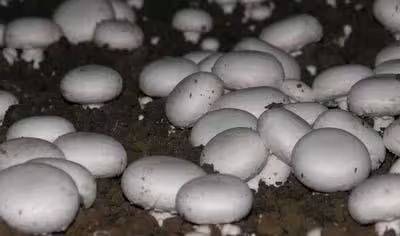
Double mushrooms are herbivorous fungus, which make good use of various herbs and various nutrients in leaves, such as straw, straw, corn straw, corn cores, etc., but other microbes are needed to ferment them or not. As a result, the plant is always fermented with a plant pile and then planted. Double mushrooms are not able to use nitro, and use ammonium nitrogen and organic nitrogen, such as urea, ammonium sulphate, protein and amino acid. The formation and growth of double mushrooms is more demanding for carbon nitrogen ratios for culture than for other mushrooms, and the lack of carbon nitrogen ratios in formulations does not yield the desired yield. The pre-carbon nitrogen ratio for culture is 30 to 35:1 and the appropriate nitrogen ratio for sub-entity growth is 17 to 18:1 because the respiratory effects of microorganisms during fermentation consume a certain amount of carbon sources and the growth of various nitrogen-fixing bacteria during fermentation。