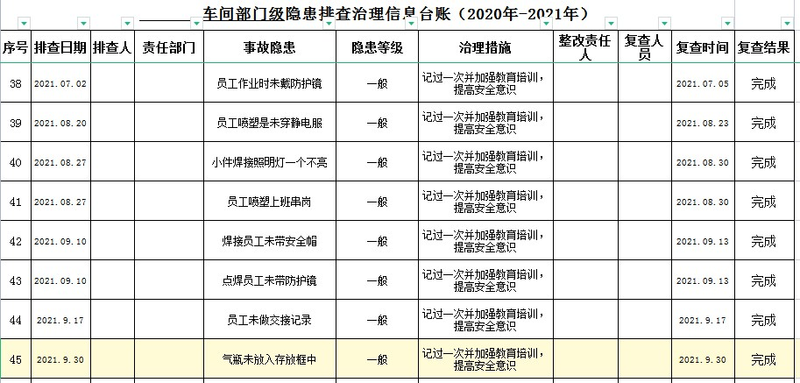
The day-to-day management of the workshop consists of routine screening of hazards and daily inspection of the security of the team. The day-to-day inspection generally consists of personnel safety and health management, electrical management, equipment management, safety education, operating environment, etc. The following table is a template form for daily workshop inspections。
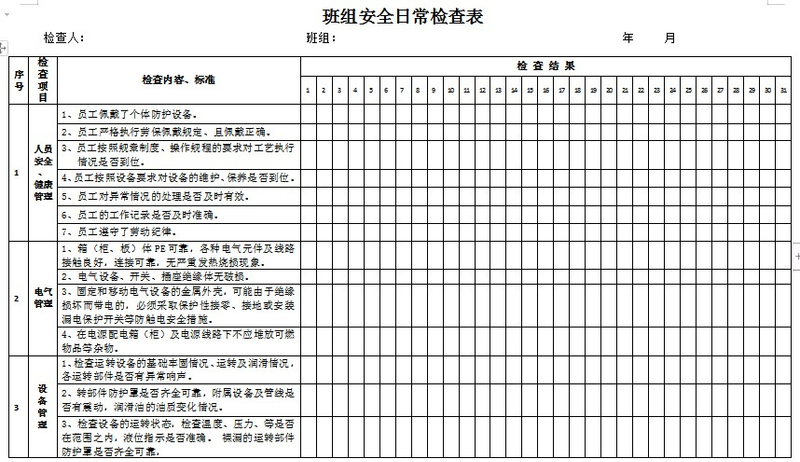
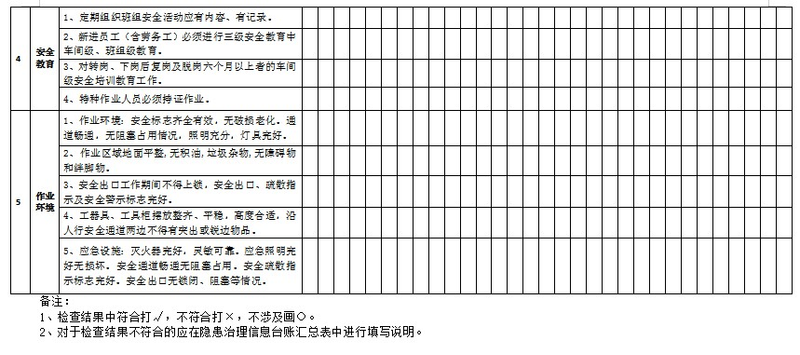
Workshop hazard screening is a process of identifying safety hazards that are dynamic in the production process, mainly from various sources of risk, such as mechanical injuries, failure of equipment safety devices, electrical leakage, toxic gases causing explosions and human asphyxiation, flammable gas explosions, etc
Practical implementation of reference security management requirements
In order to implement the occupational health safety management approach of the group's “people-centred safety, prevention and integrated management”, and in response to the requirements of the national occupational health safety management system, the safety management regulations for manufacturing plants are being developed to ensure a more smooth and efficient operation of the safety management system and a safer production of workshops。
I. Safety of production objectives
2 injuries to young people and serious injuries at the factory in one case, there were no fatal accidents, no fire accidents, no accidents at the factory, 100 per cent of new employees attended “level iii safety training” and staff received at least two safety trainings per year, 100 per cent of certified entry for special operations personnel, 100 per cent of screening for safety hazards and 100 per cent of staff medical examinations。
Training in safe production
With a view to further improving the safety awareness of project workers, improving safety skills, mastering safety operating technical norms, raising workers ' awareness of self-protection and preventing the occurrence of all kinds of casualties, the project departments have developed a safety education training system based on the following principles:
(1) strict implementation of the regulations governing the induction of national and local special operations personnel, the organization of training for special operations personnel in due course and the provision of information to the security services or the competent authorities; careful implementation of national and local regulations on labour protection and the treatment of those involved in labour protection and monitoring of their implementation
(2) level iii safety education: provides for the education of newly admitted workers, the transfer of new jobs, the introduction of new technologies, new crafts, new equipment, the safety of workers with new materials, and the training and evaluation of the safety of workers in specialized industries. A third level of safety education is required for newly arrived workers in basic safety operations, safety discipline and operating protocols. The first level of safety education is organized by a group of companies to provide labour protection to new entrants, safety-production regulations, guidelines, policies, safety regulations, safety discipline and compliance education; the second level of safety education is the responsibility of the department, which provides on-site safety information for educated personnel, safety regulations, high-altitude operations, field safety electricity, accident reporting, labour discipline education; and the third level of safety education is the responsibility of a class, which includes on-site safety care, safety technical operating protocols, machinery for the use of this type of work, knowledge of performance and safety management of tools, proper use of personal protective materials. The “three” safety education for employees is qualified for entry into operational positions。
(3) special job training: special equipment operators, such as electricians, welders, cranes, etc., are required to carry out professional safety education and operational skills training and must be certified by the municipal labour department and be accredited to work。
(4) workers attend security training at least twice a year; when new construction (production) methods, new equipment, new materials are introduced, the project departments organize the development of new security measures, new security operating methods and new job safety education。
Iii. Equipment facilities management
In order to reduce the number of casualties caused by mechanical equipment, the safety management of the processing of mechanical equipment is effectively enhanced, staff are required to maintain the equipment on a daily basis, and regular self-checking is carried out throughout the use of the equipment in order to eliminate hazards。
Ensure the safe use of equipment based on pre-service training of different equipment and establish fixed desk accounts to record the details of their use, maintenance and repair。
Iv. Operational security management
The posts in the company have a well-established job code, which specifies, for each job, the operational steps, technical requirements, equipment management requirements and safety and security requirements, as well as the management requirements, which require technical staff, business owners and safety managers in charge of the technology to organize each year at a specified time, and to prepare, update and evaluate company management documents, job protocols, etc. Staff members are also offered annual training in protocols and are eligible for induction. In-situ safety management, accident case studies, triple-checking, safety alerts, job alerts, operating safety boards, etc. Have been implemented in a number of ways to continuously enhance standardized operational awareness, promote standardized operations and improve operational safety。
V. Research and reform of disaster
The company provides timely aggregation and tracking of hazard screening and field validation of on-site corrections feedback, bringing safety management to a closed loop. At the same time, the company mobilizes all its personnel on the basis of specific time periods, seasonal shifts and accidents. It also conducts all its personnel safety management, conducts special security hazard screening, compiles staff screenings and prepares special rehabilitation plans. In the management of unsafe behaviour among employees, corrective action is promoted and appraisals, joint evaluation responsibilities and closed management are carried out in accordance with the system。
Hazard source identification
Based on the requirements of the occupational health safety management system (gb2801-2001) and the type of work, characteristics, level of self-management, etc., the company identifies, lists and evaluates the sources of risk at the construction site and defines them as major sources of risk, which cause a high probability of accidents and cause serious consequences. In response to these major sources of risk, an accident contingency plan has been prepared and an accident response organization has been established to maximize the prevention and reduction of potential harm。
Occupational health management
Establishment of a table of labour protection supplies for employees, which are equipped with labour protection items for different jobs and special protection items for special jobs (dust, noise, fire, electricity, anti-virus, high-air crash, etc.); creation of occupational health records for employees, who undergo periodic health check-ups; distribution of summer cooling items, drinks, medicines; improvement of working (office) conditions in high-temperature production jobs by means of improved ventilation and sunscreening (conditional air conditioners); certification of food quality and hygiene control by cafeteria staff。