Experimental animal number marking method
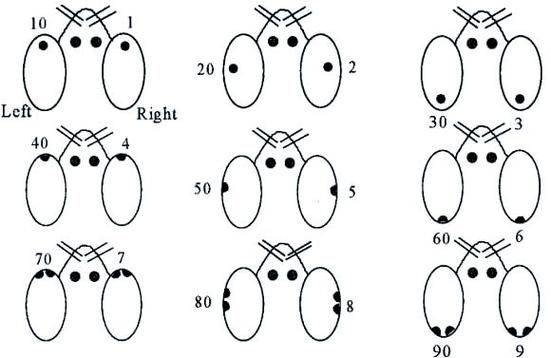
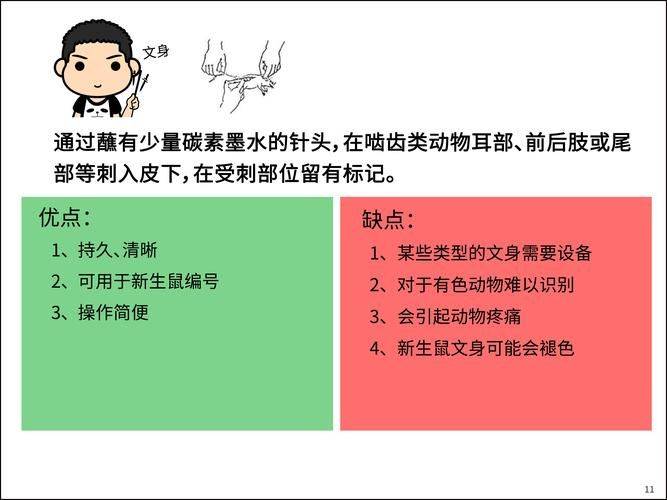
Animals often need to be properly grouped prior to testing, and then mark them to distinguish them. There are many methods of marking, and good marking should meet the requirements of clear, durable, simple and applicable markings. Common marking methods include dyeing, earring, branding, branding, etc. (i) painting, which is the most commonly used and convenient method of marking in laboratories. The paint used is typically 3-5% bitter acid solution (yellow), 2% silver nitrate (coffee) solution and 0. 5% neutral red (red), etc. The above-mentioned solution is extracted with a pencil or a cotton sticker and is marked with spots on different parts of the animal to indicate a different number. The principle of numbering is left, then right, from top to bottom. In general, the count on the front left leg is 1, the left abdomen is 2, the left abdomen is 3, the head is 4, the back is 5, the tail is 6, the right abdomen is 7, the right abdomen is 8, and the right abdomen is 9. If animal numbers exceed 10 or more, two different colours of solution can be used, i. E. One colour as a multiple and the other colour as a 10-digit number, an interactive use that can be numbered to 99, if the red is counted as ten digits and yellow as a single-digit number, then the yellow spot on the right back leg, the red mark on the head, means the mouse 49
Experimental animal anaesthesia method1
The basic task of anesthesia is to remove pain and discomfort during the experiment, to ensure the safety of the experimental animals, to make them subject to the operation of the experiment and to ensure its smooth operation. I. Commonly used anaesthesia (i) local anaesthesia: pruncaine, which is less toxic, more effective and often used for local impregnation, with 0. 5-1% of the time spent; and lidocaine, which is highly effective and organized, with 1-2% common
Method of collecting experimental animal samples
The present summary of the experiment describes the method of collection of experimental animal samples (brain spinal fluid, bone marrow, digestive fluid, abdominal water, chest water, urine, etc.). Experimental step 1. Collection of cerebral fluids 1) the collection of spinal piercing dogs, rabbits and spinal fluids is usually carried out by spinal piercing. The piercing area is slightly below the seventh vertebrae at the midpoint of the two gills. After a mild anaesthesia, the side-bed is fixed so that the head and tail bend as far as possible to the waist and cut the hair around the seventh vertebrae. Sterilization
Method of an animal pharmacological experiment on intestinal solvents
One, it's better to choose the animal? More with beagle dogs. How do you test animal medicine? The way to do this is to open and fix the dog's mouth, raise its head, put a capsule or film behind its tongue with a hammer, pour a small amount of water, otherwise the capsule will float, and then move quickly to the station, and the beagle can be gentle. Oral formulations are also more frequent in rabbits, but generally require drugs to be crushed
Experimental animal fluid collection methods
First, the methods commonly used for blood collection include cutting and cutting of the tail, cutting of the blood of the eye-breeding veins, taking of the blood of the hemorrhage, taking of the heart, taking of the blood of the cervical vein (the artery), taking of the blood of the femoral artery (the vein), taking of the blood of the ear, learning of the veins of the front limb, taking of the small vein of the back limb, etc. Second, urine collecting experimental animals are commonly collected by metabolic cages, which can also be collected through other devices. (i) the collection of urine metabolic cages from metabolism cages for the collection of urine from natural discharges from experimental animals, i. E
Methods and methods of experimental animal delivery
(vi) lymphocyte frogs are often used as they have several lymphocytes under their skins and are easy to absorb. The abdominal lymphocyte and the back lymphocyte are often used as a drug route for frogs. The abdominal lymphocytes are usually used more frequently. When injected, needles were inserted from the upper leg of the frog, into the body of the abdominal body through the upper leg, and then into the skin of the abdominal wall, i. E. Into the lymphocy, and then into the medicine. In some cases, lymphocytes can be used. It's a way to pierce the entrance cavity of the needle and get through the lower body. Enter
Methods and methods of experimental animal delivery
In animal experiments, in order to observe changes in the functioning, metabolic and morphology of drugs, it is often necessary to inject drugs into animals. The route and method of delivery are varied and can be determined on the basis of the purpose of the experiment, the type of animal tested and the type of pharmaceutical agent. (i) under the skin injection the skin is lifted with the left thumb and index finger and the syringe with needle no. 5 (1/2) is punctured under the skin. Under the skin, dogs, cats, dolphins
Experimental animal fluid collection methods
Experimental animal fluid collection methods i. Blood extraction methods commonly used in blood collection include tail cutting, blood extraction in the eye-opening veins, blood cut in the head, blood taken in the heart, blood taken in the cervical vein (artificial artery), blood taken in the femoral artery, blood taken in the ear veins, blood taken in the front leg, blood taken in the small vein of the back limb, etc. Second, urine collection experimental animals are commonly collected by metabolic cages, which can also be collected through other devices. (i) collection of urine metabolic cages from metabolic cages minoru
The method of anesthesia commonly used in experimental animals
(i) all-body anesthesia: anaesthesia by inhalation through the respiratory tract or by injection of veins, muscles, producing central nervous system inhibition, dementia, pain in the whole body, muscle laxity and reflection inhibition, which is referred to as the whole-body anesthesia. The inhibition is characterized by shallowness associated with blood concentrations of drugs, and when anaesthesia is removed from the body or metabolic damage occurs in the body, the animal is sober and leaves no aftereffects. Inhalation of anesthesia
Paths and methods of vaccination for animal experiments
The means and methods of vaccination for animal experiments are to test the contents of the examination for technicians, and the medical education network collects the relevant information for information purposes. The means and methods of vaccination for animal experiments include: 1 skin vaccination: usually suitable for back skin. Inoculations under 2 skins: selected for abdominal walls, back or groin. 3 muscle inoculations: ass and thigh muscles are generally selected and, for poultry, chest muscles. Iv. Inoculations: rabbits based on the exterior of their ears
New signs of pulmonary cancer treatment found in animals
Discrepancies in genes and their coded proteins were detected as the basis for accurate cancer treatment. Locally adhesive (focal adhesion kinase, fak) is an important non-receptor-type cheese amino acid anase, expressed in almost all cells, which transfers important signals outside the cell (e. G. Cell growth, nutrition, etc.) to the cell itself and regulates the basic biological function of the cell. Fak expresses growth and disease in tumors such as lung cancer
The real nucleocellular transfer experiment - the mammalian cell selection marker for lipid media
1. Selection conditions: 10 μg/ml thymus deoxygentium, 15 μg/ml thallium, 4 μmol/l gland-9-beta-d-furan sugar (xyl-a), and 0. 01 ~3 μmol/l2 `-deoxytoxin (dcf) in culture fluids. Fetal cow blood
Uls tag experiment
Experimental method rationale lInkage system (uls; kreatech biotechnology bv) is a method of marking n7 residual reactions with platinum dyes and bird nuclei. The reaction creates a stable chemical key between the nucleic acid and platinum fluorescent groups. Uls compounds are also associated with glands to a lesser extent depending on the reaction conditions. The method has been used
Uls tag experiment
Experimental method rationale lInkage system (uls; kreatech biotechnology bv) is a method of marking n7 residual reactions with platinum dyes and bird nuclei. The reaction creates a stable chemical key between the nucleic acid and platinum fluorescent groups. Uls compounds are also associated with glands to a lesser extent depending on the reaction conditions. The
Uls tag experiment
Basic l. Experimental method rationaleInkage system (uls; kreatech biotechnology bv)
Antibody tag method
Biotechnicalization of antibodyI'm sorry, i'm sorry, but i'm sorry, but i'm sorry
Animal experiments and animal instruments
The main objective of animal testing of medical devices is to study the safety of medical devices, the subject of animal experimental research in medical studies may be a new diagnostic method and doctrine, or the functioning of a new drug, etc., whose main purpose is to be organic, effective and safe, which may or may not be linked to the use of the device, and which may not involve implantation or the use of the device
Experimental animal sample collection experiment - experimental animal brain vertebrae extraction
Experimental material experimental animal reagents, reagent case disinfectant instruments, exhaust syringe experimental step (1) collection of larvae, rabbit brain vertebrate fluids: commonly applied through spinal piercing, with punctures in a slightly lower vertebrae at the midpoint of the two gills. The back of the animal anesthesia is fixed and the back of the head bends to the waist as far as possible to get covered. After disinfection, fixed the skin of the piercing part of the body, a penetrating needle pierced vertically, and the needle reached the vertebrae with a sense of frustration and an animal's back leg
Experimental animal sample collection experiment - experimental animal urine collection
Experimental material experimental animal reagents, reagent box water instruments, and the collection of urine from the material collector experimental step are more commonly collected methods, usually requiring animals to fill up a quantity of water prior to the experiment. (1) metabolism: this method is more common and applies to rats and mice. Putting animals in specially made cages. It is generally necessary to collect more than 5 hours of urine, with a final average. (2) utility: frequently used in male rabbits and dogs. The animal was slightly anesthetized, fixed to the operating table. Let's go
Dna probe preparation experiment - basic method
Experimental material dna reagents, reagent boxes dttpudedtads instruments, experimental step 1 of a water-sailing boiler incubator 1. Establish a standard 100 μl reaction system using 10 μl, 10 x geosin 11-dutp/dttp liquids, constant dna enzyme i enzymes, 15 °c temperature 2 h. 2. Take a small amount of electron swimming in microgels to detect the size of the probe. 3. Continue to react until it becomes larger
Presentation of animal experiments by clinical chemical examination methods
Introduction to animal experiments: animal experiments are scientific research conducted within laboratories using animals in order to acquire new knowledge about biology, medicine, etc., or to solve specific problems. Animal experiments must be conducted by or under the direction of a trained person with a research degree or technical competence. No clinical significance of animal experiments: the ultimate purpose of experimental animal science development is through the life of the animal itself. Current
The procedure used in acute animal experiments
Acute animal experiments often use blood pressure, breathing, etc., and intravenous injection, bleeding, etc. Exposure to the trachea, the general artery of the neck, the external veins, the femoral artery, the veins, and the corresponding intubation, as well as separation, decompression and neurology are required. As a result, the main neck and unit parts of the operation are performed as follows: (i) rabbits and dogs are operated on the neck with the aim of exposing the trachea, the veins of the neck and the corresponding intubation, and separation of the nerve. The neck
Experiment in the development of the virus - animal vaccination
The principles of the experimental method are sensitive to the choice of animal species, age. Select appropriate means of vaccination, such as encephalitis virus, to inject the most sensitive parts of the brain, depending on the area of the virus. An autopsy is performed after a certain period of incubation after the vaccination, when an animal has developed an illness or death. The growth of the virus can be demonstrated by the symptoms of the animal, changes in the pathology of the organ, continuous transmission of leachate from the dye tissue in the same animal and the exclusion of the possibility of contamination by other microorganisms. Experimental material, mice
Acute toxicity test experimental animal contamination method
The purpose of exposure through the mouth (the gastrointestinal tract) is to study the ability of external compounds to absorb through the gastrointestinal tract and to obtain oral exposure to lethal doses (ld50), etc. Because external compounds can contaminate drinking water and food, this form of contamination is important in sanitary toxicology. 2. A gaseous compound is a gaseous compound which is dissolved in a solvent in a liquid or solid state and is formulated in concentrations, filled into a quantitative packaging such as a syringe and injected through a catheter into the stomach. In every
Experimental animal delivery and blood collection methods (i)
1. This act is applied when the amount of blood required for tail cutting is small. Fix animals and show tails. The tail hair is cut off and disinfected and then immersed in warm water about 45°c for a few minutes, so that the tail veins are filled. They then dry their tails, cut their tails from 0. 3-0. 5 cm with sharp instruments (stabbings or scissors), free their blood to drop into the emitter or draw them from the blood protein straw, finish the blood, disinfect the wound and suppress the bleeding. Or a cross-section of the tail, cut the tail artery or the vein
General animal experimental modelling (reproduction) method (i)
I. The creation of a tumor animal model will collect the number of tumour cells that are growing, using a serobic base of 10. 0 ml, at 1500 spinners/mins, centrifugal 3mins, three consecutive washes, and eventually mixing with a serobic matrix to calculate the number of tumour cells (an average of 5 square cells x 104 tumours/ ml). After calculating the total number of tumour cells, you'll see the density of tumour cells
Animal injection methods experiment - abdominal injection
Experimental material: reagents, reagent cartridge saline instruments, scintillator (1 ml)7 needle-injecting syringes 75% iodized cotton; experimental step 1. Preparation and disinfection of syringes (with "under skin injection"). 2. Injection of the abdominal cortex 2. 1 the extraction and fixed method is the same as the subcutaneous injection experiment in mice. 2. 2 disinfect the abdominal skin and cause the rat to lower its head slightly in order to avoid needles piercing the internal organs (figure 1, b). Two
General animal experimental modelling (reproduction) method (ii)
Respiratory disease animal models 1 and chronic bronchial pneumonia models pneumococcal glands are found to be similar to humans, with frequent cases of bronchitis and pneumonia, and are considered to be more suitable animals to replicate human chronic bronchitis. The use of adrenaline can cause a human-like hypertrophy of the bronchial gland. 2. Pulmonary emphysema model
General animal experimental modelling (reproduction) method (iii)
Vi. The animal model of alzhermer disease sd rat 200-250 g. Using 3% of the abdominal anaesthesia (35-40mg/kg body weight), fixed to the brain stereo locator (reference to the rat's pancreatic locator map) and previously to zero points, the coordinates of the incoming knife were selected: the back and forth coordinates (ap) 1. 8 mm, the opening of the middle line (l) 1. 0 mm and the abdominal coordinates (v) 4. 0 mm. First, you drill it with a dentist
Experimental animal delivery and blood collection methods (ii)
4. Blood from veins below the skin of the back limbs sets the rabbit on the back or is fixed by one person. When the gill is removed and a rubber tube is placed on the upper part of the gill, the subcutaneous vein is clearly visible under the surface of the gill. (c) fixed veins with two fingers in the left hand, and a parallel direction of the lower vein of the syringe with needle no. 5 (1/2) in the right hand, piercing the vein, and pumping a needle embolism, if the blood enters the syringe, indicating that the needle has pierced the vein, i. E. The blood desirable. Once
Typical experimental method for animal tissue grinding samples
The tl-series animal tissue grinder has a symmetrical pair of high-speed large amplitude shake arms, which, through the development of the grinding beads, impact and friction in the sample tube, easily grinding, crushing, mixing and cell breaking walls in seconds to minutes. Fine grinding, as fine as 5 um. For different samples, the tl-series animal tissue grinder needs to be handled under different conditions, mainly involving grinding speed, grinding time, grinding temperature and grinding beads