1. Numbering and marking of mice
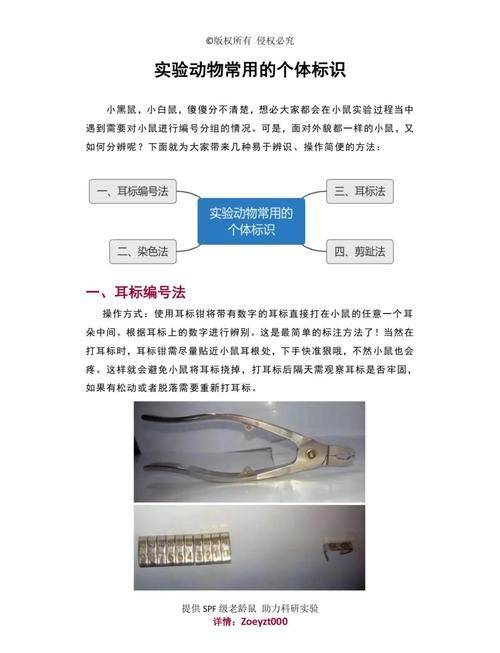
Experimental mice often need marking to distinguish. Numerous methods of numbering are used to select the appropriate marking method depending on the size of the mouse, quantity and duration of observation。
(i) chemical powdered mice
Chemical coating of mice is the most readily available and commonly used method for experiments. In mice, chemical reagents are used to dye visible parts of the body, such as limbs, hair and tails, distinguishing groups of animals by different parts or by using no colour。
Commonly used coated chemicals:
Red paint: 0. 5% neutral red or alkaline red solution。
Yellow coated: 3-5% 2,4,6-trinitrophenol solution。
Black coated: alcohol solution for kerosene。
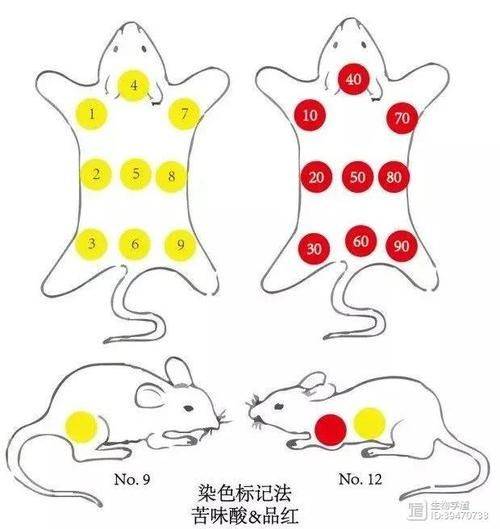
Depending on the size of the experimental group, it is possible to use a chemical drug to dye the back of an experimental animal. If there is a larger number of experimental animals, two dyes can be selected. This method is more appropriate for experimental animals with short experimental cycles, with long lead times for dyes to retreat. The colour of the dye should be selected according to the strain of the mouse. The numbering principle is left-to-right, past-to-back. The dye is normally painted on the left front limb as no. 1, the left abdomen as no. 2, the left abdomen as no. 3, the left abdomen as no. 4 at the top, the waist as no. 5, the tail as no. 6, the right abdomen as no. 7, the left abdomen as no. 8 and the right abdomen as no. 9, with 10 places marked in different colours. This joint use can be numbered 99. As shown in figure 5-2-1 for km mice, 2,4,6-trinitrophenol, neutral red paint number。
(ii) pointing or cutting gaps
A small hole in the rat's ear may be used to indicate a given number. If there is a cut-off with a scissors, the slide powder should be applied after the cut so that it is not visible after healing. The same method is used for ear cutting with scissors, which is often used as a lifelong sign when raising large numbers of mice. It is common practice to have small holes in the inner edges of the ears, representing 1 and 2 and 3 respectively, and to have a gap in the front, middle and back, representing 4, 5, 6 and 7, 8 and 9 respectively. The right ear means you, the left ear means ten places, and the central right ear punch means 100 places. The act can be numbered 1 to 400。
(iii) toe cutting
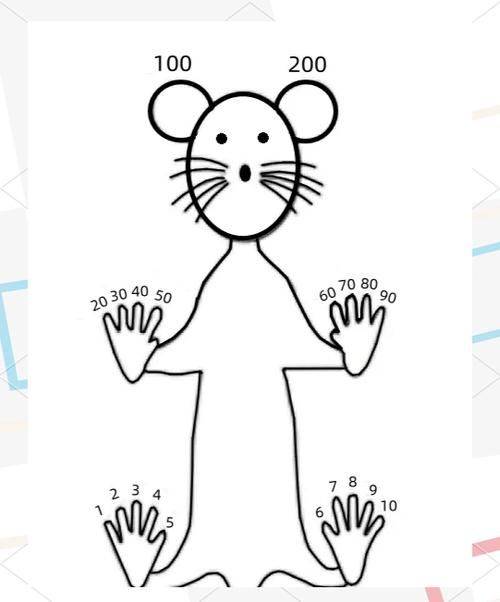
Toes to the left or right of the mouse are different in order to represent different numbers. It is common practice to cut the first toe from left to right number 1, the second toe number 3, the first toe number 3, the third toe number 4, the first toe number 5, the first toe number 6, the fourth toe number 7, the first toe number 8, the second toe number and the fourth toe number 9. The right foot stands for a bit, the left foot stands for 10 places, and the limbs can be marked as 4999 according to this law。
2. Grouping of experimental animals
(i) principle of clustering
In carrying out animal experiments, there is often a need to divide selected experimental animals into groups according to research needs. Animal subgroups should be assigned equally to the experimental and control groups, on the basis of the principle of random distribution, in order to avoid differences between groups and to influence the results of experiments, in particular by conducting accurate statistical tests, which must be done on the basis of random groupings。
The number of animals per group depends on the duration of the experiment, the type of experiment and statistical requirements. In the case of chronic experiments or experiments requiring periodic testing of dead animals, a larger selection of animals is required to compensate for the natural death of the animal and the loss of what is believed to be death, ensuring that at the end of the experiment there is a statistically adequate number of animals。
(ii) establishment of control groups
Clusters should establish control groups。
1 self-control group: refers to experimental data. The relevant data for the experimental animals themselves, before and during the last two stages of the experiment, are the results of the tests in the control and test groups, respectively, which may exclude individual differences between organisms。
2 parallel control groups: positive and negative. Some treatment is given to experimental animals and the same treatment is given to positive control groups, but not to drugs or instruments required by the experiment, and negative control groups are not given any treatment。
3 for specific grouping: an artificial factor should be avoided, and all animals should be randomly numbered and then double-numbered in group a (experiment group), single in group b (control group) or vice versa. If several groups are to be divided, they should be presented in random numbers, which should be completely random。
3. Experimental animal hair-cutting methods
In animal experiments, hair can sometimes affect experimental operations and observations and must be removed. The method of removing the hair is to cut, pull, shave and strip。