Just this afternoon, a powerful earthquake of 7. 5 degrees off the coast of japan, with a depth of only 10 kilometres, was reported to have exploded this afternoon
On this story, the first reaction of many people was, "is there another earthquake? Why is japan always an earthquake?"
Take your time. Today's 6th brother will take you to the scientific level to understand the three key knowledge behind this earthquake. - after reading this article, the next time you get an earthquake story, you're not just looking at it, but you're really good at it。
I. 7. 5 + 10 km earthquake source, what does that mean? - the "terror truth" of the shallow earthquake
First of all, there is a fact that many people do not know: the destructive power of an earthquake depends not only on the magnitude of the earthquake, but also on the depth of its source。
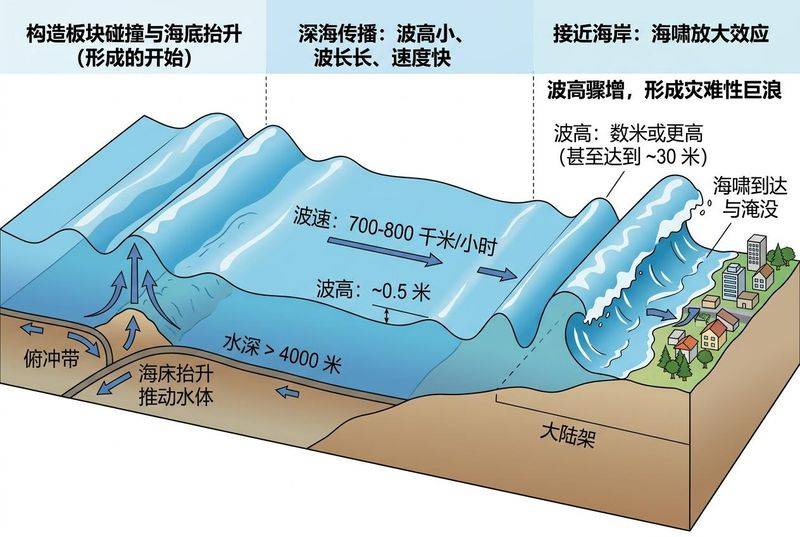
The japanese earthquake, magnitude 7. 5, had a depth of about 10 kilometres. Seismologically, the combined source of the earthquake, which is less than 60 kilometres, is called ** "since earthquake", whereas the depth of 10 kilometres is already very shallow **。
How terrible is this
It is also a 7. 0 magnitude earthquake, and if the source of the earthquake is 300 km deep (deep source earthquake), the ground may simply be "shocked"; but if the source of the earthquake is 10 km, it may be tens of times more powerful than the former。
It's like throwing a basketball on the 10th floor and the same basketball on the 1st floor — the same basketball — but the impact on the ground is very different。
** the scientific principle is as follows: ** the energy released by the earthquake is transmitted in the form of seismic waves to all directions, and the energy is gradually declining during the process. The shallower the source of the earthquake, the shorter the seismic waves reach the ground, the less energy decay, and the greater the destructive force of nature。
According to research from the china seismic network centre, about 80 per cent of the global positive earthquakes are shallow-sourced, while more than 90 per cent of the major disasters are shallow-sourced。
2. The tsunami is 800 kilometres per hour. Why can't it be won? The invisible killer of the tsunami
This time, the japan meteorological agency predicted a tsunami wave of up to 3 metres, with an actual 0. 8-metre tsunami observed and rising tides observed in kuttsu harbour, iwaman county。
A lot of people might think, "a three-metre wave, just a floor, it doesn't look that high?"
Big mistake。
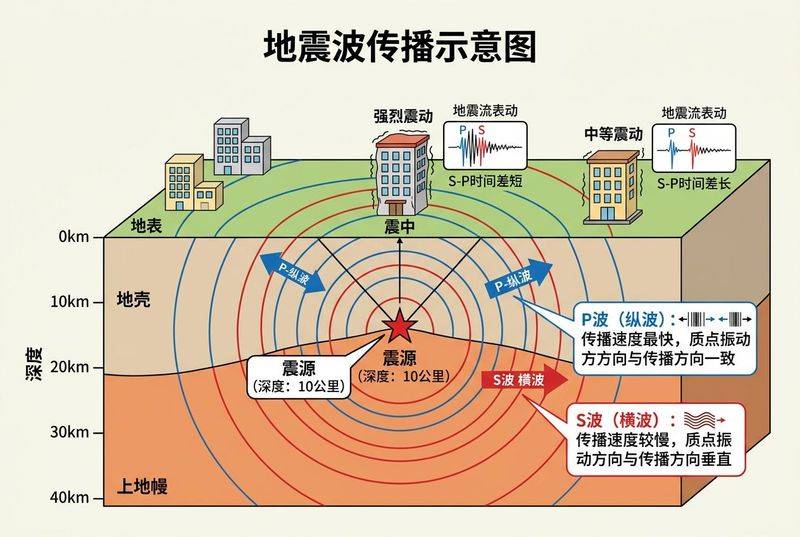
The tsunami is completely different from the waves we normally see on the sea. Ordinary waves are just "skin motion" on the surface of the sea, and tsunamis are a collective movement from the sea floor to the whole body of water. - it can be understood that ordinary waves are the goose bumps on the skin, and the tsunami is the contraction of the whole muscle。
The tsunami had three alarming features:
The tsunami spreads to the deep sea at a rate of 700-800 kilometres per hour, almost as fast as a civilian passenger cruise! This means that from the epicentre to the coast thousands of kilometres away, the tsunami could have arrived in a few hours。
2 the wavelength is extremely long: ordinary waves are typically tens to hundreds of metres long, while tsunamis can be hundreds of kilometres long. It's like an ordinary wave is a small earth slope, and the tsunami is a 100-km-long plateau pushing towards you。
3 inshore amplification effects: tsunamis decline from deep to shallow sea, but water surges behind them, leading to a sharp increase in wave heights. The tsunami, triggered by the 2011 great earthquake in japan, reached 40. 5 meters near the shore when the waves were less than 1 metre high. - it's 13 stories high
The source of the earthquake is the shallow reverse earthquake. – the submarine plates suddenly moved up and pushed the whole of the above seawater up like a giant hand from the bottom to the top, and the tsunami formed。
Fortunately, the tsunami early warning centre of the ministry of natural resources has confirmed that the tsunami will not affect our shores. But understanding the scientific principles of the tsunami remains everyone's "safety imperative"。
Three: why can japan countdown before an earthquake? The speed of life and death of p and s
Have you noticed the details of how, every earthquake in japan, people's mobile phones and television can always emit warning messages a few seconds to dozens of seconds in advance。
It's not magic, it's a physical feature of seismic waves
The earthquake produces two waves:
Japan's seismic early warning system (eew) uses this time difference to capture p-waves and to give early warning before s-waves arrive。
The process is as follows:
Detecting p-waves: japan has over 7,400 seismic stations all over the country. Once the p-waves reach the nearest station, the system will be able to make a preliminary determination of the location of the seismic source and the seismic light speed transmission within 1-2 seconds: the warning signal is instantaneous through an electromagnetic wave (radio, 300,000 km/s) throughout the country: the more destructive s-waves may still be on the road when people's mobile phones ring alarms
The system will allow for 5-30 seconds of escape in an area 100 km from the earthquake. Do not underestimate these dozens of seconds — enough to shut down the gas valves, hide under the table, automatically park the elevators on the nearest floor, and make an emergency slowdown on the new trunk train。
At present, china has also built an earthquake warning network covering 2. 2 million square kilometres, and the china earthquake warning network, officially operational in 2023, can provide early warning within 6. 2 seconds of an earthquake and reach the world's leading level。
Practical summary: summary of core knowledge of the earthquake and tsunami
Knowledge point
Core data
Key findings
A shallow earthquake
Earthquake source depth
More than 90 per cent of major disaster earthquakes, with much greater damage at the same level. Source
Tsunami speed
Deep sea 700-800 km/h
It's like a civilian airliner
Tsunami wave length
It's hundreds of miles
An unusual wave. It's the advance of the whole body
Zoom in
Deep ocean 1 m, near shore up to 40 m+
The wave height has increased dramatically after entering the shallow waters
P-wave alert
5-30 seconds ahead
Use the time difference between the p-speed and s-speed to get out of the escape window
China early warning network
Covered 2. 2 million km2, 6. 2 seconds
Officially operational in 2023, world leader
Interactive topics
Japan's strong earthquake reminds us once again that knowledge is the best talisman in the face of disasters。
Do you know what level of earthquake-resistant zone your city belongs to? Is there an emergency kit at home