In 2026, the number of questions to be examined was 125 in hubei province, with 100 points and 120 minutes of examination time
I. Ratio of thematic distribution to value
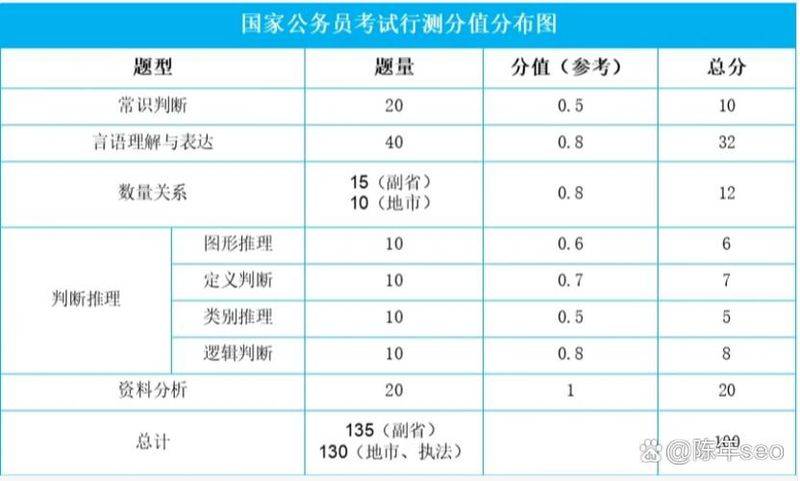
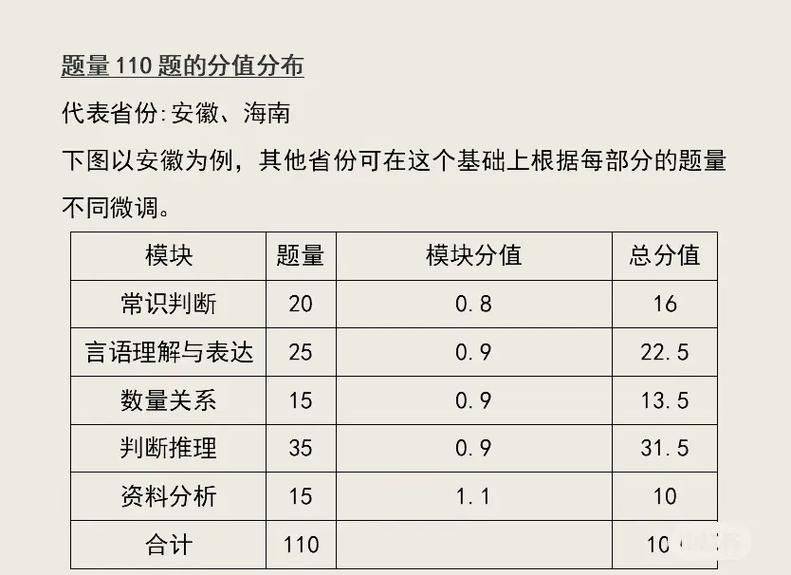
Political theory: a total of 15 issues with 0. 8 points each, for a total of 12 points. The main focus of the examination is on current political hotspots, the party's innovation theory, and recent major policy, conference spirit and theoretical updates. Common sense judgement: a total of 10 points, 0. 8 points each, for a total of 8 points. It covers the basics of politics, economy, law, history, culture, science and technology, and is broad but less difficult to examine and relies on daily accumulation. Language understanding and expression: 30 points, 0. 8 points each, 24 points in total. It includes topics such as logical emptying, reading understanding, speech expression, and focuses on language logic and text analysis capabilities, which require increased reading speed and keyword capture. Quantitative relations: a total of 15 issues with 0. 8 points each and a total of 12 points. With reference to digital reasoning, mathematical calculations, etc., which are more demanding for mathematical base and computational efficiency, it is recommended that common problem solving techniques be used to save time. Paradigm: 35 points, 0. 8 points each, 28 points in total. The breakdown of graphic reasoning (5), definitional judgement (10), analogy reasoning (10), logical judgement (10) is the splitting of key modules that require enhanced logical training and problem-specific recognition. Analysis of information: 20 issues, 0. 8 points each, 16 points in total. The ability to analyse and compute materials such as text, charts and so forth requires the skilled application of accelerator techniques (e. G., cut-off, centigrade) to improve the efficiency of answering questions。
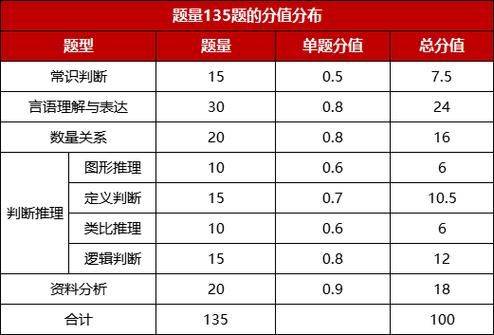
Ii. The importance of the modules indicates that the reasoning of judgement and the analysis of information are subject mattered and given high values and are key areas in which candidates compete for high scores. Among them, the computational issues of logical judgement and data analysis to determine reasoning are often difficult and require intensive targeted training. Political theory, common sense judgement, with low values but wide coverage, suggests the use of debris time to accumulate; speech understanding and quantity need to balance speed and accuracy to avoid excessive length of time to influence overall progress。
Iii. Proposals for preparation
Module breakthroughs: priority is given to judgement reasoning and data analysis, and problem resolution speed and correctness is enhanced through specialized exercises. Strengthening the foundation: quantitative relationships require basic formulas and solutions, and language understanding requires improved speech and text analysis. Accumulation of time: the political theory needs to focus on the current political hotspots during the six months preceding the examination, and common sense judgements can sum up the high-frequency test points in relation to the real issues. Simulations: complete simulations are done strictly according to 120 minutes, training time allocation and response rhythms are conducted to avoid overtime。