A few days ago, when we were chatting in the crowd, we were suddenly confronted with questions about weakness, on the grounds that the famous experiment by wu ken hung did not provide for real mirror symmetry. I was trying to find some specious instructions that went straight to the group, but i was surprised to discover that the web was full of similar misunderstandings, and even the chinese page of the wikipedia “ukranian experiment” text provided misleading content。
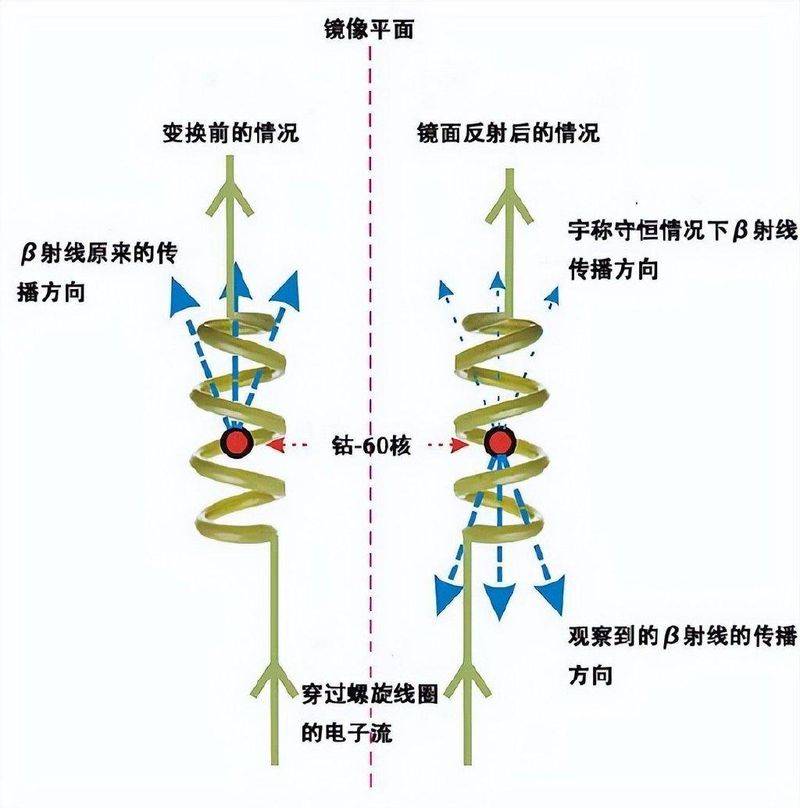
The figure on the wikipedia page is vague, and many of the misunderstandings on the web are the result. Unfortunately, although there is also an introspective rectification, it is difficult to eliminate misunderstandings in a sufficiently broad range of quantum field theory and the interpretation of various mathematical languages. So i decided to write myself an almost zero version of the formula。
It's called mirrors. It is the mirror version of our universe that should have exactly the same laws of physics. That's true for newton mechanics and maxwell's equation. The left side of the chart is the real world, the right side is the world in the mirror。
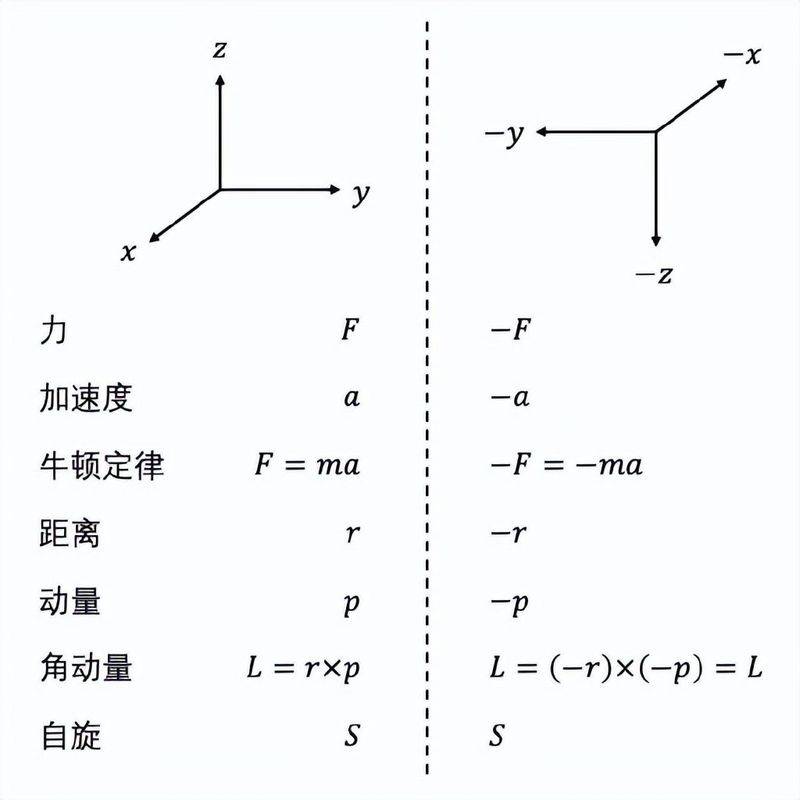
As can be seen from the figure above, if we move from the real world to the mirror world theory, the vectors of force, acceleration, distance, and momentum are all subject to the same pattern, while the agular and cycling patterns differ. Maybe one reader has forgotten what a vector forklift is, okay. Now that i'm committed to a zero formula, i'll just use the image to illustrate the problem。
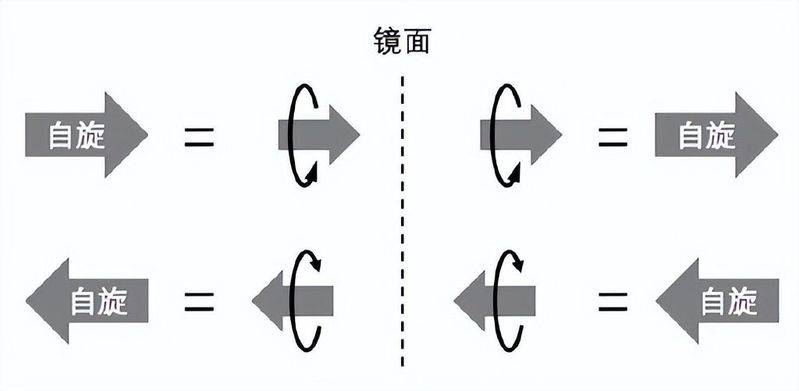
This schematic indicates at least the rotation of the rotor axes vertically in the mirror, and the same pattern in the mirror. Of course, quantum spins are not really the kind of motion that earth rotates. They're just the same introgen properties as an angle. The rotation of power as particles does not affect understanding at all in the topics addressed in this paper。
Here's a spin-axis that is vertically in the mirror and moves towards a particle. We call the right hand particles in the same direction as the motion, and the opposite is called left hand particles. It is then easy to see that the two are mirrored。
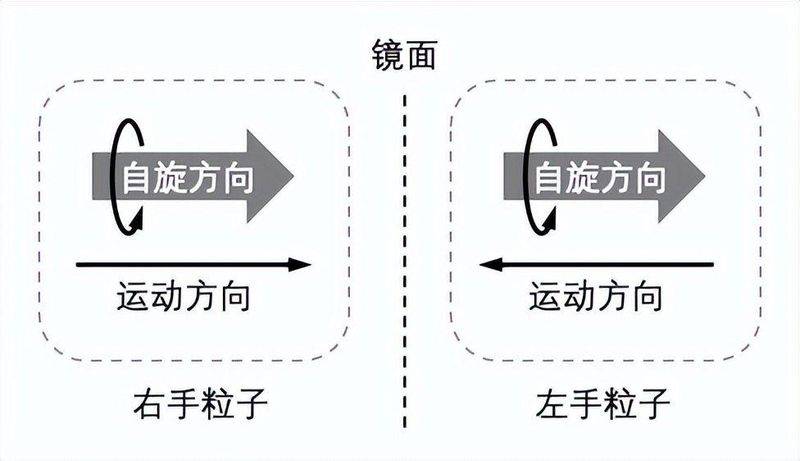
By understanding the hand of the basic particles, we can talk about the strange ingenuity of nature. According to a simple instinct, any basic particle should have both right-hand and left-hand properties, since there should be no influence between the spin direction and the overall movement direction。
There are also two basic particles in nature, such as hand-held photons and electrons. And the amazing thing is, we've never seen the neutrinos in the right hand, all of them left. Correspondingly, all neutrinos are right-handed, never left-handed. This strange phenomenon is a manifestation of what is called intransigence。

So how did wu's experiment prove this? In fact, there is only one principle at the core, which is to keep constant using the angular momentum of cobalt 60 during beta decay. Cobalt 60 can be transformed into nickel 60 after a β decay, with the release of an electron and an anti-neutron microbe. In a strong magnetic field, the total spin of cobalt 60 is 5, and the total spin of nickel 60 is 4, so that the remaining spin 1 is allocated to the released electron and the reverse neutrons, depending on the agular motion。
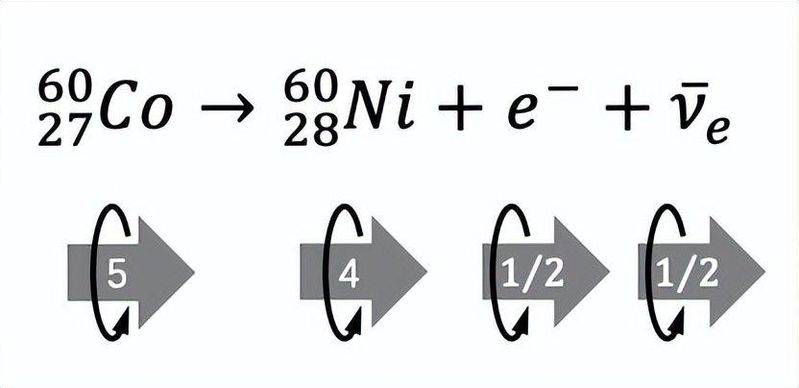
Both electrons and neutrons are philatelic particles, i. E. Particles with a spin of ±1⁄2. A simple calculation shows that the two particles must have a ⁄2 spin count after reaction。
Note that, in the wu's experiment, the strong magnetic field only polarized the direction of angular kinetics and did not limit the direction of movement, so that the electron and anti-neutron microbes released by decay should not be related to the polarization direction of cobalt 60 (i. E. The direction of the magnetic field). The only limitation here is constant power, and electrons and anti-neutrons should move in the opposite direction. If the decay process is consistent, it should be capable of monitoring the equivalent of beta rays, i. E. Electronic currents, both in the direction of the magnetic field and in the opposite direction. Here's a picture of two possibilities that should happen。
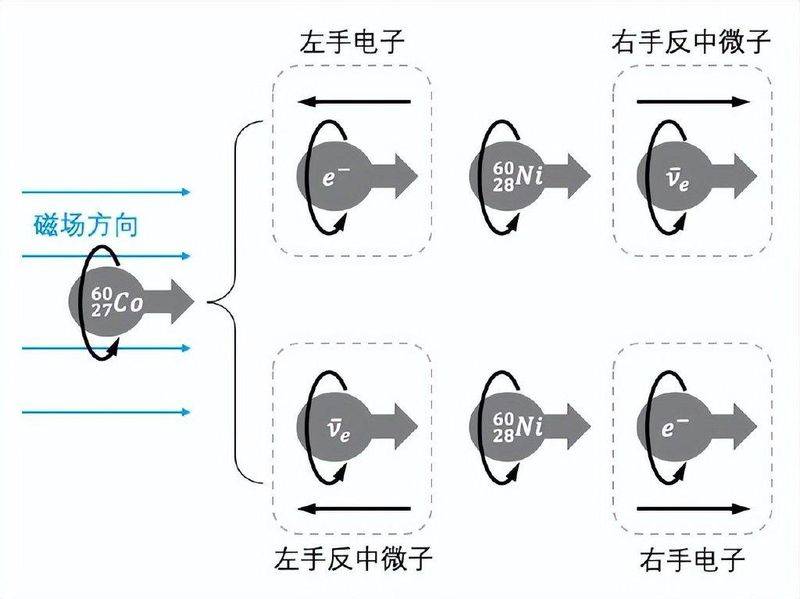
However, the results of the experiment show that electronics can only be monitored in the opposite direction of cobalt 60, which suggests that there are limits in nature to the presence of neutrinos on the right hand and the prohibition of neutrinos on the left hand。
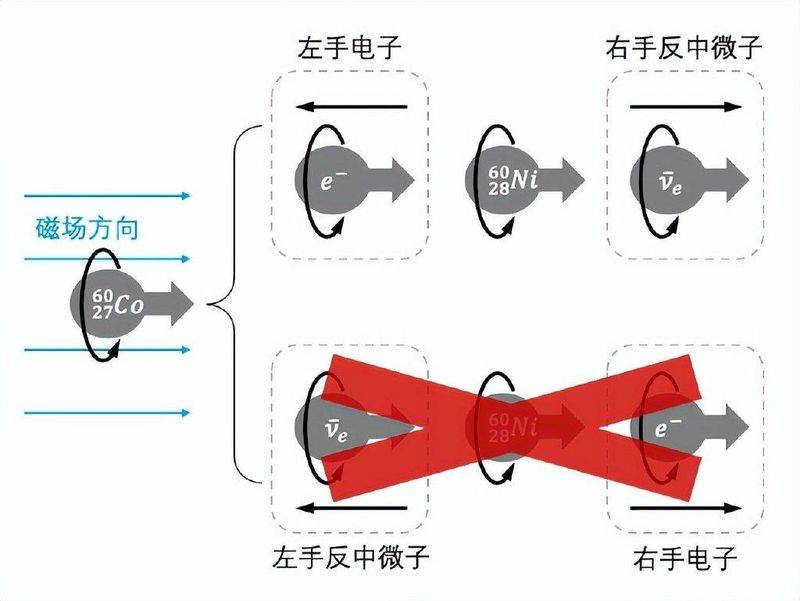
That's what the famous wu's experiment proved to be unconscionable。
Returning to the wrong image on the wikipedia page mentioned at the beginning of this paper, one of the little errors in that picture was that the polarization direction of cobalt 60 was not indicated; the more important error was that** it was stated that the direction of the beta ray under constant conditions should include the same probability of both upper and lower. ** if the experiment only detects beta-rays contrary to the direction of the magnetic field, it has proved that the so-called constant has been destroyed and there is no need to reverse the screwdriver. So the correct schematic of principle should be this。
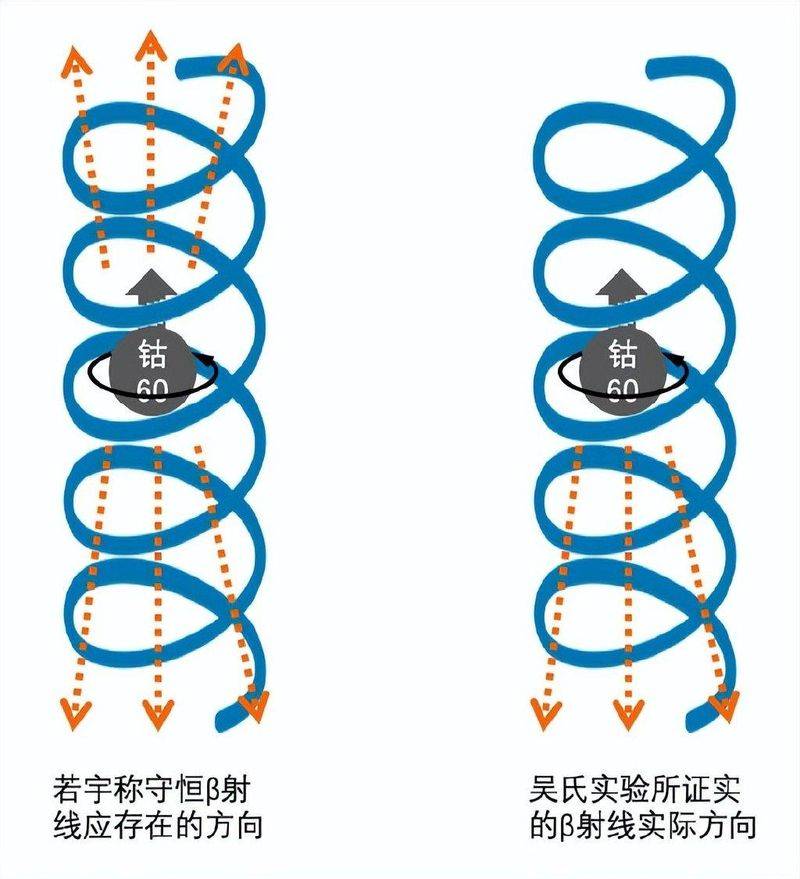
There are, of course, a variety of interference factors in practice, which do not guarantee that all cobalt 60 will polarize to the maximum extent along the magnetic field, so that the magnetic field is reversed in practice for the purpose of proof of phenomena. But this operation is not part of the rationale of the experiment, and it can be misinterpreted, as wikipedia does, by drawing it in an incoherent way。
The clarifications sought in this paper have been completed and, finally, there is a small extension。
Imagine someone sitting in their own reference system and seeing a right-hand electron in front of him (swing in the same direction as movement) flying away from himself. The other one was chasing electrons at a faster rate than electronic flight, so in the b reference system, the electron was turned into left-hand electrons (the reverse direction of spin versus movement)。
It can be seen that electronics, which are relatively slow-flying particles, are handy associated with reference lines and do not have left or right-hand electrons in absolute sense. For photons or other zero mass particles, however, the situation is different. Zero mass particles move at the speed of light, which is the maximum speed, and there is no reference system to see the inverted hand。
When we understand this, we look back at the persistence of neutrinos and immediately conclude that their quality must be zero. Otherwise, it would not have had the absolute handiness, and naturally it would not have been capable of causing a loss of hand. In the current basic particle standard model theory, neutrons are indeed viewed as zero mass particles. However, the discovery of neutrinos oscillation suggests that neutrinos may have a very small but not zero mass. It is therefore necessary to go beyond standard models to explain its quality sources and, if its mechanisms are proven, it is difficult to imagine the impact on existing theory。