Xinhua network, beijing, january 17th
Xinhua network reporter liu zeng, pan ziwei wang shang
During the previous period, a university student in shanghai had shut down more than 100 elevator advertising screens in residential areas with a “general key” purchased online, and the video had sparked popular debate, again making the issue of public revenue in the neighbourhoods a focus of public opinion. This seemingly extreme move, however, emboldened many of the population — to whom are the public gains resulting from sector elevator advertisements, public parking spaces, rental of premises, etc.? And how
Journalists' visits have found that there are problems of “invisible” public revenues in a number of sub-regions and that a range of governance challenges need to be addressed。
Who manages public revenues
“there are commercial advertisements in the elevators in our neighbourhoods, and public spaces have been converted into fee-paying parking lots and commercial activities, and the revenues generated in these public areas are of great concern to the owners.” ms. Cho, who lived in a small district of beijing, said that a number of owners had consulted with the property industry and that most of the responses had been “balance-of-payments” “for small district transportation” and had not been clearly informed of the specific benefits and uses。
Who does public revenue belong to? Article 282 of the civil code of the people's republic of china provides that income from the use of the joint share of the owner, such as construction units, property service enterprises or other administrators, shall be owned by the owner after deduction of reasonable costs。
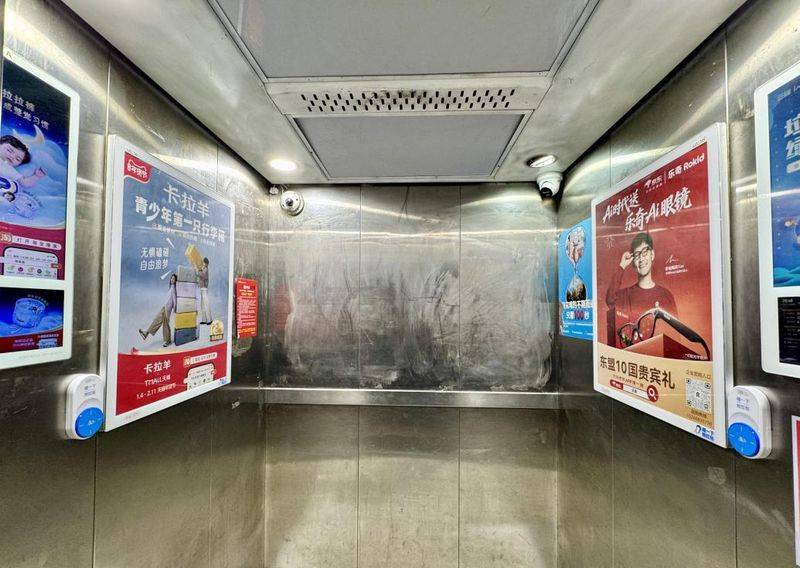
A commercial for lift cars in a small district of beijing. Xinhua net
“the joint ownership part of the civil code refers to the sub-districts `public areas'.” yuo yishan, deputy director of the beijing law office, stated that the proceeds from the use of these public areas by owners (or their authorized property companies or other administrators) were public. “our common public areas typically include buildings halls, halls, corridors, stairwells, elevators, exterior walls of buildings, roofs, public green areas, public roads, property houses, shelter floors, and parking spaces on the owners' roads or other sites.” he said。
The management of public revenues was introduced by the senior partner of the beijing dae-jin law office, yu zong peng, who had formed the small zone of the owners ' committee, which was managed or entrusted to the property companies on behalf of the owners; the small zone, which did not have an industry committee, which, under the previous contract for property services, could act on behalf of the public revenue; and the community (village) people's committee of the district, where the contract did not exist。
“it should be noted that the income attributed to the owner is the net gain `after deduction of reasonable costs'.” yue yishan noted that managers could deduct the ratio of management costs and accounting criteria. “like billboard maintenance fees, electricity charges, taxes and the necessary labour expenditures of managers, etc., can generally be considered a reasonable cost.”
Yue yishan stressed that the property company had no right to withhold or misappropriate the funds without the consent of the proprietary assembly or contractual agreement。
In addition, owners have the right to be informed of the public revenues of the sub-districts. According to the statement, the property company must not only carry out publicity and decision-making procedures prior to operating; it must also report on its own initiative to the proprietors ' congress or the board of directors in a timely and clear manner after operating; and if the owner fails to obtain the relevant information, he may, in accordance with the law, have access to it and have access to it. “some old and unincorporated subdivisions may be run by residential councils, which, together with property companies, are `managers' and have the same obligation and responsibility to disclose the proceeds and guarantee the owner's right to know.”
Why are public revenues hard to disclose
Interviews by journalists have revealed that in a number of sub-regions, the generation, use, etc. Of public revenues have been publicized as “excessive” or even “zero public”。
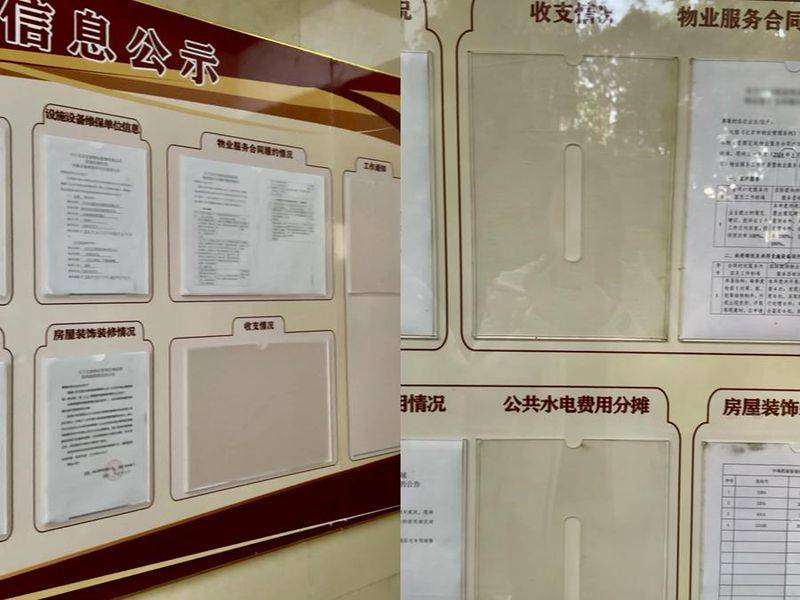
On 14 november 2025, a collage of pictures of the public display column in beijing. Xinhua's hair
Information on “space and usage” “shared costs of public utilities” has been publicized by a small estate property sector, but “payment and expenditure” “use of maintenance funds” is a gap. Journalists asked the property about public revenues and the other responded “not clear”. There is also a small commercial room, where elevator advertisements are aired around the clock and some residents reflect high noise, but it is not clear who introduced them and how the revenues are distributed. The property response stated that the information had been “publicized”, but several owners indicated that they had not seen the information either in the column or in the owner's group. The situation is more complex in old and old neighbourhoods. In some sub-regions, there is a lack of clarity on public revenue receipts and payments due to the absence of an industry committee, the vague division of responsibilities between public areas and the lack of clear lead parties for the attribution and use of proceeds。
The vice-president of the school of government and administration of beijing teacher training university concluded that the integrity of the governance structures of the sub-district industry commission and the property industry and their low governance capacity are important factors affecting the transparency and standardization of public revenue disclosure in the sub-region. “it directly affects who in the sub-districts is in charge of public revenue.”
Secondly, the lack of representation or insufficient capacity of the commission is one of the reasons for the lack of transparency in public revenue information。
Journalists are aware of the fact that some sub-districts have established business committees, but are often deadlocked because of the number of owners and diversity of claims: the desire of some owners to split directly, the preference for supplementary maintenance funds, and the priority given to upgrading the facilities in the sub-districts have led to difficulties in harmonizing programmes for the use of funds, thus affecting the publicity of progress and making the management and use of such funds more difficult. In addition, the committee is composed mostly of part-time staff, who lack professional financial and legal knowledge and are often reluctant to monitor and manage public revenues。
Another factor that cannot be overlooked is the low level of attention paid by some owners to public revenues, the perception that “single amounts have little impact”, the reluctance to devote time to monitoring and, to some extent, the lack of transparency in public revenues。
How can public revenues not be “invisible”
In response to the public revenue management challenge, local efforts have been actively explored to break the path of “suntanning” the proceeds and returning decision-making to owners。
At the policy level, since 2025, fujian, jiangxi, changsha and zhengzhou have introduced public revenue management schemes, which further refine public revenue attribution, fund management, revenue and expenditure disclosure, use procedures and audit oversight, complete implementation rules and promote more discipline and transparency in public revenue management。
Journalists have learned that the governance model of “household management, transparent accounting” has been pre-empted in many sub-districts, providing useful ideas for overcoming the challenge of “visible, invisible” public gains。
For example, the new model of party-led governance of the “sunshine industry” in the northern region of tianjin city led to the creation of a new model of governance of the “sunshine industry” that strips public revenues from the accounts of the property company, creates an independent “concrete account” and operates as an exclusive management; allows real-time disclosure of income and expenditure on the online platform at any time to be consulted by the owner; and allows owners to participate in decision-making on matters of public revenue use, with the property company solely responsible for escrow and services。
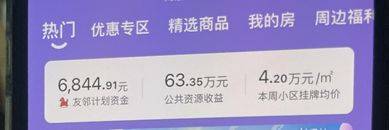
On 26 november 2025, mobile phones asked about public resource returns in 2025 in a small district of fujianfu. Xinhua net
The central region of huanco gold region of fukuzhou has a special accountancy for public revenue payments, which is strictly regulated, and all receipts and disbursements are advertised in the district's publicity column for more than a month, which allows owners to monitor them at any time。
The effective return of decision-making to owners is an important aspect of regulating the use of public revenues. In accordance with article 278 of the civil code of the people's republic of china, it is for the owner to decide jointly to change the purpose of the shared part or to use the shared part for his or her business。
In the case of district elevator advertising, yuo xianshan, for example, it was suggested that the process of organizing a vote by the trade commission to organize a conference of owners — a contract between the commission and the advertiser (or an authorization to sign a contract) — the proceeds enter the commission's account or a co-management account — should be clear and easily defended. In the sub-districts where there is no commission, the property company shall obtain the consent of the legal percentage of the owner before changing the use of the public area or profiting from the public area, and shall use the public revenue at the request of the owner, which shall be directed and supervised by the community house council (the street office). At the same time, it was recommended that the non-commissioned sub-districts require that property companies regularly publish detailed accounts of public revenues, subject to supervision by all owners。
“the supervision of public revenues in the sub-districts is the internal responsibility of the commission.” shen koe, director of sichuan tae-yi law, said that the commission should exercise its supervisory responsibilities effectively, starting with both contract formation and contract performance. He further noted that the key to oversight lay in the performance of contracts, the verification of the bookkeeping of public revenues; tracking the actual flow of money; and, in the event of a breach of contract between the parties, the commission should promptly urge the property company to claim rights and take measures to avoid damage to public revenues。
Professor at the faculty of political and public administration of the university of chinese empirium, bo ho ho ziyang, suggested that the board could commission a periodic audit of public revenues and publish the results, and that small districts in a position to do so could set up district public revenue monitoring committees。
“it is to be recalled that public revenues cannot be used directly to cover property fees owed by individual owners.” in particular, yue yishan indicated that the money was more suitable for upgrading the overall quality of the districts, such as renovation of the lobby, greening, maintenance of utilities, etc., and ensuring transparency of payments and payments; when the districts were upgraded, trust relationships between owners and property companies were established and the willingness of most owners to pay increased, creating a virtuous circle. (participating in su-hun, conway, mckinley, sun-fan-tong, liu moo-han)