


== sync, corrected by elderman ==
English: https://sourl. Cn/qziva
The yang fai triangle, also known as the pascal triangle, the jayanese triangle and the hayam triangle, is organized like a triangle. It is also known as the jia constitution triangle because it is first named in the song yang hui law on the elaboration of nine charters, which is quoted in the jia constitution's “locking book”. Old persian mathematician omar hayam also described the triangle. In europe, this triangle was also known as the pascal's triangle because it was first fully discussed by french mathematician blaise pascal in the 1653 " theory of arithmetic triangle " 。
The first 10 lines of the yang fai triangle are as follows:
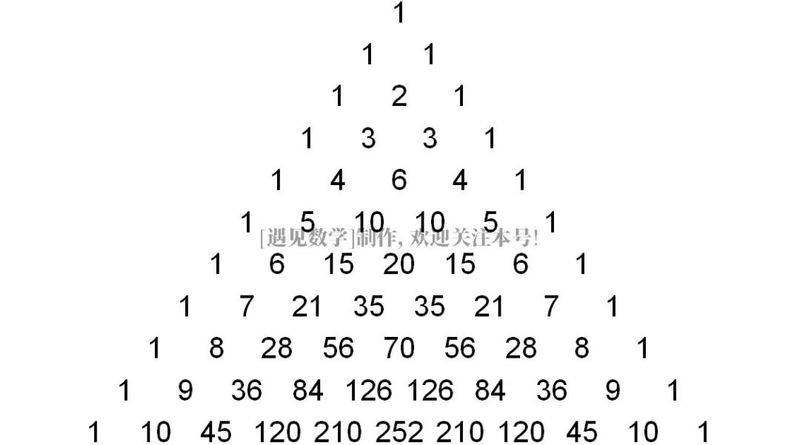
Construction of the yang fai triangle
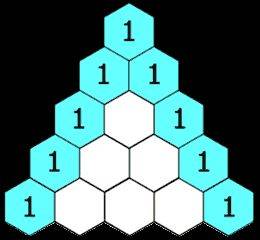
Each number is the sum of the number above the left and above the right
What's wonderful about the yang fai triangle is that it's so simple, but it's very mathematically attractive. It's one of the most amazing things in mathematics, and it's just one of many mathematical things that shows how wonderful it is。
Now let's explore the 10 secrets you might not know hidden in the yang fai triangle
Secret #1: hide arrays
Tip: in order to help find hidden information, the yang fai triangle is arranged in a left alignment manner。
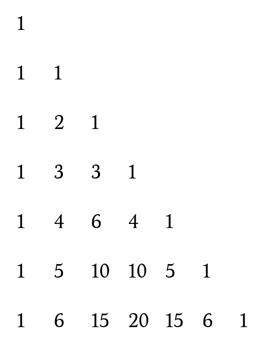
The yang fai triangle after left alignment
There is nothing special about the first two columns, both of which are 1 and the second is natural. And the third column is triangular number. As you can imagine, the number of triangles is the number of points capable of forming large and small equations, as shown below。
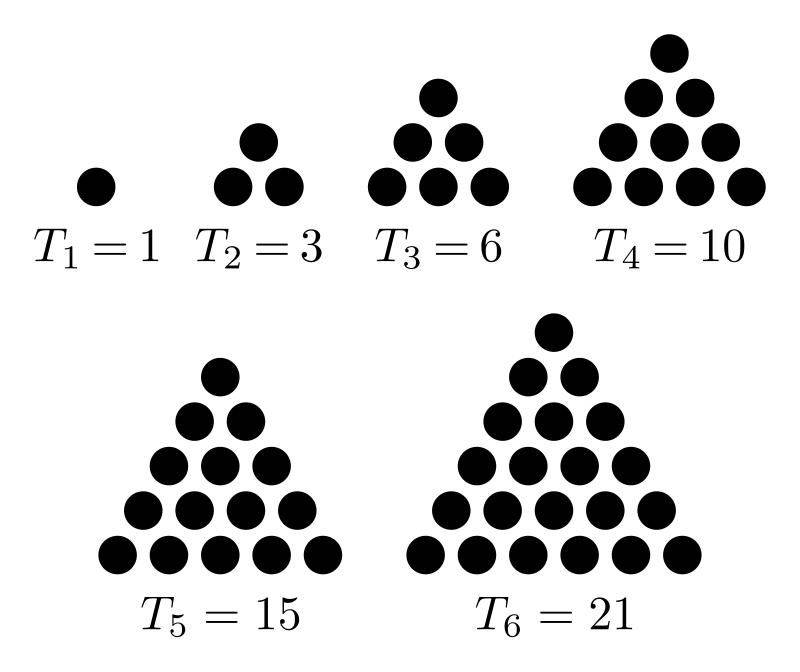
Number of triangles (figures from wiki)
Similarly, the fourth column is called tetrahedral number, also known as triangle number. By definition, they represent the number of points required for a triangle consisting of a triangle, each of which is a triangle。
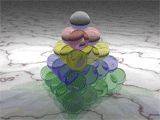
Five-storey cones contain 35 spheres
This pattern continues in each subsequent column, which describes the expansion from the number of triangles/quadrons to the high dimensions of “simple form”. The next row is 5-simplistic numbers, followed by 6-simplistic numbers, so push。
Geometrically, it is the simplest structure to be constructed in a space of dimensions: 0 -- pure is a point, 1 -- pure is a line, 2 -- pure is a triangle, 3 -- pure is a quadrilateral and 4 -- simple is a quintangular。
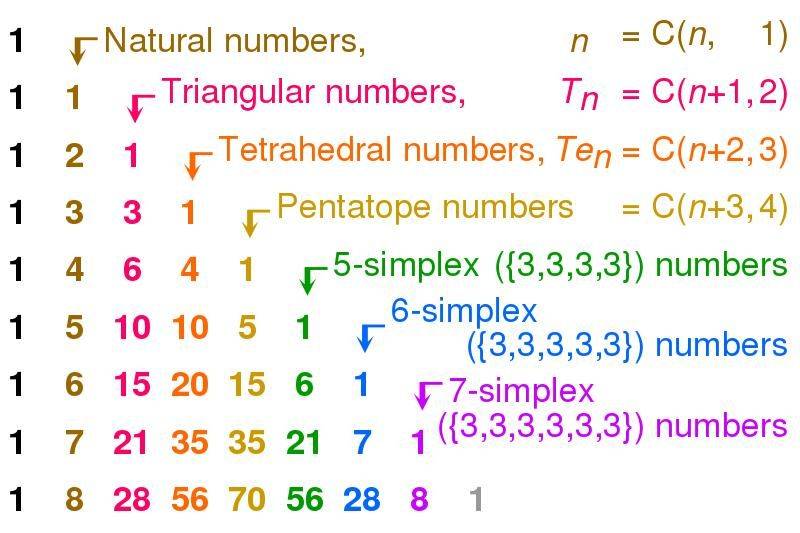
From wiki
Secret #2:2 # twilight
If you add each line together, you'll get two bottoms, starting with 20 = 1
And you can see that each line is based on two
Secret #3:11
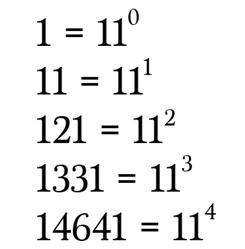
The yang fai triangle also reveals the value of the base of the calf. All you have to do is squeeze the numbers in each line together. First 5 lines are simple enough, but what happens when two digits appear
It turns out that what you're going to do is add the ten digits to the left of it, as compared to the above in the sixth line, how to move to a value of 115
If there is a three-digit equal digit processing, it is sufficient。
Secret #4: full square number
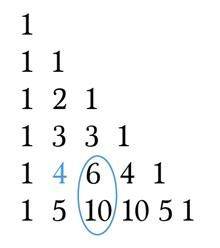
We can find the square of natural numbers in the second column by adding the number on the right to the number below the right. For example:
Secret #5: fibonacci series
In order to reveal the hidden fibonacci arrays, the left-aligned yang fai triangle is added. For example, the first nine figures of the fibonacci series found in the next figure, the yang fai triangle: 1, 2, 3, 5, 8, 13, 21, 34..
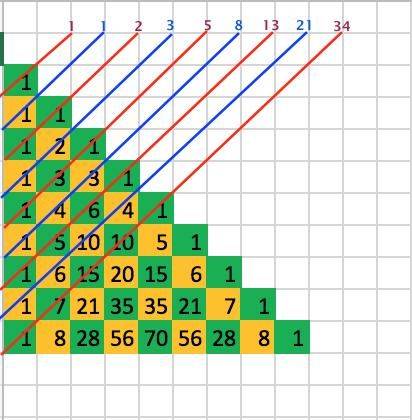
Adding results by line is the fibonacci series
Secret #6: serbinski triangle
Zoom in on the yang fai triangle and mark all odd numbers in light red. What do you see
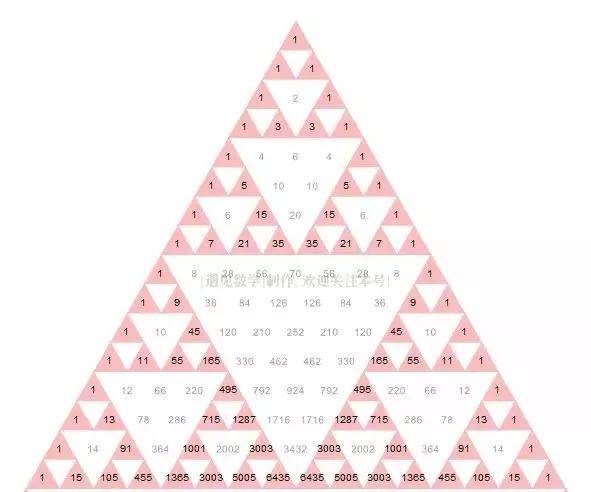
Is there a famous tuscherbinski triangle
Secret #7: combining math
Perhaps the most interesting thing to find in the yang fai triangle is how we use it to find a combination number。
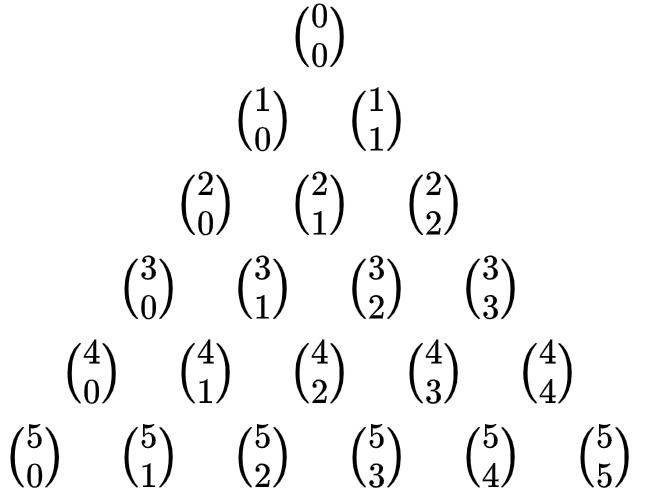
The first six lines of the yang fai triangle are written in combination
Recall the combination formula for k elements from n different elements. We found that for each line of the yang fai triangle, counting from scratch, n is the number of lines, k is the position in this line。
So, if you want to calculate four choices, two, five lines, three numbers, you'll find that the answer is 6.
Secret #8: double spread
In mathematics, the binary coefficient is the coefficient of each of the two-dimensional theorems. And the binary coefficient can be arranged into the yang fai triangle, so that such troubles can be avoided and the answer found directly。
The standard method of multiplying the two-dimensional equations is, for example, that we expand (x+y)3. Now that we have raised the value of x+y to 3, we use the value of the fourth line of the yang fai triangle as a factor for the extension. Enter the expression x and y as described below。
Hint: the number of times per single item equals (x+y) the amount given to the azimuth。
Secret #9: two-dimensional theorem
(x+y) good luck is cool, but how long do we have to solve this? Most likely, not often. Would it be easier if we could draw a more useful form from the conclusions of the previous section? Well, that's a two-dimensional theorem:
This formula is also called the binary formulae or the constant equation。
Secret #10: link to probability — binary distribution
The binary distribution describes the probability distribution of experiments with two possible outcomes. Indeed, each line of the yang fai triangle also reveals such clarity, as in the classic case of throwing a coin。
If you think about throwing three coins, there are eight possible incidents:
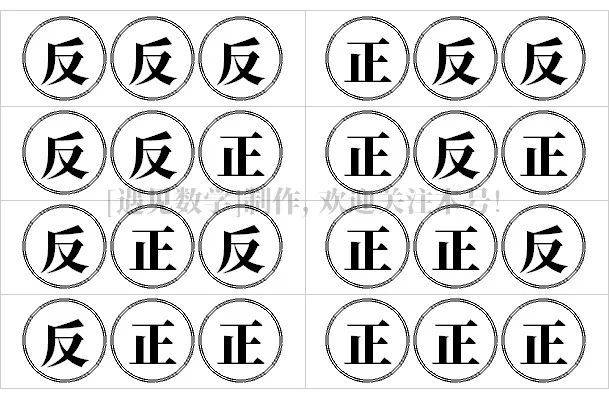
But it can be divided into four categories:
One, three, three, one is the fourth row of the yang fai triangle. Again, if you throw a coin five times, 3 positive 2 negatives will happen 10 times, and this will be the sixth row of the yang fai triangle。
If setting a coin toss has a positive probability of p, the reverse probability is 1-p. If you want to know the possibility of throwing to the front, you can use the probabilistic mass function (pmf) of the binary distribution to find the probabilities distribution, of which n is the number of tests, k is the number of successes。
Probability quality function for binary distribution
Hey, it looks familiar. It's almost the same formula as the two-dimensional theorem we mentioned earlier, but without a peace formula, and both were replaced。
Assuming that the probability of success is 0. 5 (p=0. 5), we calculate the probability of throwing to the front zero, one, two, three。
Insert n=3, k=0, 1, 2, 3 in the formula, with the following calculation, note the number of combinations in the yang fai triangle: 1, 3, 1:
The probability of throwing up on the front 0 or 3 times is 12. 5 per cent, while the probability of throwing down on the front 1 or 2 times is 37. 5 per cent, which is consistent with the results of the above analysis。
That's 10 secrets in the simple yang fai triangle, isn't it wonderful? But this is not the end, and it has another more magical nature to hide, waiting for us to continue to explore in the future。



