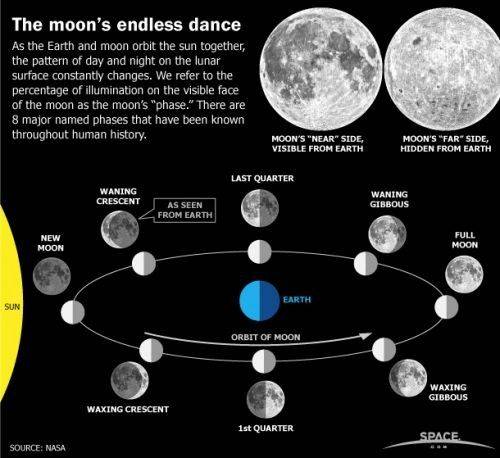
According to news from beijing time, 26 september, the moon is the most easily discovered object at night, according to foreign media reports. It is the only satellite of the earth, which is sometimes very bright in the night sky and sometimes dizziness, and only displays small moon teeth. The pattern of month-to-month changes is consistent with the full-to-manufacturing process, and the moon phase and orbits are very mysterious for many. For example, the moon is always headed for the same side, a situation that arises because it rotates and surrounds the earth with the same cycles of 27. 3 days。
We see full moons, half moons or new moons as a result of different degrees of sun ray reflection on the moon, while the changes in the moon we see on the moon are also related to the relative position of the moon vis-à-vis the earth and the sun。
Although the moon is a satellite of the earth, approximately 3475 kilometres in diameter, slightly larger than pluto. It is the fifth largest satellite in the solar system, with a moon diameter of 27 per cent of the earth's diameter, much smaller than the other planets and satellites ' diameter ratios, which means that the moon has a greater impact on the earth and contributes to the growth of life on the planet。
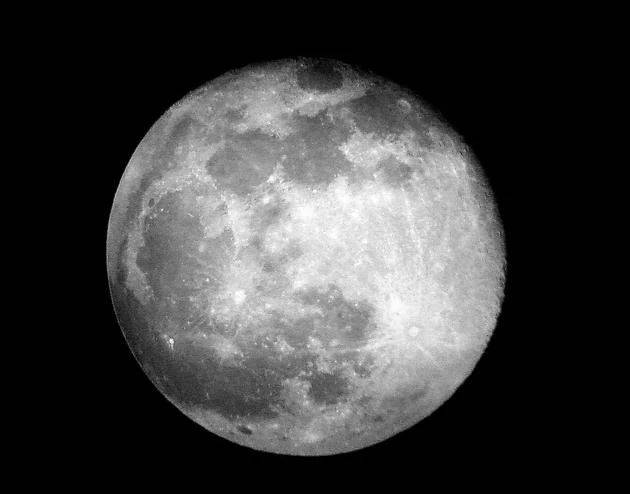
On 26 may 2013, an astronomer, anthony lopez, took a full-month picture of the city of juarez, mexico, near the united states border。
How does the moon form
Currently, the scientific community has many theoretical views on how the moon was formed, but recent evidence suggests that a massive collision took place in ancient times, tearing apart parts of the earth's mass to form the moon。
The prevailing theory of moon formation shows that a massive collision separates the original part of the earth and orbits around it. Scientists suggested that the collision had caused the earth to lose about 10 per cent of its mass, amounting to mars. Because of the very similar composition of the earth and the moon, researchers speculated that the collision had taken about 32 million years after the formation of the solar system in 95 million years. It is known that the solar system was formed about 4. 6 billion years ago。
This theory was further emphasized and supported by the latest study in 2015, based on the early simulation of planetary orbits in the solar system and the difference in the tungsten-182 elements detected on earth and on the moon. While a larger collision theory dominates scientific discussions, there are other views on the formation of the moon, including that the moon is separated from the earth and that the earth is bound by gravity. The most recent view is that the earth may have been “stolen” from venus。
Internal structure
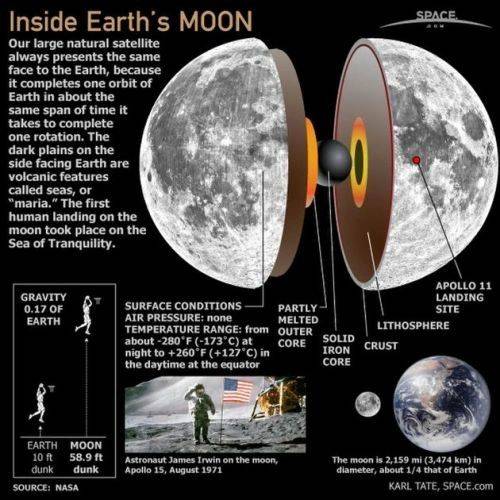
The moon is likely to have a very small kernel, accounting for only 1-2 per cent of its mass and approximately 680 kilometres in diameter. Its main composition may be iron, but it may also contain large quantities of sulphur and other elements。
The moon's rock is approximately 1,330 kilometres thick, consisting mainly of dense rock rich in iron and magnesium. The moon's mammoth magma flows to the surface in ancient times, and volcanic activity lasts for more than a billion years, from 4 billion years to 3 billion years。
The lunar hull, with an average depth of 70 km, is decompositioned by a larger collision of its outer layer, with the fracture zone exposed to inside the moon at 9. 6 km below the surface。
Surface composition
The moon is a rock satellite, and millions of years ago a large number of asteroids collided on it, resulting in “scarces” on its surface. As there is no climate change on the moon, the craters on its surface have not been eroded。
The surface composition of the moon consists of 43% oxygen, 20% silicon, 19% magnesium, 10% iron, 3% calcium, 3% aluminium, 0. 42% chromium, 0. 18% titanium and 0. 12% manganese。
Orbital vehicles found traces of water on the surface of the moon, which may have come from deep inside the surface of the moon. At the same time, scientists have observed hundreds of craters that will be the target of long-term surveys of the surface of the moon。
Continuing observations by the moon survey orbiter (lro) indicate that there is a large amount of water on the antarctic slope of the moon, although scientists have warned that this moisture content is close to the water content of the earth's extreme arid desert. In addition, a recent study in 2017 showed that there could be significant water within the moon。
Moon atmosphere
The moon's atmosphere is very thin, with all layers of dust or a footprint that will not be destroyed for centuries。
At the same time, because of the absence of too much atmosphere, the heat does not accumulate on the surface of the moon, the temperature variability is small. The surface temperature of the surface of the moon can be 134°c and that of the surface of the moon can be approximately 153°c below zero。
Moon orbital characteristics
The moon orbit data surveyed by nasa are as follows: the average distance of the moon from the earth is 384,400 kilometres; its perigee is 363,300 kilometres; its apogee is 405,500 kilometres; its perimeter is 24,13402 kilometres; and its average orbital speed is 3680. 5 kilometres per hour。
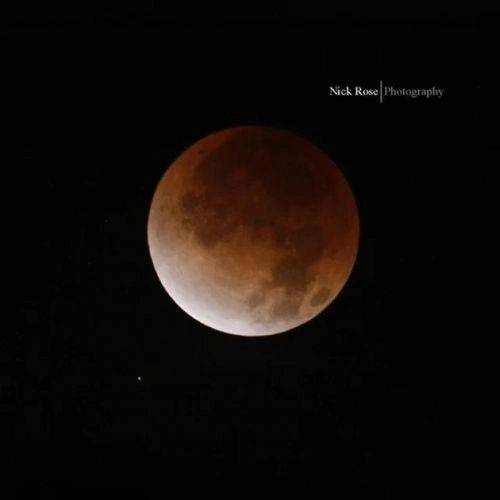
Skywatcher nick rose shot the full moon in milbury, california, usa。
Relationship between the moon orbit and the earth
The gravity of the moon has a pull-on effect on the earth, leading to predictable sea-level rise and sea-level decline. To a lesser extent, tides also occur within lakes, the atmosphere and the earth's crust。
As the tide rises, when the sea level rises, the low tide rises when the sea level is low, gravitationally, rising tides will occur on one side of the planet closest to the moon, while, due to the inertia of the sea water, rising tides will occur on the other side of the earth as far from the moon. The low tide appears between the two peaks。
At the same time, the lunar gravitational pull slows the pace of the earth's rotation, known as the tidal brake, which increases the earth by 2. 3 milliseconds a day over an average length of 100 years. The energy consumed by the earth is captured by the moon, which gradually increases the distance from the earth, meaning that the distance of the moon from the earth increases by an average of 3. 8 centimetres per year。
The gravitational pull of the moon may be a key factor in the planet's becoming a liveable planet, making the earth a liveable planet by regulating the axle oscillation angle of the earth, which will create a relatively stable climate in which life flourishes over billions of years。
The moon does not leave the earth without loss, and a recent study shows that the earth's gravity stretches it into an abnormal structure early in the moon。
The eclipse
During the eclipse, the moon, the earth and the sun are lined up, and the eclipse appears directly or almost directly between the sun and the moon, and the shadow of the earth falls on the moon, where it appears only at full moon。
The eclipse occurs directly, or almost directly, between the sun and the earth, and the shadow of the moon falls on earth, and it only occurs in the new moon. Because the moon's shadow is small on the earth's surface, rare eclipses can be observed only in very small areas. The last one in the united states occurred in august 2017, and the next one is expected in april 2024。
Moon season
The earth's rotation axis is tilted, which is related to the zodiac plane, a virtual surface of the earth's orbit around the sun. This means that the southern and northern hemispheres of the earth sometimes change the light of the sun to receive the exposure and form the corresponding seasons of the earth, depending on the year。
The earth's axis is about 23. 5 degrees, but the moon's axis is only 1. 5 degrees, so there is little seasonal change in the moon, which means that some parts of the moon are always luminous and others are always shadowed。