And the moon was the object of love of the scribes, and the good things about it were numerous. For example, the sakai li baek's "little moon", "little moons", which call for a white jade disk; and "flying in the cloud" depicts a poet's childhood awareness of the moon's childish atmosphere, in the sense of "white jade disk", in which the shape of the moon and the beauty of the moon's light are vividly displayed. The interesting thing about the moon is that it's a mystery. What does it have to do with our planet
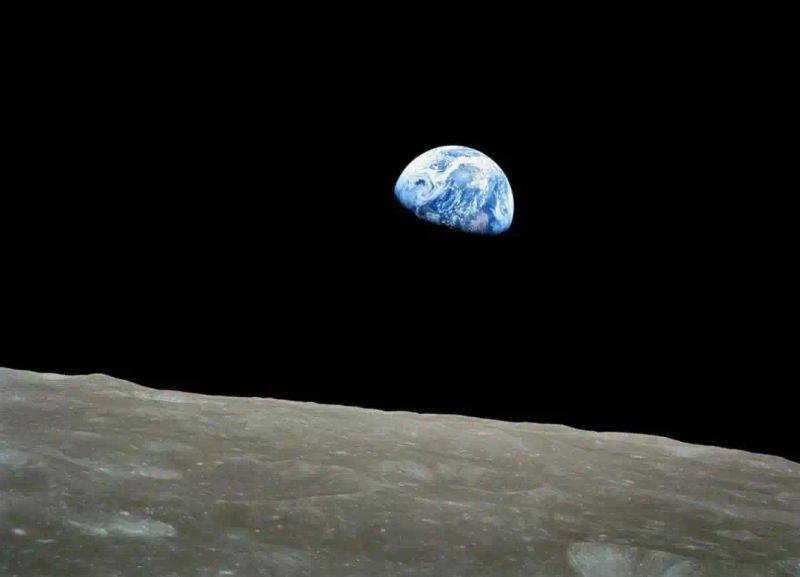
In 1968, the first manned apollo 8 filmed earth out (earthrise, viewing the earth slowly rising from the surface of the moon in space)
The moon, which is called the only natural satellite of the earth, is about 3474 kilometres in diameter, slightly more than a quarter of the earth, and the gravitational acceleration on the surface of the moon is almost equivalent to one sixth of the earth's surface (for example, if you are 100 pounds on earth, it is just over 16 pounds on the moon). In terms of its size relative to the bypass planets, the moon and earth are undoubtedly the largest of the solar system, almost as large as the twin planets that can be considered earth. The mass of the moon is 1/81 of the earth's mass, while the mass of other satellites in the solar system is less than 1/4000 of its orbiting planet。
With regard to the origin of the moon, there are four main hypotheses: fragmentation, capture, co-ingestion and collision。
The mission theory
The division says that in the early days of the solar system, the raw earth rotated so quickly that a portion of the surface material split out into the moon, and even the pacific basin was thought to be the most likely place to break out. At present, most scientists do not believe in fragmentation and argue that it is difficult for the original earth to rotate fast enough to eject a large rock to form the moon, and that, on the one hand, the original earth is growing at such a rate that only a very small probability is able to do so; on the other hand, if the early pace of the earth's rotation reaches the level of fragmentation, it means that the ground-monthly system is carrying excessive agglomerations, and scientists do not currently find a mechanism to slow down the later earth。
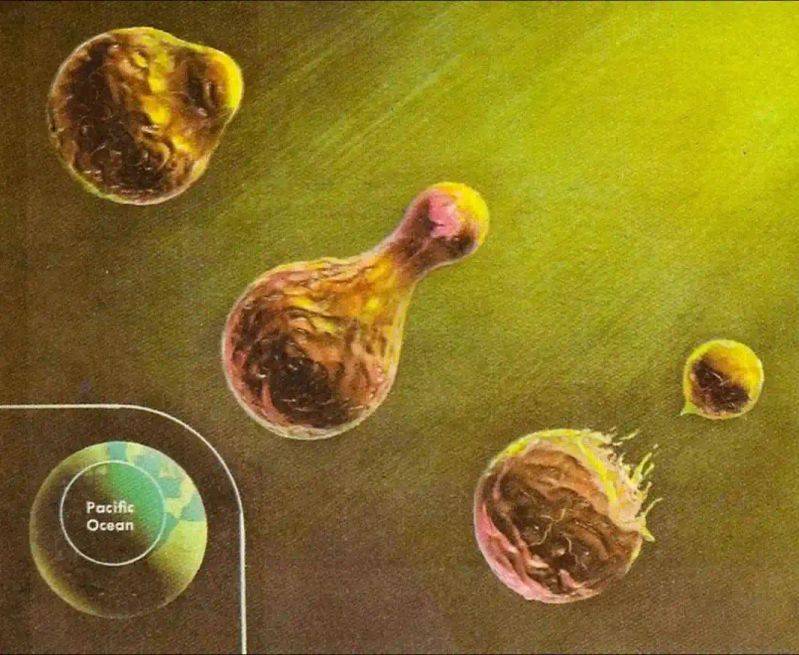
The cleavage of the origin of the moon
The capture theory
The catch said that the moon formed elsewhere and was later captured by the earth's gravity field as a satellite of the earth. In fact, satellites formed in this way are more common, such as the two satellites of mars, phobos and deimos, are considered asteroids captured by mars. The biggest flaw in capture is that it is impossible to explain why the earth and the moon have similar geochemical properties, such as the almost identical oxygen isotope composition of the earth and the moon. The catch said that it was also inexplicable that the moon was very lacking in moderate volatile elements, while the moon had only a small metal core. If the moon was a normal asteroid until it was captured by earth, it should have a larger metal core and not be so poor and volatile。
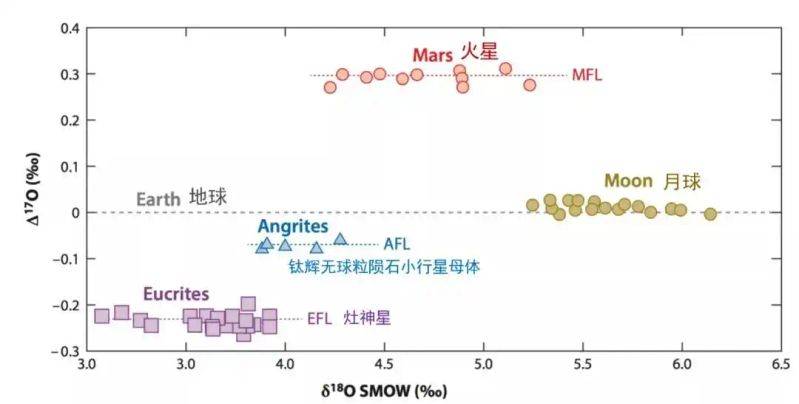
The moon and the earth have the same oxygen isotope composition. Transverse coordinates are the oxygen isotope ratio relative to the standard average ocean water smow
The co-accumulation theory
Co-inhalation suggests that the moon and the earth are condensed by gases and dust in the same nebula area in the primitive solar cloud. This theory can explain the similarity of isotopes between the earth and the moon, but it is not possible to explain the high angular motion of the lunar system, nor why the moon has a smaller iron core, resulting in a much lower average density of the moon than the earth (lunar: 3. 3 g/cm vs. Earth: 5. 5 g/cm), nor why the medium volatile elements of the moon (e. G. Potassium, zinc, thallium, copper, etc.) have a significant loss relative to the earth. It is also difficult to explain why the moon is going through a full-month magma and ocean process, as co-inhalation says it is difficult to provide so much heat。
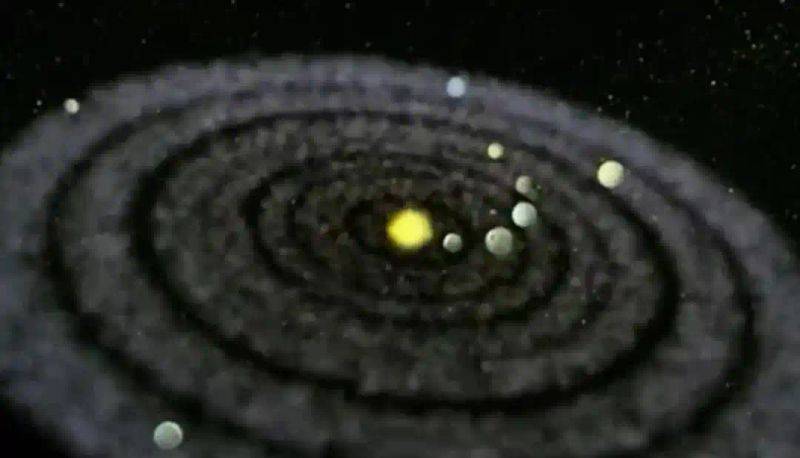
Symptoms on the origin of the moon
Giant impact theory
What is most widely accepted by the scientific community today is collision theory, according to which some 4. 5 billion years ago, in the early stages of earth's birth, a star of the size of mars, known as theia, the mother of the mythical moon, had a violent collision with the primitive earth, and the fragments thrown by the collision had re-integrated near earth orbit to form the present moon。
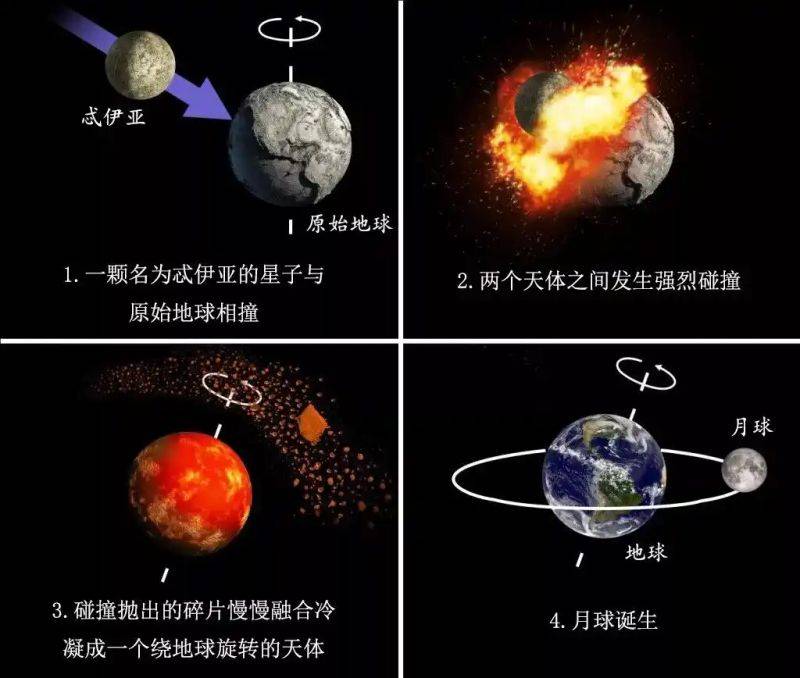
A map of the massive collisions of the origin of the moon
The main evidence supporting the big impact theory is:
(b) the general rotation of the moon and the rotation of the earth
The isotopic composition of the moon (e. G., oxygen, titanium, chromium and tungsten) is consistent with the altitude of the earth and is significantly different from other planets
Most of the moon's crust consists of tilted long rock, which means that the moon once owned the global magma ocean, and there was a similitude crystal (imagining that the moon was a melting fireball, gradually cooled down)
(a) the loss of volatile and light elements of the moon, which are presumed to have escaped by gasification at extreme temperatures
With a smaller iron core inside the moon and a lower average density than the earth, the moon may have been formed by a combination of “lighter” substances ejected after a collision, and the core of the “higher” impact body has been merged with the core of the earth, which is now the core of the earth。
Although the collision theory also faces a number of questions and challenges, with the emergence of the so-called “isotopic crisis” (which, according to the classic collision model, results in 72 per cent-88 per cent of the material forming the moon from the collision body theia, which is completely consistent with the earth's oxygen isotopes, and which is contrary to the current observation of the moon), this theory is the current hypothesis that can explain the most lunar observations and the most prevailing lunar birth theory in the scientific community. A number of revised big collision theory or models related to big collision theory have also emerged, such as the nuclear-nuclear integration big collision model, the starlation model, the impact-escape model, the impact rebalancing model, the high-speed ice plough planet impact model, the multiple impact month model and the eleo-earth high rotation impact model。
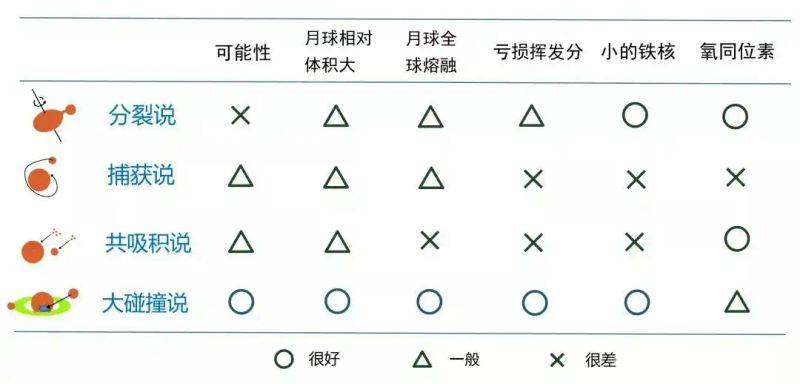
The match between the hypothesis and the observation of the facts
Thus, the moon is neither the “child” of the earth, nor the “capture” of the earth, nor the “sister” of the earth. In the early days of the solar system, the interplanetary environment was volatile, and the moon and the earth were described as “discovery”, yet “only because of the sight of you in the crowds”, they fell into their arms like moths, and from then on, you had me, and i had you, and i had you, a community of destiny that was independent and inseparable, just as god had made eve with adam's ribs. This is the closest “partner” of the solar system, and since then 4. 5 billion years have passed by each other and have been the only one in a vast universe。