The chinese daily newspaper globe online: the moon is commonly known as the moon, and it is also called too pussy. The moon is the most obvious example of a natural satellite. In the solar system, other planets, except mercury and venus, have natural satellites. The moon, also about 4. 6 billion years old, is closely connected to the earth. The moon also has shell, mantle, nuclear stratification. The average thickness of the outermost crust is about 60-65 km. The mantle, which covers most of the moon, is 1,000 kilometres below the shell. Under the mantle is the lunar core, which has a temperature of about 1,000 degrees and is likely to melt. The moon is approximately 3476 kilometres in diameter, 3/11 of earth. The size of the earth is only 1/49, with a mass of about 73. 5 billion tons, equivalent to 1/81 of the earth's mass, and the gravitational strength of the moon surface is almost 1/6 of the earth's gravity。
The moon has dark parts and bright areas. Early astronomers, when observing the moon, thought that the dark areas were covered by seawater, and they called them the “sea”. Notable are clouds, wet seas, silent seas, etc. And the bright part is the mountains, where the mountains are stacked, and the mountains are all over, and the rings are everywhere. The belly ribbon, located near the antarctic, is 295 km in diameter and can be loaded into the entire southern island. The deepest mountain is newton circle, 8788 metres deep. Besides the ring mountain, there are ordinary mountains on the moon. And the mountains and the valleys are folded, and there is no glory。
The moon's head is always on earth. On the other hand, most of the back of the moon is not visible from the earth, except in areas around the edge of the moon that are visible by weight. In the absence of detectors, the back of the moon has been an unknown world。
A significant feature of the back of the moon is that it has almost no darker moon surface features. And when the probe runs to the back of the moon, it will not be able to communicate directly with the earth。
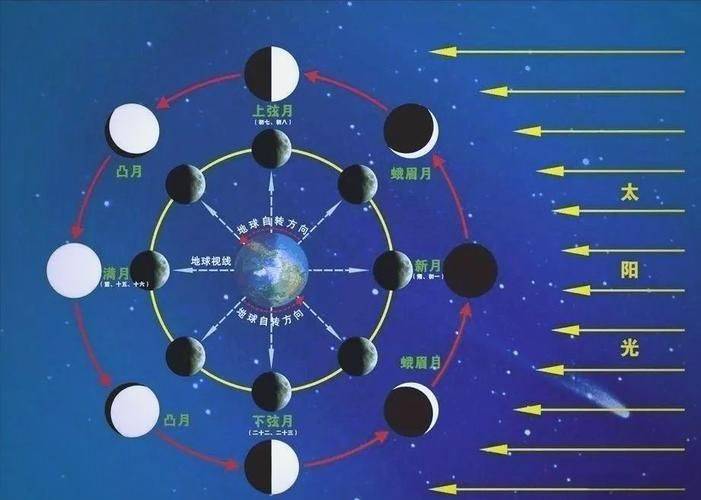
The moon runs around the earth for about a week for an agricultural month and moves half an hour relative to the background sky, that is, similar to the visual diameter of the moon. Unlike other satellites, the orbital plane of the moon is closer to the zodiac than near the equator of the earth。
In contrast to the background sky, the time required for the moon to run around the earth (the moon rotates widely) is called a star-moon, while the time required for a new month and the next (or between the same months) is called a promise month. The longer moon is to be expected because the earth itself has moved some distance in orbit around the sun during its operation。
Because the cycle of rotation of the moon is exactly the same as that of its public rotation, we can only see that the moon will always look to the earth the same way. Since its early formation, the moon has been subjected to a force-set/url
The effect is to slow the rate of rotation, a process called tidal locking. As a result, part of the rotation of the earth's agglomerations has been transformed into an agglomerations around the earth, with the result that the moon is approximately 38 mm away from the earth per year. At the same time, the rotation of the earth is becoming slower and the length of the day is 15 microseconds per year。
The gravity of the moon on earth is one of the causes of tidal phenomena. The orbit of the moon around the earth is synchronous, and so-called synchronous rotation is not strict. Because of the elliptical shape of the orbit of the moon, when it is at a recent point, its rate of rotation does not catch up to the rate of public rotation, so we can see the area up to 98 degrees east of the moon, on the contrary, where the rate of rotation is faster than the rate of public rotation when the month is at a distant point, so we can see the area up to 98 degrees west of the moon. This phenomenon is called scale. Also, because the orbit of the moon is tilted towards the equator of the earth, the moon moves by approximately seven degrees in the polar region when it moves in the air, a phenomenon known as scale motion. Moreover, since the moon is only 60 earth radiuss away from earth, if observers observe from the moon out to the moon, there is a shift in the earth's diameter, which can be seen more in areas with a 1-degree period. This phenomenon is called scale。
Strictly speaking, the earth and the moon operate around a common mass of 4,700 km (or two thirds of the earth's radius). Since the common mass is below the surface of the earth, the movement around the common mass seems to be “shaking”. From above the earth's arctic, the earth and the moon rotate around the clockwise; and the moon also operates around the clockwise; even the earth turns around the sun。
Many people do not understand why there will be such a large change in the values of the lunar orbit inclination and the lunar rotation axis. In fact, the orbital inclination is relative to the central celestial body (i. E. The earth), while the rotational axis is relative to the orbital surface of the satellite (i. E. The moon) itself. This definition custom is well suited to the general situation (e. G. The orbit of artificial satellites) and is fairly fixed in value, but not to the moon。
The orbital plane of the moon (white-channel) and the zodiac plane (the earth's public-turned orbital plane) are kept at the corner of 5. 145,396°, while the axis of the moon is at the angle of 1. 5424°. Because the earth is not a perfect spherical form, but rather is rising in the equator, the balconies are constantly moving (i. E., the intersection with the ecstasy is spinning in timewise) and are completed every 6793. 5 days (18. 5966). During this period, the angles of the aldicarb vis-à-vis the earth's equatorial surface (the equatorial surface of the earth leans 23. 45° towards the ecstasy) vary from 28. 60° (i. E. 23. 45° + 5. 15°) to 18. 30° (i. E. 23. 45°-5. 15°). Similarly, the angles of the lunar rotation axis and the white-channel surface can range from 6. 69° (5. 15° + 1. 54°) to 3. 60° (5. 15° - 1. 54°). These changes in the moon orbit, in turn, affect the inclinations of the earth's rotational axis, resulting in a swing of ±0. 002 56°, known as the chapter motion。
The two points between the white and yellow sides are known as the moon junction - the ascending point (north) is the point through which the moon passes north of the korea; the downing point (south) is the point through which the moon passes south of the korea. The eclipse occurs when the new moon coincides with the moon, and when the full moon coincides with the moon, it occurs。
Orbital data
Average orbital radius 384,400 km
Orbital eccentricity 0. 0549
Perigee 363,300 km
Distance from apogee 405,500 km
Average bus cycle 27 days, 7 hours, 43 minutes, 11. 559 seconds
Average bus speed 1. 023 km/s
Orbital inclination varies between 28. 58 and 18. 28 degrees
(5. 145° on the zodiac)
I'm at the node
Perigee angle 318. 15°
"repeat verse/day" 19 years
Average monthly distance ~384,400 km
Nodal period 18. 61 years
Perigee campaign cycle 8. 85 years
346. 6 days
Saroo cycle (repeat eclipses) 18 years 10/11 days
Average inclination of orbit and zodiac 5 ° 9'
The average angle of the moon's equator and korea is 1°32'
Physical characteristics
Equator diameter 3,476. 2 km
Bipolar diameter 3,472. 0 km
Flat rate 0. 0012
Surface area 3. 976 x 10 ^ 7 km2
Flat rate 0. 0012
Volume 2. 199 x 10^10 cubic kilometres
Mass 7. 349 x 10. 22 kg
Average density: 3. 350 times water
Equator gravitational acceleration 1. 62 m/s2
1/6 of earth
Escape speed 2. 38 km/s
Rotation cycle 27 days, 7 hours, 43 minutes, 11. 559 seconds
(sync rotation)
Rotation speed 16. 655 m/s (in the equator)
Self-rotation axis inclinations vary between 3. 60 and 6. 69 degrees
(angle with zodiac 1. 5424°)
Contrast 0. 12
The full moon looks like a star
Surface temperature (t) - 233 ~ 123 °c (average of 23 °c)
Atmospheric pressure 1. 3 x 10⁻¹⁰ kpa
Moon cycle
Name value(d) definition
Star moon 27. 321 661 relative to background stars
The moon, 29. 530 588 versus the sun
27. 321 582 versus spring point
Recent months 27. 554 550 relative to perigee
Nodal month 27. 212 220 relative to the nodal point