Ecofocus
The green and low-carbon transformation of the development approach needs to be accelerated, green and low-carbon development should be maintained as a cure for ecological problems, green production methods and lifestyles should be accelerated and the green background for high-quality development strengthened。
- from 17 to 18 july 2023, general secretary xi stated at the national congress on ecological environmental protection
"love" green consumption. What do we do
Submitted by zhao ling (research fellow, nanjing university of aeronautics and astronautics, china centre for research and research into specialist socialist thoughts of the new age of xi jinping, jiangsu province)
Green consumption, as a new fashion, attracts and infects an increasing number of people. Green consumer behaviour, such as the implementation of the cd-rom initiative, the purchase of energy-efficient home appliances, the choice of green travel, and participation in waste classification, is increasingly becoming a matter of people's own choice and life. However, the fact that the green consumption situation in our country is far from satisfactory compared to the goal of achieving carbon-neutrality, that the concept of green consumption needs to be further developed, and that there is still a certain range of environmental hazards, such as overconsumption, luxury waste and wild consumption, also partly reflects the paradox of green consumption。
In the context of growing pressure on the resource environment in the consumption sector and the growing urgency of environmental governance issues at the consumer level, if society as a whole is to develop a green, low-carbon, healthy and civilized way of life and to advance the green transformation of the consumption structure, it is essential to address the deep-seated problems that constrain green consumption and to create a positive attitude towards green consumption that translates green consumption into conscious action。
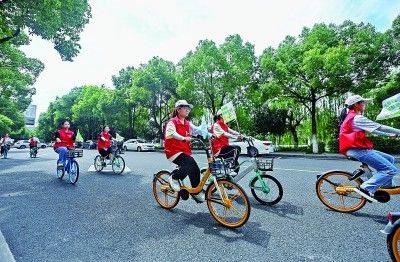
Young volunteers in zhejiangxiang state ride bicycles to promote low-carbon day themes and green trips. Xinhua
Improving the quality of green supply
The willingness of consumers to consume green depends on the supply side of the product and the dialectic between the supply and demand sides。
Adequate and high-quality green low-carbon products are a material prerequisite for green consumption. Products with branded and eco-friendly characteristics are positive incentives for green purchasing practices and can more easily be translated into genuinely voluntary consumer behaviour; on the contrary, products of poor quality that are not ecologically friendly are less favoured by consumers, leading to conflicting supply and demand. The constant focus on research and development and production of green low-carbon products, driven by incentives such as policy support and financial support, will lead objectively to a green consumer market that responds to the need for upgrading consumption and is ecologically friendly, creating a green supply dynamic of diverse, high-quality and technologically advanced quality, thus greatly meeting and better guiding the green demand of consumers and making them “friendly” of green low-carbon products。
Of course, because the production and circulation of green low-carbon products takes into account the environmental costs of technology, processes, materials, etc., prices are often high. Depending on income levels, consumers are likely to be less interested in green low-carbon products or feel more consuming and less purchasing power. In addition to raising the income level of the population, this contradiction should lead enterprises to actively develop advanced green low-carbon technologies and to continue to reduce the prices of green low-carbon products through green low-carbon technologies, the diffusion of digital technologies and their conversion, so that they can “fly into normal people's homes” — which is also a compelling reason for consumers to choose green consumption。
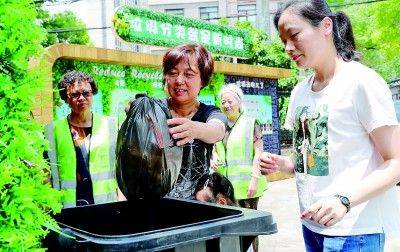
The shanghai city community waste classification supervisor assists residents in the classification of waste. Xinhua
Sound green safeguards system
Trust in green low-carbon products is the psychological basis on which consumers dare to consume: the higher the level of trust, the more proactive the buying of green products becomes; and once there is mistrust of green information, such as environmental certification, it is difficult to put green consumption into action。
If businesses comply with laws and regulations and business ethics, do not use the so-called “green” concept in short-term interests, do not sell non-green commodities in the name of green, do not misuse environmental labels, and sub-opt poor products to the detriment of consumers, and do not continue to produce and sell products regardless of their adverse impact on resources, the environment and the environment, then consumers will naturally dare to buy green low-carbon products with environmentally marked products certified and of good quality。
Similarly, when the state creates a good institutional environment for green consumption in society by establishing a sound legal and regulatory framework for green production and consumption, improving ecological conservation and green consumption; when markets have a unified green product standard, certification, labelling, with a well-developed green product market access and retroactive system; and when consumers are aware of the legal regime relating to green consumption and of their rights and obligations under the law, they naturally have the basis for choosing green low-carbon products, and the courage to buy green low-carbon products has strengthened the self-consciousness and legitimacy of green consumption。
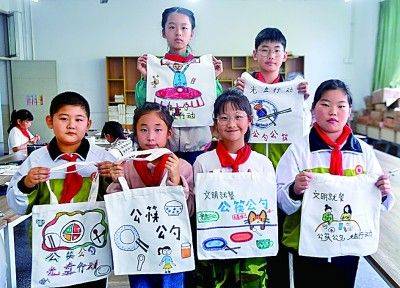
Zhejiang ka xing elementary school students are presenting their own environmental bag posters. Xinhua
Green consumption education
Some consumers display complex attitudes towards green consumption, mainly because they have insufficient awareness of eco-friendly and green consumption and do not know what to do to qualify green consumption. In real life, some equate green consumption with consumption “natural” and consider consumption “purely natural” as consumption; some consider green consumption to be the purchase of organic green products without considering green consumption as a whole; and others lack understanding of the systemic and environmental implications of the ecological environment to link environmental consequences to individual consumption. These partial or erroneous perceptions point to the need for green education in our country. To this end, government departments, the media, schools, enterprises, social organizations and others should work together, using a combination of media, platforms and forums, to promote and disseminate knowledge of eco-environmental issues throughout society, to teach and disseminate experiences of green consumption, to develop green consumption education and guidance, to help people develop the capacity to recognize, choose, use and dispose of green products, and thus to translate green awareness into positive environmental action, to bring together the common sense of energy conservation in life into the great wisdom of caring for nature, protecting the environment and to participate in the fight against environmental pollution and high energy consumption and high emissions。
Promoting green lifestyles
Green lifestyles are in fact a profound change in consumption perceptions, laying the green tone of daily life and embedding the strongest possible ground for a better life. It is not easy to maintain a simple, green, low-carbon consumer pattern in everyday life, such as food and clothing. It requires a genuine acceptance of green lifestyles and commitment on the part of consumers。
This “reality” stems from respect for nature and piety. Only with respect will there be gratitude for nature; only with piety will there be fear of the pressures placed on the environment by its own consumption, thereby insisting on “a life-like approach to the environment” and against wasteful and polluting consumption。
This “reality” is a form of love between people. By valuing, conserving and caring for every natural resource and every work product, it not only expresses respect for and care for others, but also unites in an act of kindness for the preservation of the ecological environment and for future generations。
This “genuine” is translated into a consumption operation of economy and restraint. It is important to note that austerity and restraint do not want to live without consumption or desire, but rather define the ecological responsibility of every consumer, that is, everyone should “start with me”, develop a low-carbon, environmentally friendly and proportionate consumption habit, act as an implementer, promoter and defender of green consumption, and contribute to building a clean and beautiful world。
Knowledge card
Green consumption is the consumption behaviour of all categories of consumers to implement the green low-carbon concept throughout their activities. In its philosophy, it emphasizes greening and sustainability of the whole process of consumption activity; in its target audience, it advocates the selection of products and services that are less resource-consuming, reusable and least harmful to the environment; in its nature, it focuses on resource conservation, a new type of consumption that is adapted to the level of economic and social development and ecological carrying; and, in its goal, it encourages the formation of a green low-carbon lifestyle that promotes living in harmony with nature and has far-reaching implications for building a beautiful china。
The day of light (29 july 2023, 09th edition)