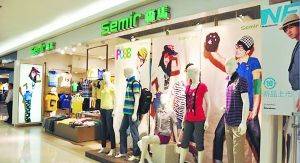
Zhejiangsen ma ' a (hereinafter referred to as "senma " ) recently published the 2017 performance express. According to the performance express, total corporate revenue exceeded $12 billion, an increase of 12. 76 per cent from year to year; business profits of $1. 501 billion, a decrease of 19. 54 per cent from year to year; and net profits of $1,118 million, a decrease of 21. 63 per cent from year to year, attributable to shareholders in listed companies. With regard to growth in performance, simma indicated that the main causes were increased research and development, optimization of marketing systems, deeper channel changes and the continuous development of online e-commerce and children's businesses. It is worth mentioning, however, that while the overall rise in children's clothing has been accompanied by the pre-suppression of leisure clothing, the main reason for the decline in profits. The independent analyser of the footwear industry and general manager of the shanghai homes brand management ltd., cheng wei hung, argued that senma needed to adjust the clothing boards for leisure and change the strategic layout. At the same time, the competitive market for children's clothing in recent years has also tested the sustainability of growth。
Net profit decline
Revenues exceeded $12 billion, and senma achieved remarkable sales performance in 2017, but net profits declined the same year. According to the performance express, the income from the sale of simama clothing was $12. 28 billion, an increase of 12. 76 per cent over the same period, a further record high. However, the net profits attributed to shareholders in listed companies declined by as much as 21. 63 per cent over the same period. In response, simma indicated that increased r & d inputs, better pay for personnel and the development of electric power companies had led to higher costs. At the same time, since the second half of 2017, the increased support provided by sammae to affiliated companies and the increase in stock over the season have resulted in a corresponding increase in the impairment loss of the assets。
However, beijing journalist journalists have found that the decline in samma's performance and, in addition to increased investment by electricians, the continued decline in leisure boards is one of the keys to the decline in profits. As the main player in leisure clothing, it has always been in the young consumer group. In recent years, however, the stagnating of the recreational clothing boards brought about by the ageing of brand names has been the biggest bottleneck that needs to be broken. According to the data, in 2011 the share of the simma children's clothing in the company's overall revenues was not high, at a mere $2. 05 billion, or less than half of that of leisure clothing. However, with the development of the children's clothing market in recent years and the growing age of the simma brand, performance has declined significantly as a result of recreational clothing that had previously contributed to improved performance. In 2012-2013, the senma camp received $7. 06 billion and $7. 29 billion respectively, of which the adult recreational clothing block received only $4. 88 billion and $4. 68 billion, a decrease of 12. 6 per cent and 4 per cent respectively。
According to cheng weiung's analysis, the current consumer market is dominated by “after 80” and “after 90” consumers, who have difficulty meeting the needs of this segment of the consumer, who are more demanding about the diversity of their products, and who need to be better informed about consumer needs and psychology and ensure that supply chains are closely linked to consumers。
The powerful children's clothes market
In the context of the continuing decline in leisure clothing, children's clothing has become the main driver of the rising performance of the horse and has been overstretched in the camps。
According to the data, the income of the main camp for leisure clothing had declined for the second consecutive year in 2012 and 2013. Of these, in 2012, samma's recreational clothing camp received $4. 88 billion, a decrease of 12. 64 per cent over the same period, and in 2013, it received $4. 683 billion, a decrease of 4. 04 per cent over the same period. At the same time, in 2013 the number of shops in samma nationwide decreased from 4,420 to 4029。
However, the performance of the sema children's dresser block has continued to improve. According to data released by the senma electrician, during the period of “two eleventh” in 2017, the sale of senma exceeded $812 million, and barabara was ranked first in the 320 million dollar range for the size of the skycat. It is known that, starting in 2011, the baby dress in barabara began to show an upward trend, with an increasing share of the total collection in samma。
In addition, samma has continued to expand in the children's market and will also reach out to children's education, entertainment, etc., with early education and many dreams of children's commercial complexes. In the second half of 2017, a cumulative 2. 2 million annual arrivals and an annual sale of $200 million were recorded in mondo town, laying a solid foundation for the march of senma into the child industry。
In the next five years, senma has indicated that it will adhere to the main garment industry and complete the transformation of leisure clothing, children's clothing to the garment industry, the children's industry, the electricity industry and the emerging industries, as well as the transformation of single brands to multiple brands, wholesale capacity to retail capacity, industrial chain capacity to operate in the biosphere, elite entrepreneurial capacity to develop entrepreneurial capacity。
Challenges to development
In fact, although the performance of senma in the child clothing market has grown rapidly, the question of whether it can be increased has become a pressing one。
The domestic market for leisure clothing is now saturated, with many brands competing for market shares and some strong brands starting to decline. In the face of the burgeoning child-dressing market in recent years, foreign brands such as zara, eugar, h&m, and gap will also reach out to the child-dressing market, along with the emergence of the domestic brands of gangnam and anele, which are increasingly competitive with the children's urban market, and where the survival of the imbeciles, who are struggling to develop child-dressing without an absolute advantage, is at risk。
With the liberalization of the “two-child” policy in the country, senma is increasingly investing in child dress boards. The data show that in 2016 the cost of operating the senma children's clothing block was 2,857 million yuan, an increase of 22. 7 per cent over the same period; it accounted for 43. 45 per cent of the total cost of senma's business, compared to 39. 51 per cent in 2015. With regard to the development of the children's clothing business, senma indicated that in the future it would further strengthen the management of channels, enhance the image of brand terminals, advance the construction of two customer systems: retail service providers and professional retailers, carry out practical and effective work around building the capacity of clients and upgrading their services, and continue to advance the ole channel. At the same time, improving product competitiveness and increasing product research and development while continuously optimizing product structures. (c) strengthen research and development, promote the development of the whole range of products with age-specific entry points and reform product supply systems. Further consolidate supplier resources, improve supply chain effectiveness and further optimize supplier structures and international market layout。
Cheng wei-hsiung stated that sama should adjust to other brands and change strategic layouts. At present, it is not easy for simma to rely solely on the child's market for sustained increases in raw materials and manufacturing costs, as well as increasing competition in the child-dressing market。