Following the full opening of the two-child policy in 2016, the gears of the national dress brand, the fate of the horse, also began to turn。
In the second year, the new population reached 1. 72 million, which in fact was almost the highest in more than two decades (after 17. 86 million in 2016) and the last wave of demographic dividends。
In 2017, for the first time, a children's clothing camp in senma exceeded its leisure clothing and became the first largest collection business. In the decade since then, the proportion of children's clothing camps has gradually increased, reaching over 70 per cent by 2024, with the brand name barabara becoming asia's largest sales。
Children's clothing, including balabala, is the second business that samma ran away from after her leisure dress. In retrospect, from $5. 6 billion in 2017 to $4. 2 billion in 2024。
That is to say, if it was just a casual dress, it would've been a long time ago. With child-dressing products, senma spent the most comfortable 10 years of gold and was also a small business in clothing brands that ate the last wave of demographic dividends。
However, with the restructuring of the population, the dividends have now disappeared. Today, 2025, from milk powder to infant and child products, the crisis is in turn unfolding。
Samma has also experienced structural problems, and when the number of newborns born continues to decline, where does the child-centred simma grow
100 billion in child clothing
Samma's worth 10 billion, 70% of which is due to child clothes。
As a former national brand, samma's main business today is already a child costume. According to financial data, during the first half of the year, the sum of $6,149 million was collected at the senma general camp, of which $4,313 million was collected at the children's dresser block, an increase of 5. 97 per cent over the previous year and a steady 70. 15 per cent. However, during the same period, the revenue from recreational boards decreased by 4. 98 per cent to $1. 723 billion, and the share of the revenue from the companies contracted to 28. 02 per cent。
In the past few years, the simama dress has in fact been “a fall in adult leisure and a rise in child clothing”。
According to the data, the proportion of children's clothing collected rose from 52. 6 per cent in 2017 to 63. 05 per cent in the first half of 2021, and eventually stabilized at over 70 per cent in 2024-2025, with the shift from a “recreational clothing company” to a “child clothing company”。
(the data from the almond platform clearly show that in 2017 the proportion of children in simama's clothing exceeded that of leisure clothing, making it the first category.)
The child clothing of senma is divided into three main categories。
The first category consists of children's clothing products under the samma brand, as well as various brands such as the incubated macalé; the second category consists of products under the barbara brand; and the third category consists of associated products such as children of arthur and pema。
Barabara is the boxing brand of children's clothing under the banner of sama, and it has been repeatedly mentioned in the newspaper that the barabara brand has the absolute advantage of the children's dress market, that it has the highest share of the domestic market for many years, and that data from eurowise show that barabara has the highest sales of asian children's clothing。
At the same time, samma expanded the children's dress business, which in 2021 and 2023 took the authorization of the “assess kids” and “puma kids” children, respectively, and formed the business matrix for the children's dress in its own incubation brands。
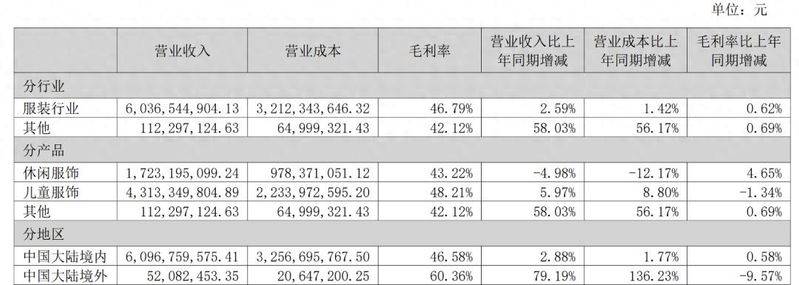
(senma's semi-annual report shows a higher māori rate of child clothing than leisure clothing)
The “support” role of the children's clothing, represented by barabara, is reflected not only in the collection figures but also in the company's physical retail networks and profitability。
According to the 2025 semi-annual report data, as at 30 june 2025, there were 8325 underline shops in samma clothing. Of these, the number of “child clothing” shops was 5514, or 66 per cent of the company's main store, while only 281 were left。
It is not just a collection, but a child's dress is an important source of profit。
Financial data for 2025 show that the māori rate for children's clothing is slightly higher at 48. 21 per cent than for leisure clothing at 43. 22 per cent, but that profits are also apparent to be higher because children's clothing is much higher than leisure clothing。
A rough estimate is that the gross profit ratio for child clothing should be two thirds。
2, 2017 turning points
Many listed companies have a history of development in their performance. With the full opening of the two-child policy in 2016, the number of births in 2017 reached its highest level in more than 20 years。
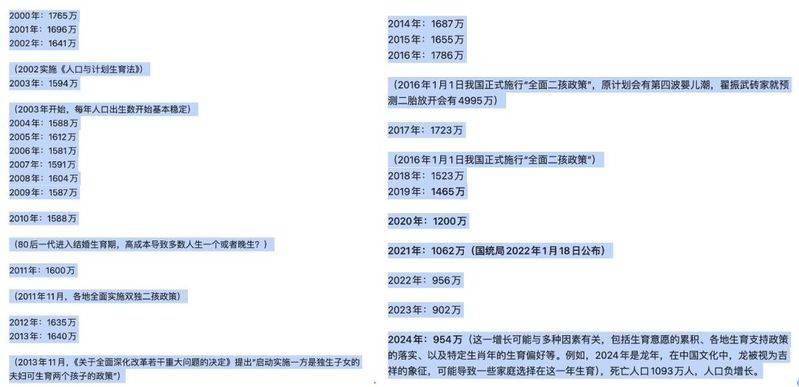
Zhang zhang zhang zheng zhui, founder of the viet nam investment corporation, compiled the data in his reply
It is not difficult to understand that between 2000 and 2016 there was a year-on-year increase, but the rate of growth slowed and, after 2017, the overall liberalization of the second child slowed the downward trend in growth, but it was true that the total number of births was reduced。
The shift from a “national leisure brand” to a “child-dressing giant” in samma dress took place in 2017。
According to publicly available data, in 2017, the proportion of children's clothing collected at the samma general camp was 52. 6 per cent. This is the first time that the children's clothing business has exceeded adult leisure clothing in size, formally establishing its “c” status within the company。
From this year onwards, the scale has continued to tilt, and by 2024 the proportion has increased further to 70. 21 per cent, with children's dress boards being the backbone。
The change of time is not an accident。
The central release of the structural dividends of the “two-child policy” in 2017 was accompanied by an increase in domestic consumption and rapid growth in the middle-high-end market-oriented balabala。
Just as simma has enjoyed the dividends of the last decade in common with markets and population cycles, it has also planted a pen to its subsequent “path dependence”。
At the same time, another issue we would like to discuss is why there has been a decline in the sale of leisure clothing。
A better understanding is that fast-fashion has become an important trend in garments, with brands such as the united states and samma lagging behind in domestic competition, and the hangars, zara and h&m are more popular with young people。
It was also in those years that the founders of zara once became the richest in the world, and in 2015 and 2017 the wealth of omano otega exceeded that of bill gates。
Children's clothes and leisure clothing were lifted and the structure of the senma's harvest completely changed。
Can ip strategies win the next decade
The core drivers of the next decade could be derived from ip strategies。
In the last week, samma's stock prices have increased by 20 per cent over time. In the news, the second of the world-renowned ip crazy animal cars is about to be released, asking investors whether there is a joint venture with mad animal city 2。
And samma has confirmed that under the banners samma, barabara, and sama children have launched joint ip products like disney crazy animals. Attention, this could be the first. Samma doesn't know if the tax is the first or the second
And the forthcoming release of mad animal city 2 is one of the most promising film films of the time, the first of which was a global box office of $1. 02 billion and the tenth largest in the history of animated box house, and was a phenomenon-oriented film at home。
In fact, not just crazy animal city, the ip push has become the core growth engine of senma。
Turning over the financial paper, you can see full-screen ip cooperation。
For example, the financial paper mentions that barabara continues to introduce well-known ips such as the trinity goose, harry potter, the red mountain zoo, and piggy pec, covering users of different ages。
In response to investors ' questions, simma responded that brands under the flag would introduce ip resources based on brand positioning, consumer portraits, cooperate and build deeper emotional links with consumers. In-house, samma has established an ip-cycle management system to manage key elements of the process from ip introduction, product development, product marketing, etc。
For example, in 2023, the samma brand introduced the kings glory ip joint product。
Moreover, at the end of 2024, samma had invited xu zhi-sheng, a talk show actor, to speak out as an event; in addition, sam ma hatched the brand of shuku shuku, which was created by samma and actor janing, who was not only the actor, but also the lead broadcaster in the head。
These are the shift from a single clothing producer and seller to an ip-driven clothing cultural role。
After almost two years of consumption, such as bubble-mart, valley culture, and so on, there is a remarkable new generation of consumers, and it has become a hot market。
Ip will be an important component of future consumption, as a collection of high-value goods as low-priced commodities, but with the help of ip and combinations, it will bring huge outlets for commodities and separate them from everyday goods。
And senma, as the number of children in the child dress business declines, the dividends of the “gold age” are coming to an end; the next new golden age, with the ip at its core, can samma capture it