Introduction: to determine the "bones" and "colours" of the image, we came to the critical step in determining the instant clarity of the image: the type of fast door. This is the most central part of the industrial camera selection and the one that is most likely to lead to the image “turner” as a result of a selection error. Selecting the wrong fast door, objects that move at high speed will be filmed as “jellies” or “mixes”, and precision measurements will be meaningless. This paper will provide you with a complete picture of the fundamental difference between the global fast door and the roll fast door, as well as with the iron rule of decision-making to eliminate ambiguity。
I. The central role of the fastgate and the two ways to achieve it
Inside the camera, the fast doors control the duration (exposure time) of the sensor's “seeing” light. Industrial cameras perform exposure control mainly through two different sensor techniques: global shorter and rolling shorter。
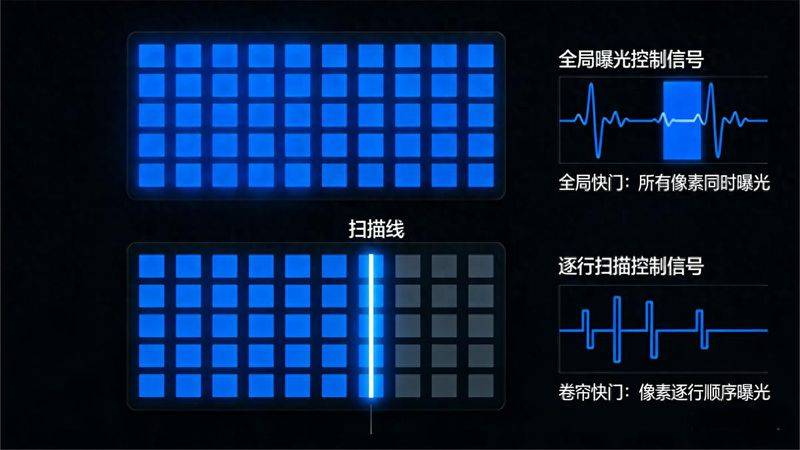
The most fundamental difference is whether all pixel points on sensors are exposed simultaneously or in line-by-line order。
Ii. Global fast doors: born for industry, fixed instantaneous
Motion of work:
The global fast-door sensor internalizes additional storage units. At the beginning of exposure, all pixels simultaneously start collecting light signals (charges). At the end of the exposure, all pixels simultaneously transfer the collected charge to the adjacent, unsensible storage unit for temporary storage. The signal is then read from these storage units in a line-by-line or column-by-line manner. Thus, it captures the entire sensor scene within the same "time slice"。
Core strengths:
No motion malformations: this is its core value. Regardless of how fast the object moves, the camera captures the real geometric shape of the object at that moment, the edge is sharp and precise. This is the basic requirement for robotic visual guidance, high-speed measurements and testing. For flash lighting: it is possible to synchronize accurately with the source of light, to open high-light flashes at very short exposures, to freeze high-speed motion objects perfectly, while overcoming environmental light interference。
Areas to be considered:
Cost and complexity: intra-pixel integrated storage units increase design and process complexity, usually at a higher cost than volumed fast door sensors. Inherent noise may be slightly higher: the charge transfer process may introduce additional noise and may sometimes be less dynamic than the top-roll fast-door sensors in a very low-light, long-exposure scenario。
Typical application scenario:
Iii. Volume drapes fast doors: a price choice for static drawings
Motion of work:
There is no global charge storage node for the curtains. It's exposed and read by line. When the first line of pixels begins to be exposed, the second line starts later, and so on, until the last line. After the first line of exposure is completed, it is usually done directly in the line to convert the numbers and read them out before the next line begins to be exposed (or there is a short overlap). It therefore captures not a moment but a “time belt” from the top。
Core strengths:
Simple pixel structure: without additional storage units, the pixel filling rate (the ratio of active light area) can be higher. Higher-intensity drawings: under static or low-speed scenarios, lower reading noise, higher dynamic ranges and better low-light performance, with high image quality potential. Cost is more advantageous: a global fast door camera that usually has a price below the same resolution。
Core disadvantage:
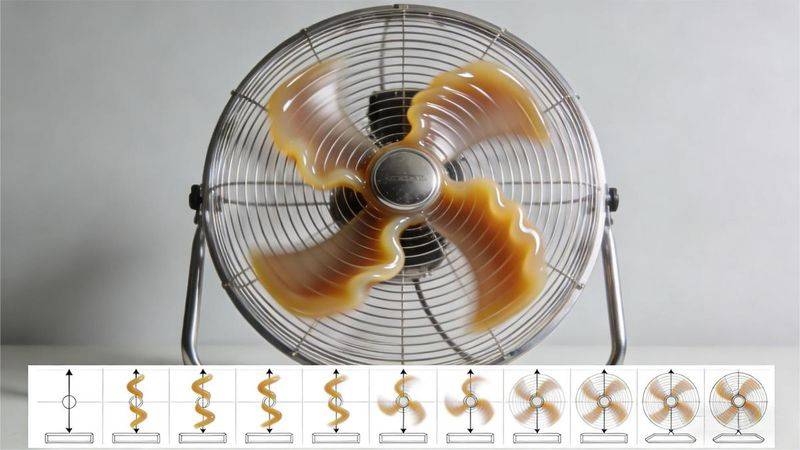
Jell-o effect: this is its most lethal shortcoming. When a high-speed moving object or camera itself moves fast, it is not possible to accurately measure the problem of flash synchronization because of the fact that the time is different from the time recorded in the upper and lower parts of the image, which results in the distortion of the straight line and of the rotating object: under flash sources such as sunlights, stripes may be taken in the dark。
Typical application scenario:
Iv. Core decision-making codes and flow charts
The decision logic for choosing a fast-door type is more direct and tough than the first two steps, as it relates directly to the availability of the image。
Gold decision iron:
“so long as the object has a relatively visible movement during exposure, a global fast door must be chosen. Only when the object can be considered to be completely static shall the curtains fast-gates be considered to obtain a possible paint quality or cost advantage.”
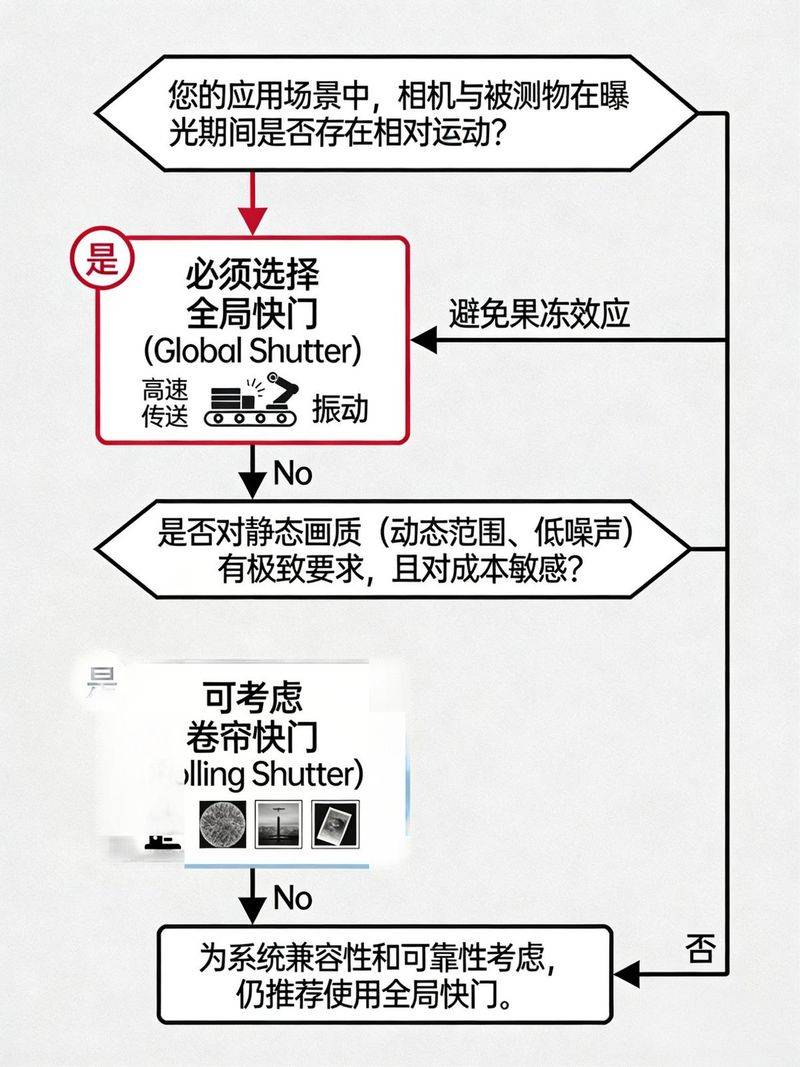
One sentence: in the field of industrial automation, the global fast door is the “safe rope” that guarantees the reliability of imaging, while the roll-out door is the “option” for the pursuit of extreme value for money or for painting in a given static scenario. When you're not sure, it's always safer to choose the global gate。
V. Summary and views
The choice of a fast door is a rigid rule in the industrial camera selection. It is not about which is better, but about which is useful. The global fast door guarantees the authenticity of motion images and is the cornerstone of a dynamic visual system。
And we understand how to "set the moment," and we're going to go deep into the camera's "heart" -- the image sensor chip itself. Why are the once-infinite ccd technologies almost completely replaced by cmos in today's industrial market? This implies profound technological evolution and market choice logic。
The next one says: "industry camera selection is a complete guide to 5" chip: ccds are a thing of the past, why is cmos the preferred one today? We'll analyze the underlying causes behind this technology change and show you how modern ccos cameras can achieve a complete leap in performance。
Series article navigator:
And the beginning and the beginning: six steps, and never step on the pit
Structure: form or line? Let's see how the object moves
Colours: black and white or colour? Don't pay for useless information
[strend: global or curtain express] the key chip to address movement ambiguity: ccds are a thing of the past, and why is cmos the preferred of today? (forthcoming) fov and precision: resolution, target size? An interface: gige, usb3, cxp... What's the choice of transfer protocol? Case in action: six-step decomposition of real applications