Many families are confused that the elderly have common diseases such as brain infarction, diabetes, parkinson, chronic drug use, lack of mobility and poor quality of life without knowing that the state has a long-standing policy that allows them to obtain a disability certificate and receive monthly allowances and benefits。
The disability certificate policy for 2026 was fully optimized and no longer referred to only as “innate disability”, with greater emphasis on functional impairment. According to the latest data of the china disabled persons ' federation, more than 20 million persons with disabilities are eligible but not certified in the country, of whom more than half are chronically ill and middle-aged. Today, 28 common certified diseases, the latest evaluation criteria, the full processing process and the benefits available are presented in one-time, all of the latest 2026 policies, allowing self-checking and preparation of materials。

I. Understanding: it's not the “lack of arms and legs” that counts as disability
Many people misunderstood the disability certificate and felt that only severe trauma and congenital malformations were considered disabilities. In fact, in the latest evaluation rules of 2026, long-term functional impairments caused by illness are eligible for certification as long as they affect daily life and cannot be recovered. Three hard criteria, which meet the following requirements:
1. The seven categories of statutory disability
- visual, hearing and speech disabilities
- physical, intellectual, mental, multiple
All documented common diseases correspond to these seven categories, with clear quantitative indicators and not a sense of judgement。
Functional handicaps must be “long-term irreversible”
This is the core threshold, which does not count for short-term illness, post-operative recovery, but must be a cure that affects life in the long term:
- physical, visual and hearing groups: regular treatment for more than six months and steady improvement in condition
- chronic diseases such as brain infarction, diabetes complications, rheumatism: 1 year old, functional failure
- severe depression, alzheimer's disease, schizophrenia: more than two years of standard treatment, still unable to live independently
3. Requirement to attain level iv and above
The disability is divided into levels 1-4, the first most serious, the fourth the least, and the fourth the minimum threshold. For example:
- visual disability: optimal vision 0. 3 (one eye does not count)
- physical disability: single-sided body muscle level 3, inability to walk independently and carry things
- hearing disability: average hearing threshold of 60 db, normal communication impaired
Simple self-measures: old people are unable to wear clothes, eat, walk, go downstairs or go out in need of help, can't speak properly, can't read simple words, and presumably meet the assessment criteria。
Ii. Comprehensive list of 28 common diseases: high prevalence among older persons, self-censorship pass
The most recent 28 common diseases, covering the five main categories of body, vision, hearing, mental and intellectual, were found in 2026, all of which were high-prevalence diseases among middle-aged and old-age persons
(i) physical disability (most common and highest number of witnesses)
1. Brain infarction/breeding/dimensions in the brain (paraplegic, physically weak, unstable walking)
2. Parkinson's disease (shocking hands, stiff limbs, slow movement, easy to fall)
3. Rheumatism (artificial malformation, pain, inability to hold things, difficulty going up and down)
4. Strong straight spinal cord (hard spinal column, hard bend, limited walk)
5. Diabetes complications (diabetes ulcer, lower leg death, risk of amputation)
6. High blood pressure complications (brain haemorrhage, brain infarction, physical palsy)
7. Chronic obstructive pulmonary disease (long-term asthma, requiring oxygen, inability to walk for long periods)
8. Spinal damage (inflammation, inflammation leading to paralysis of the lower limbs, incontinuation)
9. Severe osteoporosis (artificial deformation, severe pain, inability to walk independently)
10. Polloplasmic after-effects (judgmental deformity, difficulty walking)
11. Severe muscle atrophy (fragmentation, muscle atrophy, inability to hold)
12. Symptoms of cerebral palsy (adult physical convulsions, uncoordinated actions)
(ii) visual disability (high, easy to ignore)
Glaucoma (several loss of vision, shrinking of vision)
14. After cataracts (correction of vision is still 0. 3, inability to see road, face)
15. Yellow spots (old-age yellow spots, loss of central vision, deformation of reading)
16. Retinal chromosomal variability (night blindness, shrinking vision, eventual blindness)
17. Visual nervous atrophy (permanent loss of vision, inability to correct)
18. Serious eye trauma (eye damage, irreversible loss of vision)
(iii) hearing/verbal disability
19. Old-age deafness (average hearing threshold of 60 db, normal speech failure)
20. Medicinal deafness (caused by drugs such as quintacolin, permanent hearing loss)
21. Post-brain infarction speech barriers (disappointment, incoherence, inability to communicate properly)
22. Post-larynx cancer (acoustic ectopsis, inability to speak, needing aids)
(iv) mental/intellectual disability (vulnerable to misunderstanding, welfare best served)
23. Alzheimer's disease (adultia, above and above moderate, life inoperable)
24. Severe depression (regulated treatment for 2 years is ineffective, socially unsocial, suicidal)
25. Schizophrenia (long-term medications, unstable conditions, care-giving)
26. Epilepsy (more than three times a month, affecting life, unable to travel independently)
27. Mental disorders after brain trauma (remuneration, cognitive decline, inability to self-care)
28. Innate mental low (moderate above, life is not independent)
Critical reminder: if not diagnosed, it must have long-term functional impairment and meet the level iv standard. Diabetes, for example, does not count as such, but it causes diabetes and retinal disease and does not recover for a year, and can be assessed as a physical or visual disability。
Iii. Recent processing processes: 5 steps complete, cross-provincial and accessible the door
In 2026, the policy was optimal: free of charge, cross-provinces, inability to act, no need to run back to home, no need to play repeatedly。
1. Preparatory material (one-time, no running)
- original identity card, account book + copy
- three recent two-inch bareheaded photos
- complete medical records for the last 1-2 years, summary of discharges, examination reports (ct, nuclear magnetic, visual/heart test forms)
- paternity id + certificate (intellectual/mental disability, required in case the elderly cannot take care of themselves)
- residence permit (required when applying for an “inter-provincial” residence permit)
2. Application channels (2 optional, all online)
- underline: cadastre/residency district disability union, csc disability window
- online: national disability federation information service platform, app special branch of the government service inter-provincial office
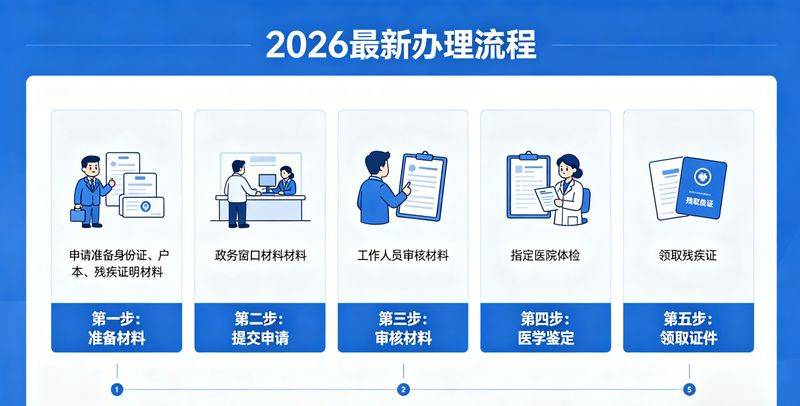
3. Core steps (5 steps to be completed within 30 working days)
1. Application: fill in application form, evaluation form, selected disability category
2. Acceptability: fimitic reviewed material and informed the designated assessed hospital
3. Evaluation: specialized testing at hospitals (instruments + quantities, objective scores)
4. Publicity: 5 days of community publicity after qualification (minors, older persons)
5. Certification: publicity without objection, issuance of three generations of disability certificates (nationally available)
4. Special facilities (new in 2026)
- inter-provincial: permanent residence with a residence permit, no return to domicile land
- home-based assessment: bed-bed, older persons with severe disabilities, with appointment of staff for home-based assessment
- free of charge for the entire journey: the disabled union does not charge the cost of the work, but only the hospital assessment fee is based on local standards
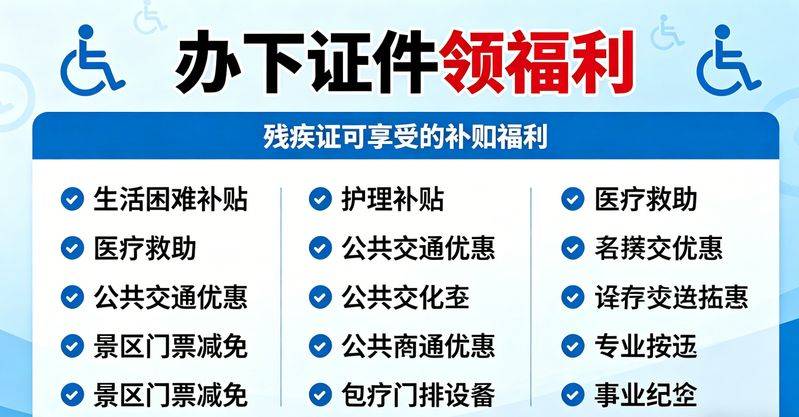
What can i get for it? Subsidy + full benefit combo (2026 updated standard)
Many people do not know that the disability certificate is more than a piece of paper, and that monthly cash allowances, medical benefits, free travel, and life relief are used to reduce family burdens。
1. Two core subsidies (national harmonization of minimum standards, upward revision in 2026)
- subsidy for persons with disabilities in difficult circumstances: low-insured/certified persons with disabilities in low-income families, minimum 85 yuan/month for the country, 100 to 120 yuan/month for most provinces and 200 to 300 yuan/month for developed regions
- allowance for the care of persons with severe disabilities: a minimum of 95 yuan per month for level i and ii (all disabilities); a minimum of 60 yuan per month for level iii intellectual/mental disabilities
- rules for receipt: eligibility is granted at the same time, on a monthly basis, directly to the social security card, without running for payment
2. Other practical benefits (nationally available, fully covered by 2026)
- patient benefits: increased rate of health insurance reimbursement, in-patient exemption, priority visits, rehabilitation benefits
- free travel: free public transport on the basis of a disability certificate, subways, priority tickets for long-distance vehicles, free accessories
- free of charge: free access to public view areas, museums and gymnasiums throughout the country
- life relief: halving the cost of water and electricity in some areas, cable relief
- accessibility and adaptation: families of persons with disabilities with severe difficulties, with the installation of hand helpers, ramps and low-level stoves free of charge station
V. Common error zones: do not be rejected for these reasons and miss benefits for nothing
Zone of error 1: only congenital disability can be done - wrong! New regulation 2026, which allows for post-disease and chronic impairments, as long as they are met
Mistake 2: one-eye blindness, one-heart deafness - wrong! On the better side of the rating, one eye/one ear normal, not a disability
Mistake 3: you can do it when you get sick - wrong! You have to be stable, you can't recover, you have one year of chronic illness, you have two years of mental illness
Mistake 4: disability certificates affect children - wrong! Information is confidential, no deposit is checked, children are not affected in school, employment, political review
Mistake 5: must go to the domicile - wrong! Full inter-provincial coverage in 2026, with residence permits
Vi. Conclusion: not to sleep on the enjoyment of policy benefits to the enjoy
There are chronic illnesses and after-effects in the home for the elderly and do not feel “just sick and not disabled”. The disability certificate policy of 2026 has been fully relaxed, with 28 common diseases being met, with monthly allowances and multiple benefits, effectively reducing family economic and care stress。
The list and criteria for the assessment of the above-mentioned diseases are checked for compliance with older persons; materials are prepared as soon as they are met, and applications are made online and are simple and accessible。
Many families have missed years of well-being for lack of knowledge of policy. The state's safeguard policy was designed to help families in need, so that “not knowing” did not delay the rights to which they were entitled. One day early, one day early, so that the elderly do not suffer any more from the disease and the burden on their families。