


Time relays are usually widely used in production equipment, capable of accurate manipulation of time, improving product accuracy and performance, such as in electronic equipment such as remote control, communications, automated manipulation, etc., is one of the most important control components. Time relays function as time-lapse closures or disconnects in circuits. There are two types of time relays, one for electrical extension and the other for blackouts. There are also parts of intermediate relays that act as converters in circuits, transforming a single signal into several separate signals. What's a time relay? What's the effect? What is its structure and rationale and what are its classifications? And the usual questions and answers about time relays。
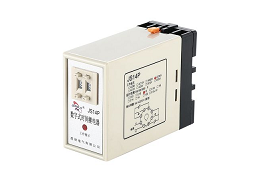
What's a time relay
Time relays are very important components of electrical control systems. In many control systems, time relays are used to achieve delay control. Time relays are automated control devices that use the principle of electromagnetic or mechanical action to delay contact closures or disconnects. They are characterized by a delay in receiving signals from the attracting wire to the contact action, and time relays are generally used to control the start-up process of a time-functional electrical device。
In summary, the main function of the timers is to serve as an enforcement device in a simple program control. When it receives the start-up signal, it starts to count, after which its work contacts are disconnected or closed to facilitate subsequent circuit work. In general, the delayed performance of time relays can be adjusted within the design scope to facilitate the adjustment of their delay. In addition, a single time relay may not be able to shut down. After a while, it'll open again. It is a cycle that is shut down and opened with a delay, but only with a certain number of time relays and intermediate relays。
What's the role of time relays?
Typical time delay features include start-up delay, repetition cycle (start-off), spacing, closure delay, re-activation of a trigger, repetition cycle (start-up), pulse generator, one trigger, start/off delay and memory locking。
Structure of time relays
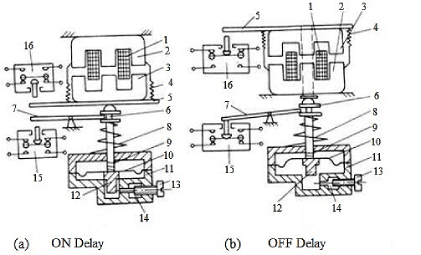
Structure of air-blocking time relays
1 circle
Five pushers
Nine weak springs
Thirteen to screw
2 iron cores
Six pistons
10 rubber film
14 in
3 hubs
7 leverage
11 airlock
Fifteen microswitch
4 reaction springs
8 springs
Twelve pistons
16 micro-switch
The working principles of time relays
The widespread use of time relays in electronic equipment such as remote control, telecommunications and automated controls is one of the most important control elements. When wires are wired, the cortex and trays are drawn from the core and move down in an instant, closing or breaking the action point, but the piston and lever cannot go off at the same time as the cortex, because the upper end of the piston is connected to the rubber membrane in the air chamber。
When the piston begins to move downwards with the release spring, the rubber membrane is dented downward. The air in the air chambers is thinner, causing pistons to be blocked and slowly reduced. After a certain period of time, the piston drops to a certain position and then leverages the time-lapse action to separate and close the motion. The time between electrical transmission of the wire and the completion of the action by the time of the delay point is the time extension of the relay. The length of the delay can be changed by screws to adjust the size of the gas chamber into the wind hole. Following the loss of electricity from the inhaler loops, relays rely on springs to recover and air is quickly released through the vent。
How are time relays classified
Time relays classified according to delayed mode
Based on the delay pattern of the time relay, the time relay can be divided into two types: the connection delay and the disconnection delay。
1. Delayed time relays
Starts the delay as soon as you receive the input signal. When the delay is complete, the operative output signal is used to manipulate the control circuit. When the input signal disappears, the relay restores its pre-action state immediately。
2. Disconnected delay time relays
Disconnection of delayed time relays is the opposite. An output signal is immediately available in the operative part when you receive the input signal. After the input signal has disappeared, the relay needs a certain delay to return to its pre-action state。
Time relays classified according to the principles of work
Depending on the method of work, time relays can be classified as air interdiction time relays, electric time relays, electromagnetic time relays, electronic time relays, etc。
1. Air interdiction time relays
This type is derived from the principle of resistance when air passes through small holes. Its structure consists of three components: an electromagnetic system, a time-delay mechanism and a contact point. The electromagnetic agency is a two-mouth direct motion, the contact system is a micro-motion switch, and the time-delaying institution uses airbag blockers。
2. Electronic time relays
The principle of non-jumpability of the holding voltage on rc circuits can only be gradually changed according to the index pattern, i. E. Delayed by the electro-retarded nitric properties. Characteristics: long duration, high accuracy (generally around 5 per cent), small size, earthquake resistance, ease of adjustment。
3. Electric time relays
Time lags are obtained using the mini-synchronous power drive gear system. Characteristics: a wide range of delays of up to 72 hours and 1 per cent accuracy. At the same time, the delayed value is not affected by voltage fluctuations and ambient temperatures。
The range and accuracy of the delay is not comparable to other time relays. The disadvantages are structural complexity, size, short life expectancy, high prices and accuracy affected by power frequency。
4. Magnetic time relays
Using the principle of slow decline in magnetic flux after the electromagnetic loop has been cut, delayed release of magnetic cortex is delayed, resulting in delayed movement of the contact point. It is characterized by high exposure and therefore high control capacity. However, the delay was of a small duration and slightly less precise, so it was mainly used for direct current circuit control。
Common questions and answers about time relays
What's a time relay circuit?
Time delay relay. Delay relays. Relays are circuit-controlled switches. Essentially, relay messages begin to tell something. When the car is activated, the ignition device interacts only indirectly with the car's battery, as relays are sending signals to tell the car to start。
How to make time relays?
These relays provide “time delay” between online loops or power outages and power hub movements. This relay is referred to as a delay relay. The delay relay consists of a normal machine relay and a control circuit to control the operation and timing of the relay。
What's off the time relay?
The relays were shut down as soon as the online loops went off and the online loops were shut down for some time. It is also known as frequent, shut-down delayed relays. 3: closed, scheduled。
How does the shut-off timer relay work?
Operation to close the delay feature
After applying input voltage, the time delay relay is ready to receive the trigger. When applying a trigger, the output is electrified. The time delay (t) begins when the trigger is removed. At the end of time delay (t), the output is out of power。
What's the difference between a delay and a delay timer?
For the timer on delay, the timer is activated by triggering the timer to the timer position on and the timer output position to set the time to pass. As for the timer's delay, the timer's output is closed when the timer's input has passed the set time。
How do you test timer relays?
Load testing
• adjust the timer to a high delay, e. G. 2 minutes。
• powering of relays with 125 v and measuring current currents。
Note the current before the timer runs。
• a 2-minute relay will be activated. Note the current after operation。
Calculates relay power (w) = 125vx to measure currents。



