Consumer demand for a commodity refers to the quantity of the commodity that consumers are willing and able to purchase at various possible prices for a given period of time。
The expression and shape of the demand curve of the demand pattern of the desired purchasing capacity table demand curve
Consumer demand for a commodity refers to the amount of the commodity that consumers are willing and able to purchase at various possible prices for a given period of time。
Demand emphasizes both the purchasing desire of consumers and their ability to purchase. As a result of demand patterns, consumer demand for goods has changed in the opposite direction from its price。
Demand patterns are also known as demand theorems, the rules of demand or the principles of demand, which refer to patterns of reverse shifts between consumer demand and commodity prices。
In particular, while other conditions remain unchanged, the number of goods that consumers are willing and able to buy is generally reduced as commodity prices rise; on the contrary, the number of commodities that consumers are willing and able to buy increases as commodity prices decline. The establishment of a demand pattern means that the consumer's demand curve is tilted downwards to the right, so that the demand curve is tilted downwards to the right as a visual expression of the demand pattern。
Supply is the quantity of the commodity that the producer is willing and able to supply for a certain period of time at various possible prices, subject to other conditions。
Producers must be willing and capable to supply a particular commodity. If a producer offers only a desire to sell a commodity without providing the ability to sell, it cannot produce an effective supply or be counted as a supply. The quantity of a commodity supplied depends on the impact of a number of factors, the main ones being:
Supply patterns, also known as supply theorems, supply codes or supply principles, refer to patterns of change in the same direction as the producer's supply and commodity prices。
In particular, while other conditions remain unchanged, producers are generally willing and able to supply more commodities as commodity prices rise; on the contrary, producers are willing and able to supply fewer commodities as commodity prices decline. If supply patterns are established, the producer's supply curve is tilted above the right。
Balanced prices are prices when market demand for goods is equal to market supply。
In markets, market prices tend to be balanced because of the interplay of supply and demand forces. If market prices are higher than even prices, then the amount of supply is greater than the amount of demand, and some producers are forced to lower their prices because they cannot sell the goods, thereby reducing the market price; on the contrary, if market prices are lower than even prices, then demand is larger than supply, and some consumers are willing to offer higher prices because they cannot buy the goods they need, resulting in higher market prices. Thus, the result of competition in the market is that the market is stable at even prices。
Comparative static analysis is the method of comparing different static balances。
When the external variable of an economic model changes, it will have an impact on the internal variable balance. A more static analysis examines the extent and direction of such impacts. Comparative static analysis as abstract as static analysis. Unlike dynamic analysis, the comparative static analysis ignores the process of change in the internal variables and examines only the differences between the new equilibrium and the original equilibrium when the original conditions change。
The price elasticity of demand reflects changes corresponding to the price, the sensitivity of demand movements, as measured by the elasticity factor, defined as the percentage of demand variability divided by the percentage of price variation。
In practice, elasticity can be measured by a point or arc elasticity。
Income elasticity of demand refers to changes corresponding to consumer income and to the sensitivity of changes in demand, defined as the percentage of changes in demand divided by the percentage of changes in income。
The use of income elasticity allows for the classification of commodities. In particular, income elasticities for food reflect a country's wealth。
Cross-flexibility of demand refers to the percentage of a change in demand for a particular commodity or service relative to the percentage change in the price of another relevant commodity or service at a given time。
It is used to measure the sensitivity of the relative movement of demand for a particular commodity or service to the relative variability of the price of another. Related commodity prices are an important factor in determining commodity demand, and changes in related commodity prices can lead to changes in commodity demand。
The formula for cross-price arc elastication of demand is:
$e xy}=\frac{q{x}/q x}(delta{p{y}/p y}=frac{\delta{p y}}\cdot\frac{p y}
The formula for cross-price point elasticity of demand is:
$e xy}=frac{dq}x}}\cdot\frac{p y}{q{x} $$
The symbol of the cross-price elasticity factor of demand depends on the correlation between the two commodities examined. The cross-flex factor is of the following nature:
Price elasticity of supply means the degree to which, over a period of time, changes in the supply of a commodity respond to changes in the price of that commodity。
It is the ratio of changes in commodity supply to price. The price elasticity of supply can be divided into arc elasticity and a little elasticity. The price arc elasticity of supply represents flexibility between two points on a commodity supply curve. The price point elasticity of supply represents the elasticity of a point on a commodity supply curve。
Supporting prices, also known as minimum prices, are the minimum prices set by the government for products in an industry to foster production in that sector. Supporting prices are always higher than the market-determined equilibrium。
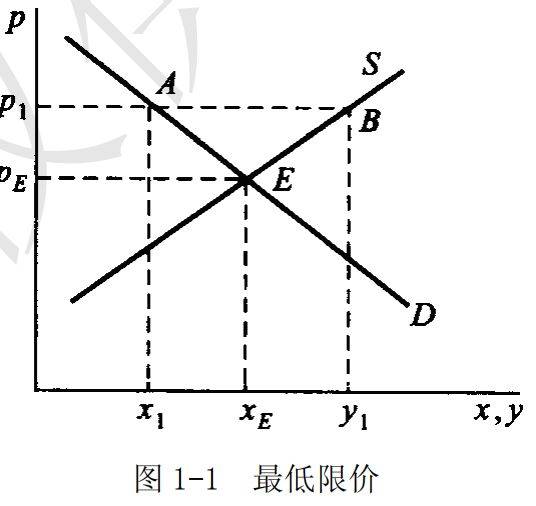
As shown in figure 1-1, it is assumed that in order to foster the development of the industry, the government has set the minimum price for the industry at $p $1. At $p 1 level, the supply is greater than the demand and the difference is $(y 1 - x 1). Prices tend to decline as supply exceeds demand and market-based patterns of supply and demand are spontaneous. Thus, in order to keep prices from falling, the government must purchase the excess supply while setting minimum prices。
Response: restraint prices are the highest prices for certain essential goods set by the government in order to prevent price increases. Price-restriction is one of the measures taken by the government to regulate prices, which are always below market equilibrium。
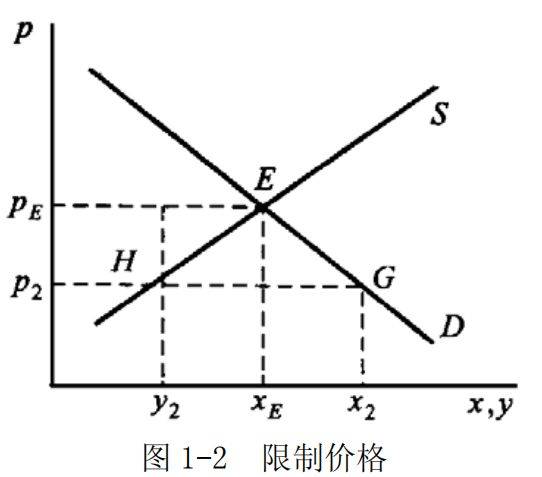
As shown in figure 1-2, the market equilibrium price is $p e, and the government imposed a price limit of $p 2 which, under the price restriction, will result in an excess demand of $hg in the economy. Restrictive prices are often used in times of war or natural disaster, and some countries have long adopted price-restrictive policies for certain necessities of life. Price restrictions contribute to social stability, but there are many disadvantages. Because of the shortage of commodities, governments tend to maintain such price restrictions through a rationing system that limits the amount of consumer purchases, when there is a tendency to buy, black market transactions, speculation in the market; and it is not conducive to stimulating production, causing long-term losses; and it causes price distortions and waste。
Demand indicates that, while other conditions remain unchanged, consumers will be able to purchase the quantity of goods at various possible prices for a certain period of time. The above definition assumes that there will be no change in other factors affecting demand other than commodity prices. If anything other than prices changes, consumer demand changes. These include, inter alia, the following:
The supply indicates that, while other conditions remain unchanged, the producer is willing and able to provide the quantity of the goods sold for a certain period of time, corresponding to the various possible prices. The above definition was obtained under other conditions. Supply is influenced not only by prices but also by other factors. In addition to commodity prices, one of the other factors affecting supply changes, leading to changes in producer supply. These include, inter alia:
When the rains were smooth, the number of food harvests by farmers increased, but income from food sales decreased。
The economic logic of this phenomenon is that, in conditions where other factors remain constant, food harvests cause food prices to fall, and food prices to decline more than food production。
The underlying cause of the economic phenomenon of “gavage-camel farmers” is that demand elasticity of agricultural products is often less than 1, i. E. When prices change, demand for agricultural products is often inelastic. Its analysis is shown in figures 1-3。
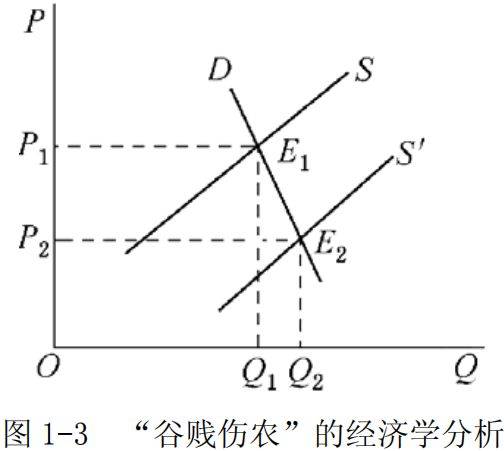
Figure 1-3 shows that the demand curve d for agricultural products is inflexible. The harvest of agricultural products has moved the supply curve from $s$ to right in the position of $s^}, and the balanced price of agricultural products has fallen significantly from $p 1 to $p 2 due to the inflexible demand curve. As the decline in balanced prices for agricultural products was greater than the increase in the balanced quantity of agricultural products, it eventually led to a decrease in the total income of farmers. The decrease in the total income corresponds to the difference between the area of the rectangle in the chart。
(2) similarly, as oil is an important source of energy for all countries, its demand is less resilient. In the absence of a change in the demand for oil, the organization of the petroleum exporting countries (opec) restrictions on the supply of oil could lead to higher oil prices. Because of the inflexible demand for oil from countries, the increase in oil prices would increase the overall earnings of the organization of petroleum exporting countries (opec). If oil supplies were not restricted, the increase in supply would lead to a decrease in oil prices, and the increase in supply would not compensate for the loss of gains from lower prices, so they would limit oil production。
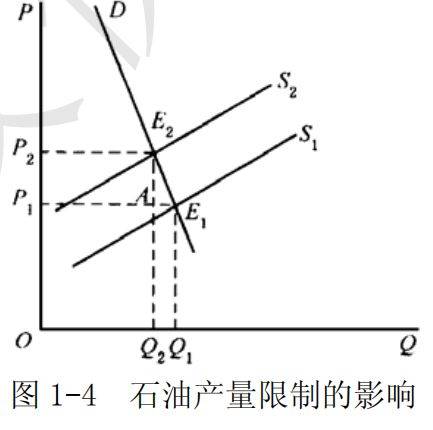
The organization of the petroleum exporting countries (opec) limits oil production because the price of oil will rise while the demand for oil remains unchanged. As shown in figure 1-4. The policy of limiting oil production allows the supply curve to be moved from $s $1 to the left level to $s 2 and the balance point from $e $1 to $e 2 and the price from $p 1 to $p 2. When prices rise, the demand is reduced from $q 1 to $q 2 but $q {2} ae 1} 1} 1} 1} 1} 1} 1} } } } } } } } } } } } } } } } } } } } } } } } } } } } } } } } } } } } } } } } } } } } } } } } } } } } } } } } } } } } } } } } } } } } } } } } } } } } } } } } } } } } }。
$e d=-\frac{dq}\cdot\frac{p}$$
When prices $p = $2, market demand is $q = 20-3\times2 = $14, and $\frac{dq}{dp}= $3。
Thus, the elasticity value required when the price of $p = $2 is:
$e d=-(-3)\times{2/14}=\frac{3}}$$$
$e d=\frac{3}
This means that the demand for products produced by the manufacturer is rather inelastic. Therefore, according to the demand theory, producers should raise their prices to increase their incomes. Because for commodities that lack elasticity in demand, total sales income and prices change in the right direction, that is, it increases with higher prices and decreases with lower prices. Thus, in order to increase the earnings of producers, price increases for commodities that lack flexibility in demand can increase total earnings。
Calculator
The demand price elasticity factor for a given commodity is known to be 0. 5 and the demand is 1000 units when the price is 10. Please analyse whether the manufacturer should increase or decrease the price in order to increase the total income and justify it. Answer: demand price elasticity
Calculator
Qd = 500-50p, supply function qs =-100+50p. Purpose: (1) balance price and equal quantity; (2) p=2-hour price elasticity. Answer: (1) order qd=qs, 500-50p=-100+50p, solved by p=6, q=200. (2) p = 2 hours qd = 400, elasticity ed = (-50) x (2/400) = 0. 25, inflexibility。